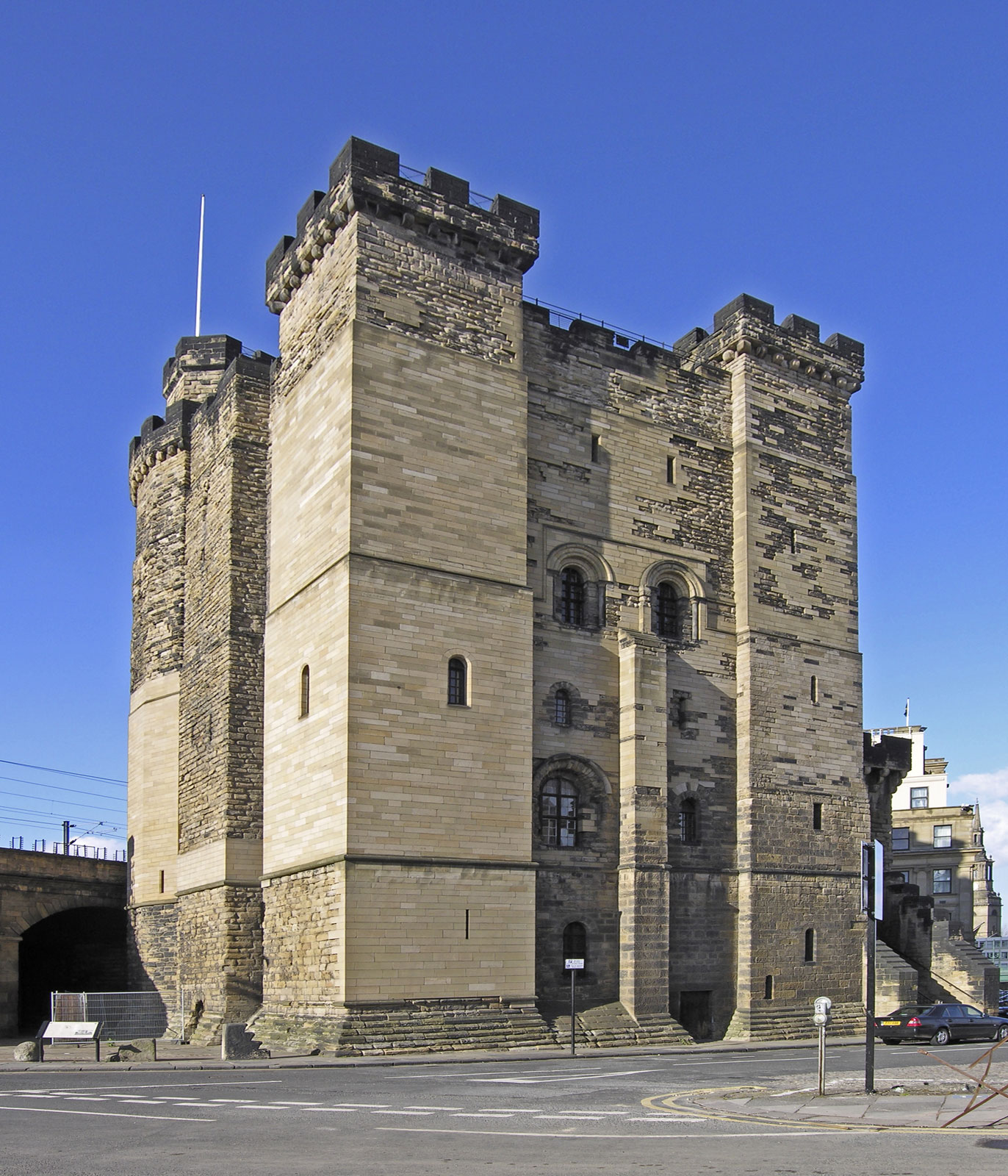
Newcastle Castle is a medieval fortification located in the city of Newcastle upon Tyne, England. It stands on the site of the original wooden motte-and-bailey castle built by Robert Curthose in 1080, which gave the city its name. The current stone structures, the Castle Keep and the Black Gate, were constructed during the 12th and 13th centuries to defend the northern border of England against Scottish incursions.
The site serves as a significant example of Norman military architecture. While the original defensive complex was much larger, the surviving Keep and Black Gate remain as prominent landmarks that illustrate the strategic importance of the River Tyne crossing throughout the Middle Ages.
Key Facts
- Materials
- Sandstone, Limestone
- Civilization
- Anglo-Norman
- Accessibility
- Limited due to historic staircases; ground floor accessible
- Date(s)
- 1168-1178 (Keep), 1247-1250 (Black Gate)
- Condition
- Restored and open to the public as a heritage site
- Original Function
- Royal fortress and administrative center
- Key Figures
- Henry II, Robert Curthose, Henry III
Origins and the 'New Castle'
1080Following the Harrying of the North, William the Conqueror's son, Robert Curthose, established a wooden motte-and-bailey castle to secure the river crossing. This structure replaced the Roman fort of Pons Aelius.
Stone Construction
1168-1178King Henry II commissioned the stone Keep to replace the timber fortifications. This massive structure served as a royal stronghold and a symbol of monarchical authority in the volatile northern borderlands.
The Black Gate Expansion
1247-1250King Henry III ordered the construction of the Black Gate, which served as the primary barbican or gatehouse for the castle complex, further strengthening the defensive perimeter.
Decline and Urban Encroachment
16th-19th centuryBy the late medieval period, the castle lost its military utility. The site was gradually encroached upon by the growing city, with the Keep serving as a prison and the surrounding area becoming densely populated slums.
Modern Preservation
20th century - presentThe site underwent significant restoration in the 20th century. Today, it is managed by the Society of Antiquaries of Newcastle upon Tyne and the Old Newcastle Project, providing public access to the historic interiors.
Cultural Significance
Newcastle Castle is the namesake of the city and a focal point for regional history. It represents the long-standing tension between England and Scotland, acting as a primary defensive node for centuries. Its survival amidst the industrial expansion of Newcastle highlights the city's commitment to preserving its medieval origins.
The site is deeply embedded in local folklore and serves as a primary educational resource for the history of the North East of England, bridging the gap between the Roman occupation and the modern industrial era.
Interpretive Notes
Scholarly debates and areas of uncertainty
There is ongoing academic discussion regarding the exact layout of the original 11th-century motte-and-bailey and how much of the Roman masonry from the underlying Pons Aelius fort was repurposed in the Norman construction. Archaeological surveys continue to refine the understanding of the castle's outer bailey, which has been largely obscured by modern urban development.
Visiting Information
Entry Rules
Open daily. Tickets are required for entry to the Keep and Black Gate. Visitors should be prepared for steep, narrow medieval staircases.
Best Times to Visit
Weekdays during the off-season for quieter access to the upper levels of the Keep. The site is best visited in daylight hours to appreciate the architectural details of the masonry.
Photography
Personal photography is permitted throughout the site. Commercial photography requires prior arrangement with the site management.
Preservation Notes
The stone surfaces are fragile; visitors are requested not to touch the walls. The site is subject to ongoing conservation monitoring to manage the effects of urban pollution and weathering.
Nearby POIs
6 shownSources & Further Reading
- [1]The Castle of Newcastle upon Tyne — Society of Antiquaries of Newcastle upon Tyne. Archaeologia Aeliana (2015)
- [2]Newcastle Castle: A History — Colm O'Brien. Newcastle City Council Heritage Series (2018)
Key Facts
- Materials
- Sandstone, Limestone
- Civilization
- Anglo-Norman
- Accessibility
- Limited due to historic staircases; ground floor accessible
- Date(s)
- 1168-1178 (Keep), 1247-1250 (Black Gate)
- Condition
- Restored and open to the public as a heritage site
- Original Function
- Royal fortress and administrative center
- Key Figures
- Henry II, Robert Curthose, Henry III