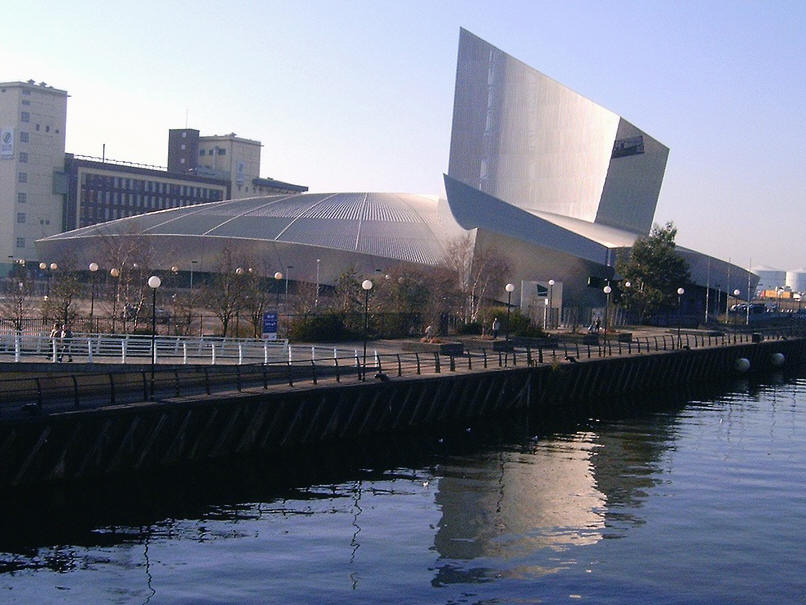
Imperial War Museum North, located in Trafford Quays, Manchester, is one of five branches of the Imperial War Museum. Designed by architect Daniel Libeskind and opened in 2002, the building’s deconstructivist design features three interlocking shards representing the earth, air, and water, symbolizing the fragmentation of conflict and its impact on human lives.
The museum’s permanent collection focuses on the history of modern warfare from the First World War to the present day. Through immersive displays and a central 'Big Picture' show, the institution examines how conflict has shaped British society and global geopolitical landscapes, emphasizing the personal experiences of those affected by war.
Key Facts
- Materials
- Steel, Concrete, Glass
- Civilization
- British
- Accessibility
- Fully wheelchair accessible with lift access to all levels
- Date(s)
- 2000-2002
- Condition
- Active
- Original Function
- Museum
- Key Figures
- Daniel Libeskind
Conception and Design
1990sThe project was commissioned to provide a northern counterpart to the London-based Imperial War Museum. Architect Daniel Libeskind was selected for his ability to create spaces that evoke the emotional and physical disruption caused by war.
Opening and Inauguration
2002The museum officially opened to the public in July 2002. It was the first major building in the United Kingdom designed by Libeskind, quickly becoming a landmark of the regeneration of the Manchester Ship Canal area.
Modern Operations
2002-PresentThe museum continues to host rotating exhibitions alongside its permanent collection. It remains a key site for historical research and public education regarding the social history of conflict in the 20th and 21st centuries.
Cultural Significance
The museum serves as a critical site for public memory regarding the impact of war on civilian and military populations. Its location in Manchester, a city with a significant industrial and social history, underscores the connection between global conflict and local societal evolution. It is widely recognized for its architectural contribution to the city's skyline and its role in the cultural regeneration of the Trafford area.
Interpretive Notes
Scholarly debates and areas of uncertainty
Debates often center on the efficacy of the 'deconstructivist' architecture in conveying the gravity of war. Some critics argue the building's aesthetic can overshadow the artifacts, while others contend that the physical environment successfully mirrors the chaos and fragmentation of the historical events depicted.
Visiting Information
Entry Rules
Open daily. Admission is free, though booking a timed entry slot is recommended during peak periods. Security screening is in place for all visitors.
Best Times to Visit
Weekdays outside of school holidays offer the quietest experience for viewing the permanent collection.
Photography
Personal photography is permitted for non-commercial use. Flash and tripods are prohibited in certain gallery spaces.
Preservation Notes
Visitors are requested to refrain from touching artifacts. Large bags may be subject to search upon entry.
Nearby POIs
11 shown- Science and Industry Museum3.1 km
- People's History Museum3.3 km
- Manchester Art Gallery4 km
- Manchester Cathedral4 km
- National Football Museum4.2 km
- Manchester Museum4.3 km
- Greater Manchester Police Museum4.6 km
- The Whitworth4.7 km
- Williamson Tunnels44.4 km
- Liverpool Metropolitan Cathedral45.1 km
- Liverpool Cathedral45.5 km
Sources & Further Reading
- [1]Imperial War Museum North: The Architecture of Memory — Daniel Libeskind. IWM Publications (2002)View
- [2]Museums and the Representation of Conflict — G. Kavanagh. Routledge (2015)
Key Facts
- Materials
- Steel, Concrete, Glass
- Civilization
- British
- Accessibility
- Fully wheelchair accessible with lift access to all levels
- Date(s)
- 2000-2002
- Condition
- Active
- Original Function
- Museum
- Key Figures
- Daniel Libeskind
Nearby POIs
11 shown- Science and Industry Museum3.1 km
- People's History Museum3.3 km
- Manchester Art Gallery4 km
- Manchester Cathedral4 km
- National Football Museum4.2 km
- Manchester Museum4.3 km
- Greater Manchester Police Museum4.6 km
- The Whitworth4.7 km
- Williamson Tunnels44.4 km
- Liverpool Metropolitan Cathedral45.1 km
- Liverpool Cathedral45.5 km