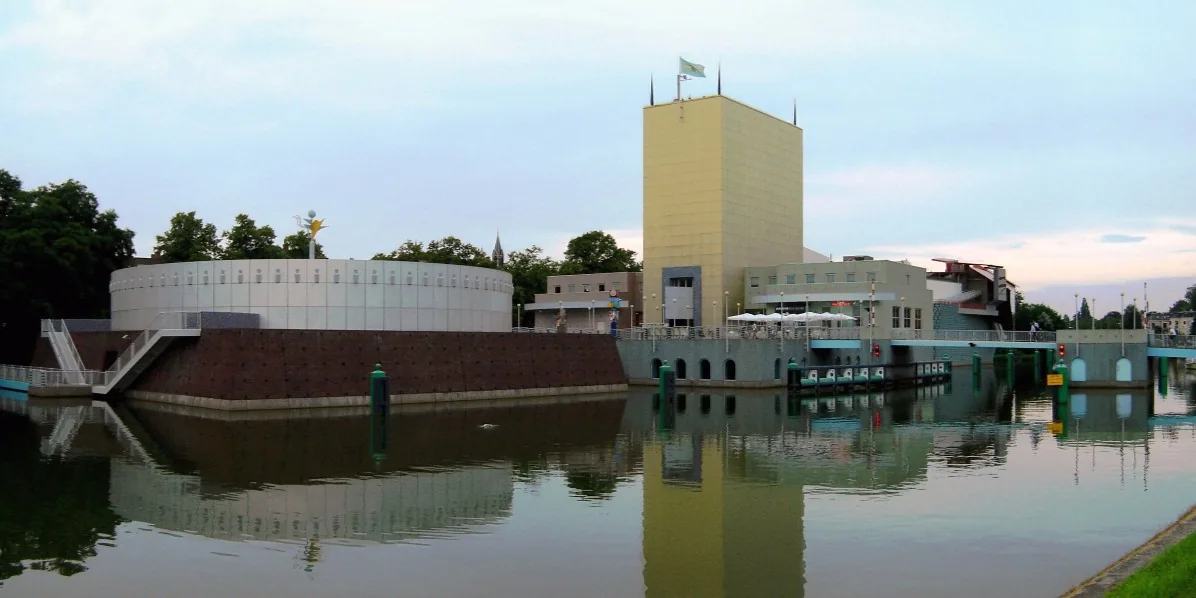
The Groninger Museum is a prominent contemporary art museum located in the city of Groningen, Netherlands. Situated on an island in the Verbindingskanaal, the museum is renowned for its bold, postmodern architecture, which consists of three distinct pavilions designed by Alessandro Mendini, Philippe Starck, and the architectural firm Coop Himmelb(l)au. The facility was inaugurated in 1994 and serves as a landmark of avant-garde design in the region.
The museum's collection is diverse, encompassing contemporary art, design, fashion, and local archaeological artifacts. Its rotating exhibitions often focus on international art movements, while its permanent collection highlights the history of the Groningen region and the development of the De Ploeg artists' collective. The building itself is considered a significant work of art, reflecting the experimental spirit of 1990s architectural theory.
Key Facts
- Materials
- Steel, Glass, Ceramic tiles, Concrete
- Civilization
- Dutch
- Accessibility
- Fully wheelchair accessible
- Date(s)
- 1992-1994
- Condition
- Active, well-maintained
- Original Function
- Art Museum
- Key Figures
- Alessandro Mendini, Philippe Starck, Coop Himmelb(l)au, Frans Haks
Conception and Design
1987-1990Under the direction of museum curator Frans Haks, the project was initiated to replace the existing museum building. Haks sought to create a radical, multi-disciplinary space and invited international designers to collaborate on a fragmented, pavilion-based structure.
Construction and Opening
1992-1994The construction took place on an artificial island adjacent to the Groningen railway station. The museum opened in 1994, immediately drawing international attention for its unconventional, colorful, and deconstructivist aesthetic.
Modern Expansion and Maintenance
2000s-PresentThe museum has undergone several interior renovations to accommodate changing exhibition needs. It remains a central hub for cultural life in Northern Netherlands, balancing its role as a design icon with its function as a research and exhibition center.
Cultural Significance
The Groninger Museum is a symbol of the city's commitment to innovation and cultural investment. By commissioning world-renowned architects to create a 'total work of art,' the museum challenged traditional notions of museum architecture, which typically favored neutral, white-cube spaces. It remains a focal point for discussions on the intersection of architecture, design, and fine art.
Locally, the museum is deeply tied to the identity of Groningen, housing the legacy of the De Ploeg artists' group, which played a crucial role in the development of expressionism in the Netherlands. It serves as a bridge between the city's historical roots and its contemporary aspirations.
Interpretive Notes
Scholarly debates and areas of uncertainty
The museum is frequently cited in architectural discourse regarding the 'Bilbao Effect'—the idea that a singular, iconic building can transform a city's cultural profile. Critics have debated whether the museum's highly stylized architecture distracts from the art displayed within, or if the building itself is the primary exhibit.
Visiting Information
Entry Rules
Open Tuesday through Sunday, 10:00 to 17:00. Closed on Mondays and certain public holidays. Tickets can be purchased online or at the desk. No large bags are permitted in the galleries; lockers are available.
Best Times to Visit
Weekday mornings are generally quieter. The museum is a popular destination during the summer months and for major temporary exhibitions.
Photography
Personal photography is permitted for non-commercial use without flash or tripods. Specific temporary exhibitions may prohibit photography due to copyright restrictions.
Preservation Notes
The building's unique materials, including its exterior ceramic tiles and metallic surfaces, require specialized maintenance. Visitors are asked to refrain from touching artworks and to follow designated pathways.
Nearby POIs
4 shownSources & Further Reading
- [1]The Groninger Museum: A Postmodern Landmark — Frans Haks. Groninger Museum Publications (1994)
- [2]Architecture of the Groninger Museum — Alessandro Mendini. Domus Magazine (1995)
Key Facts
- Materials
- Steel, Glass, Ceramic tiles, Concrete
- Civilization
- Dutch
- Accessibility
- Fully wheelchair accessible
- Date(s)
- 1992-1994
- Condition
- Active, well-maintained
- Original Function
- Art Museum
- Key Figures
- Alessandro Mendini, Philippe Starck, Coop Himmelb(l)au, Frans Haks