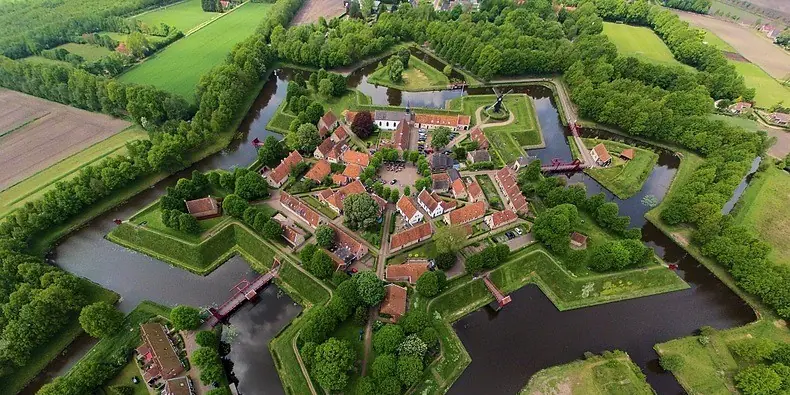
Fort Bourtange is a star-shaped fortification located in the village of Bourtange, Groningen. It was originally commissioned in 1580 by William the Silent during the Eighty Years' War to control the only road between Germany and the city of Groningen, which was then held by the Spanish. The fort's unique geometric design, characterized by its bastions and moats, was intended to provide maximum defensive coverage against artillery fire.
Following its military decommissioning in the mid-19th century, the fort fell into disrepair and was converted into a civilian village. In the 1960s, the local municipality initiated a comprehensive restoration project to return the site to its appearance during the mid-18th century. Today, it functions as an open-air museum and historical site, showcasing the defensive architecture and military life of the period.
Key Facts
- Materials
- Earth, Brick, Wood
- Civilization
- Dutch
- Accessibility
- Grounds are accessible; some historic buildings have limited mobility access
- Date(s)
- 1580
- Condition
- Restored to 1742 appearance
- Original Function
- Military fortification
- Key Figures
- William the Silent
Establishment during the Eighty Years' War
1580The fort was established by order of William the Silent to isolate Groningen from its Spanish-held supply lines in Germany. Its strategic location in the Bourtanger Moor made it a critical defensive point.
Military Significance
17th - 18th CenturyThroughout the 17th and 18th centuries, the fort was expanded and modernized to keep pace with evolving artillery technology. It successfully withstood several sieges, most notably during the Münster invasion in 1672.
Decline and Village Conversion
1851The fort lost its strategic military value in the mid-19th century and was officially decommissioned in 1851. The site was subsequently repurposed as a civilian village, leading to the degradation of the original earthworks.
Restoration
1964 - 1988The municipality of Vlagtwedde began a massive restoration project in 1964 to reconstruct the fort's bastions, moats, and historic buildings based on 18th-century maps and archaeological findings.
Cultural Significance
Fort Bourtange serves as a primary example of Dutch defensive engineering and the 'trace italienne' style of fortification. It represents the historical struggle for Dutch independence and the strategic importance of the borderlands between the Netherlands and Germany.
Locally, the fort is the center of community life in the village of Bourtange. It is a significant cultural landmark that preserves the memory of the Dutch Republic's military history while supporting the regional tourism economy.
Interpretive Notes
Scholarly debates and areas of uncertainty
There is ongoing discussion among historians regarding the extent to which the 20th-century reconstruction accurately reflects the 18th-century reality, particularly concerning the interior layout of the non-military structures that were lost during the 19th-century decline.
Visiting Information
Entry Rules
The site is open daily. Tickets are required for entry into the museum buildings and the central fort area. Visitors are encouraged to check the official website for seasonal opening hours.
Best Times to Visit
Spring and summer months are ideal for exploring the outdoor ramparts and moats. The site is particularly active during historical reenactment events held throughout the summer season.
Photography
Personal photography is permitted throughout the grounds. Commercial photography requires prior authorization from the museum administration.
Preservation Notes
Visitors are requested to stay on designated paths to prevent erosion of the reconstructed earthworks. Climbing on the ramparts is restricted to marked areas.
Nearby POIs
4 shownSources & Further Reading
- [1]The Dutch Republic: Its Rise, Greatness, and Fall 1477-1806 — Jonathan Israel. Oxford University Press (1995)
- [2]Fort Bourtange: A History of the Star Fort — H.J.W. Drenth. Groningen Historical Society (2010)
Key Facts
- Materials
- Earth, Brick, Wood
- Civilization
- Dutch
- Accessibility
- Grounds are accessible; some historic buildings have limited mobility access
- Date(s)
- 1580
- Condition
- Restored to 1742 appearance
- Original Function
- Military fortification
- Key Figures
- William the Silent