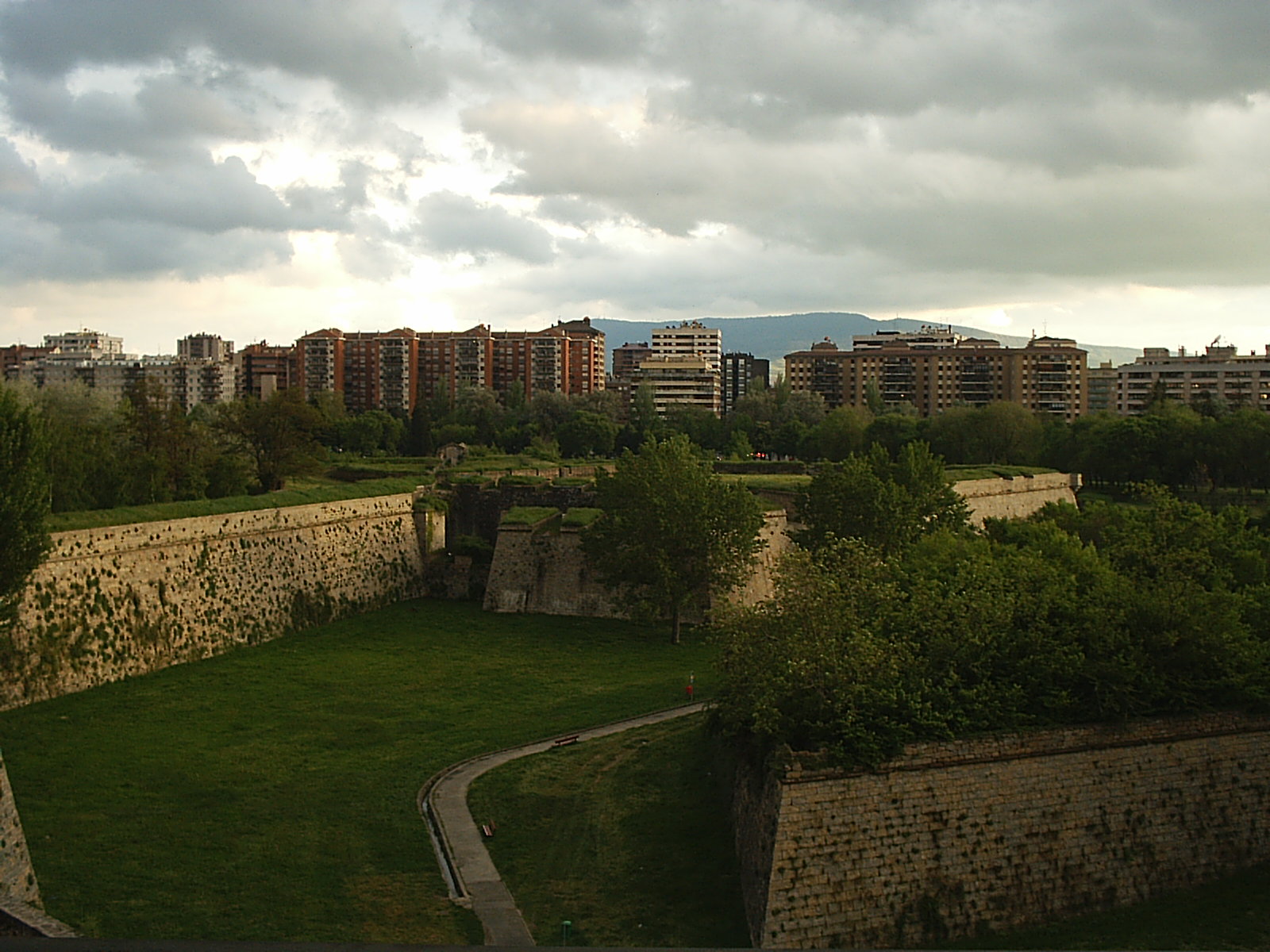
The Citadel of Pamplona, also known as the Castillo Nuevo, is a pentagonal fortification constructed starting in 1571 under the orders of King Philip II of Spain. Designed by the Italian military engineer Giacomo Palearo, known as 'El Fratin', the structure was intended to modernize the city's defenses against potential French incursions and internal unrest following the annexation of Navarre.
The fortress features five bastions connected by curtain walls, surrounded by a complex system of moats and glacis. It represents one of the most significant examples of Renaissance military architecture in Europe, maintaining its original geometric layout despite the partial demolition of its outer defensive works in the late 19th century to allow for the city's urban expansion.
Key Facts
- Materials
- Stone, Brick
- Civilization
- Spanish
- Accessibility
- Ground level accessible, park paths are paved
- Date(s)
- 1571 - 1645
- Condition
- Well-preserved, repurposed as a public park and cultural space
- Original Function
- Military fortification
- Key Figures
- Philip II of Spain, Giacomo Palearo
Strategic Origins
16th CenturyFollowing the conquest of the Kingdom of Navarre, the Spanish Crown sought to secure the border. The Citadel was commissioned to replace older, medieval fortifications that were vulnerable to modern gunpowder artillery.
Military Utility
17th - 19th CenturyThe Citadel served as a primary military installation for centuries. It successfully withstood several sieges, most notably during the War of the Spanish Succession and the Peninsular War, where it was briefly occupied by French forces.
Urban Integration
1888 - PresentIn 1888, the city of Pamplona began the demolition of the outer defensive perimeter to accommodate urban growth. The inner citadel was preserved and eventually transferred to municipal control in 1964, transforming the site into a public park and cultural venue.
Cultural Significance
The Citadel is a defining landmark of Pamplona, serving as the city's 'green lung.' It symbolizes the transition from medieval feudal defense to the centralized military power of the Spanish Habsburgs. Today, it is a central hub for local cultural life, hosting exhibitions, concerts, and public festivals.
Interpretive Notes
Scholarly debates and areas of uncertainty
There is ongoing academic discussion regarding the extent to which the Citadel's design was influenced by the 'ideal city' concepts of the Italian Renaissance versus purely pragmatic military requirements of the time.
Visiting Information
Entry Rules
The park is open to the public daily. Access is free. Certain interior buildings used for exhibitions have specific operating hours and may be closed on Mondays.
Best Times to Visit
Spring and autumn offer the most pleasant weather for walking the perimeter. Early mornings are ideal for avoiding crowds and observing the architectural geometry in soft light.
Photography
Personal photography is permitted throughout the park. Commercial shoots require authorization from the Pamplona City Council.
Preservation Notes
The site is a protected heritage asset. Visitors are requested to stay on designated paths and refrain from climbing on the historic masonry walls.
Nearby POIs
2 shownSources & Further Reading
- [1]The Renaissance Fortifications of Pamplona — Javier Martínez de Aguirre. University of Navarra Press (2015)
- [2]Military Architecture in the Spanish Empire — Juan L. de la Fuente. Historical Review of Spain (2019)
Key Facts
- Materials
- Stone, Brick
- Civilization
- Spanish
- Accessibility
- Ground level accessible, park paths are paved
- Date(s)
- 1571 - 1645
- Condition
- Well-preserved, repurposed as a public park and cultural space
- Original Function
- Military fortification
- Key Figures
- Philip II of Spain, Giacomo Palearo