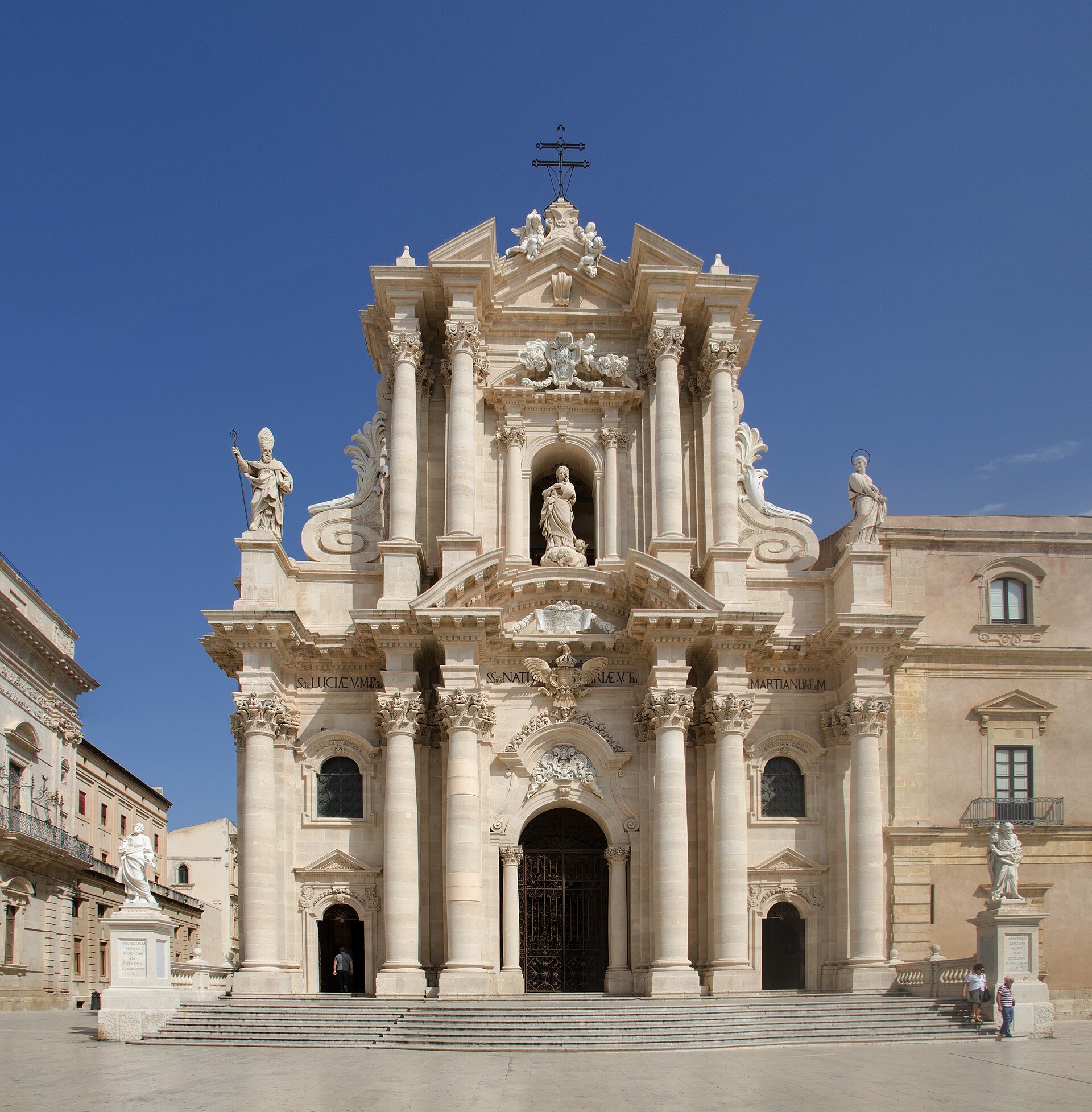
The Cathedral of Syracuse, dedicated to the Nativity of the Blessed Virgin Mary, is a Catholic cathedral located on the island of Ortigia in Syracuse, Sicily. The structure is unique for its architectural layering, as it was built directly upon the foundations and within the frame of the 5th-century BCE Temple of Athena.
The current facade is a prominent example of Sicilian Baroque, designed by Andrea Palma in the early 18th century following the devastating 1693 earthquake. The interior retains the massive Doric columns of the original Greek temple, which remain visible within the walls of the nave, illustrating the site's continuous use as a place of worship for over two millennia.
Key Facts
- Materials
- Limestone, Marble, Stucco
- Civilization
- Greek, Byzantine, Norman, Sicilian
- Accessibility
- Accessible via ramp at the main entrance
- Date(s)
- 5th century BCE (Temple); 7th century CE (Church conversion); 1725-1753 (Baroque facade)
- Condition
- Well-preserved, active cathedral
- Original Function
- Temple dedicated to Athena
- Key Figures
- Andrea Palma, Bishop Zosimus
The Temple of Athena
5th century BCEThe original Doric temple was commissioned by Gelon, the tyrant of Syracuse, to commemorate his victory over the Carthaginians at the Battle of Himera. It was a peripteral temple with 6 by 14 columns, featuring a massive gold-plated shield at its apex that served as a beacon for sailors.
Christian Conversion
7th century CEIn 640 CE, Bishop Zosimus converted the temple into a Christian church. The spaces between the columns were walled in, and the interior was reconfigured to create a nave and aisles, effectively preserving the structural integrity of the Greek temple within the new church walls.
Norman and Medieval Additions
11th-15th centuryDuring the Norman period, the cathedral underwent further modifications, including the addition of mosaics and the construction of a new roof. The structure served as the primary religious center for the city throughout the Middle Ages.
Baroque Reconstruction
18th centuryFollowing the 1693 Sicily earthquake, the cathedral's facade was severely damaged. Architect Andrea Palma was commissioned to design a new Baroque facade, which was completed between 1725 and 1753, giving the cathedral its current exterior appearance.
Cultural Significance
The Cathedral of Syracuse serves as a physical timeline of Sicilian history, embodying the transition from pagan antiquity to Christian dominance. It is a central element of the UNESCO World Heritage site of Syracuse and the Rocky Necropolis of Pantalica, representing the cultural synthesis of Mediterranean civilizations.
Locally, the cathedral remains the spiritual heart of the city and a focal point for the feast of Saint Lucy, the patron saint of Syracuse, whose relics are housed within the cathedral complex.
Interpretive Notes
Scholarly debates and areas of uncertainty
There is ongoing academic discussion regarding the exact layout of the original Greek temple's interior, specifically the placement of the cella and the nature of the internal colonnades. Additionally, the extent of the modifications made during the Byzantine conversion remains a subject of archaeological investigation.
Visiting Information
Entry Rules
Open daily for visitors. Modest dress is required (shoulders and knees must be covered). Entry is ticketed for tourists; please check the official website for current hours as they may change during religious services.
Best Times to Visit
Early morning or late afternoon to avoid peak cruise ship crowds. Spring and autumn offer the most comfortable temperatures for walking through the Ortigia district.
Photography
Photography is permitted for personal use without flash. Tripods and professional equipment require prior authorization from the diocesan office.
Preservation Notes
The site is a protected monument. Visitors are requested to remain within designated areas and refrain from touching the exposed ancient masonry or the Baroque statuary.
Nearby POIs
2 shownSources & Further Reading
- [1]The Cathedral of Syracuse: A History of the Temple and the Church — G. Voza. Ediprint (1999)
- [2]Syracuse: The Ancient City — Christopher Smith. Oxford University Press (2015)
Key Facts
- Materials
- Limestone, Marble, Stucco
- Civilization
- Greek, Byzantine, Norman, Sicilian
- Accessibility
- Accessible via ramp at the main entrance
- Date(s)
- 5th century BCE (Temple); 7th century CE (Church conversion); 1725-1753 (Baroque facade)
- Condition
- Well-preserved, active cathedral
- Original Function
- Temple dedicated to Athena
- Key Figures
- Andrea Palma, Bishop Zosimus