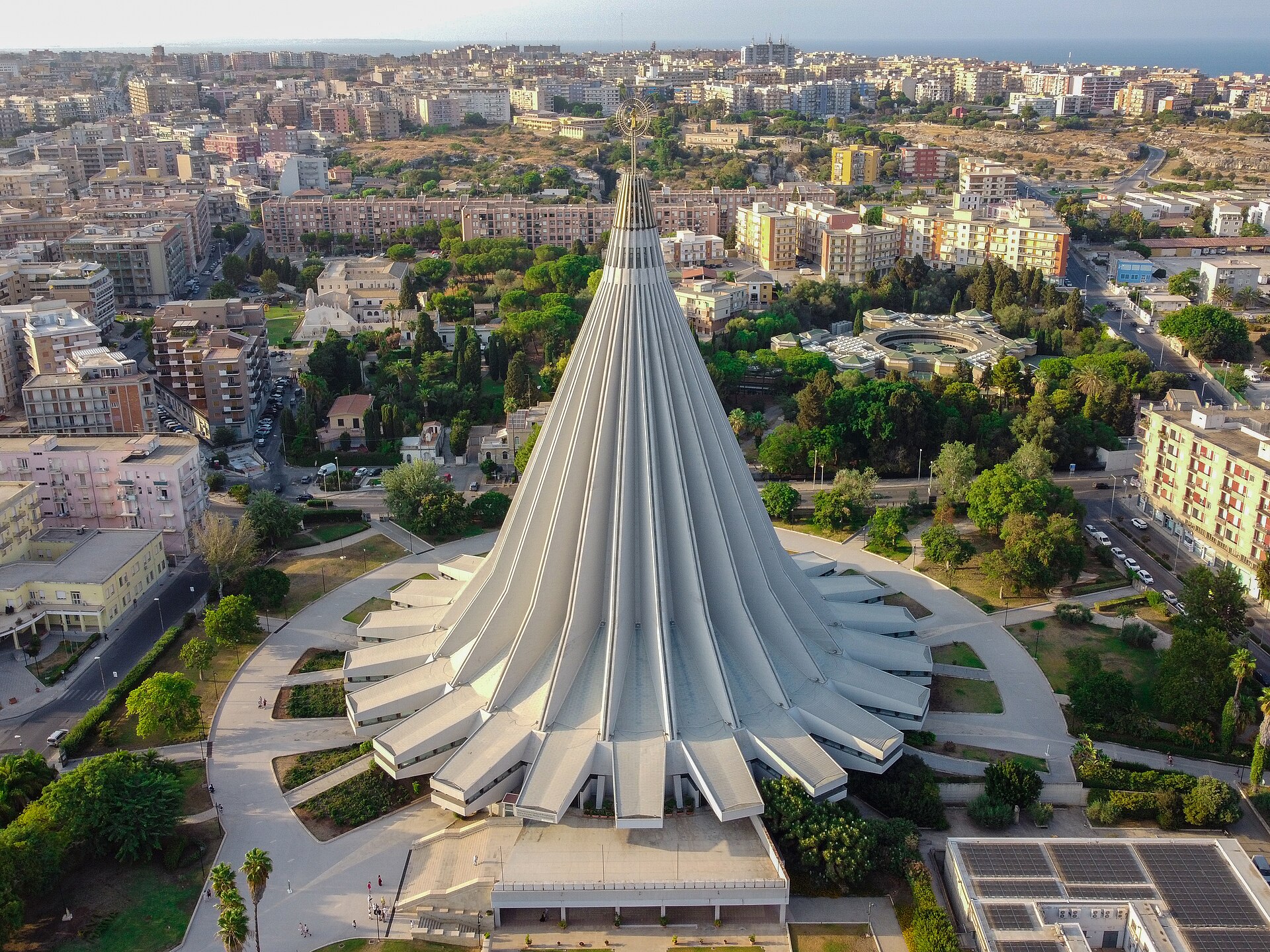
The Basilica Sanctuary of the Madonna delle Lacrime is a prominent modern Roman Catholic church located in Syracuse, Sicily. Completed in 1994, the structure is defined by its distinctive conical, teardrop-shaped design, which serves as a symbolic reference to the miraculous weeping of a plaster image of the Virgin Mary that reportedly occurred in a local home in 1953.
The sanctuary consists of two main levels: the upper basilica, capable of holding thousands of worshippers, and the lower crypt, which serves as a space for prayer and reflection. The building's reinforced concrete structure and soaring height make it a landmark of modern ecclesiastical architecture in Southern Italy, attracting significant numbers of pilgrims annually.
Key Facts
- Materials
- Reinforced concrete, Steel, Glass
- Civilization
- Italian
- Accessibility
- Fully accessible with ramps and elevators
- Date(s)
- 1966-1994
- Condition
- Active
- Original Function
- Pilgrimage sanctuary
- Key Figures
- Pope John Paul II
The Miracle of the Tears
1953In August 1953, a plaster relief of the Madonna located in the home of a young couple in Syracuse reportedly shed human tears. The event was investigated by a commission of theologians and medical experts, and the phenomenon was officially recognized by the Sicilian Episcopal Conference in December 1953.
Design and Construction
1966-1994Following the recognition of the miracle, an international competition was held to design a sanctuary. The winning project by French architects Michel Andrault and Pierre Parat proposed a bold, conical structure. Construction began in 1966 but faced numerous delays, spanning nearly three decades before the basilica was finally consecrated by Pope John Paul II in 1994.
Consecration and Modern Status
1994-PresentSince its inauguration, the sanctuary has become a major destination for religious tourism in Sicily. It serves as a center for the Diocese of Syracuse and continues to host large-scale liturgical events and international pilgrimages.
Cultural Significance
The sanctuary represents a significant intersection of modern architectural ambition and popular piety in post-war Italy. It serves as a focal point for the religious identity of Syracuse, drawing pilgrims who seek to commemorate the 1953 event. The building's unique silhouette has become an iconic feature of the city's skyline, distinguishing it from the surrounding ancient Greek and Baroque urban fabric.
Interpretive Notes
Scholarly debates and areas of uncertainty
The primary scholarly and theological discourse surrounding the site concerns the interpretation of the 1953 weeping phenomenon. While the Catholic Church officially recognized the event, secular observers and some historians have debated the sociological impact of the miracle on the local community during the mid-20th century.
Visiting Information
Entry Rules
Open daily. Entry is free. Visitors are expected to maintain a respectful demeanor appropriate for a place of worship. Modest dress is required.
Best Times to Visit
Early morning or late afternoon to avoid peak heat and large tour groups. The anniversary of the miracle in late August sees the highest concentration of pilgrims.
Photography
Personal photography is permitted without flash. Professional photography or video equipment requires prior authorization from the sanctuary office.
Preservation Notes
The structure is maintained by the Diocese of Syracuse. Visitors are asked to remain in designated areas and refrain from touching liturgical artifacts.
Nearby POIs
2 shownSources & Further Reading
- [1]Il Santuario della Madonna delle Lacrime — Diocese of Syracuse. Official Sanctuary Archives (2020)View
- [2]Modern Architecture in Sicily — Giuseppe Barbera. Edizioni di Architettura (2015)
Key Facts
- Materials
- Reinforced concrete, Steel, Glass
- Civilization
- Italian
- Accessibility
- Fully accessible with ramps and elevators
- Date(s)
- 1966-1994
- Condition
- Active
- Original Function
- Pilgrimage sanctuary
- Key Figures
- Pope John Paul II