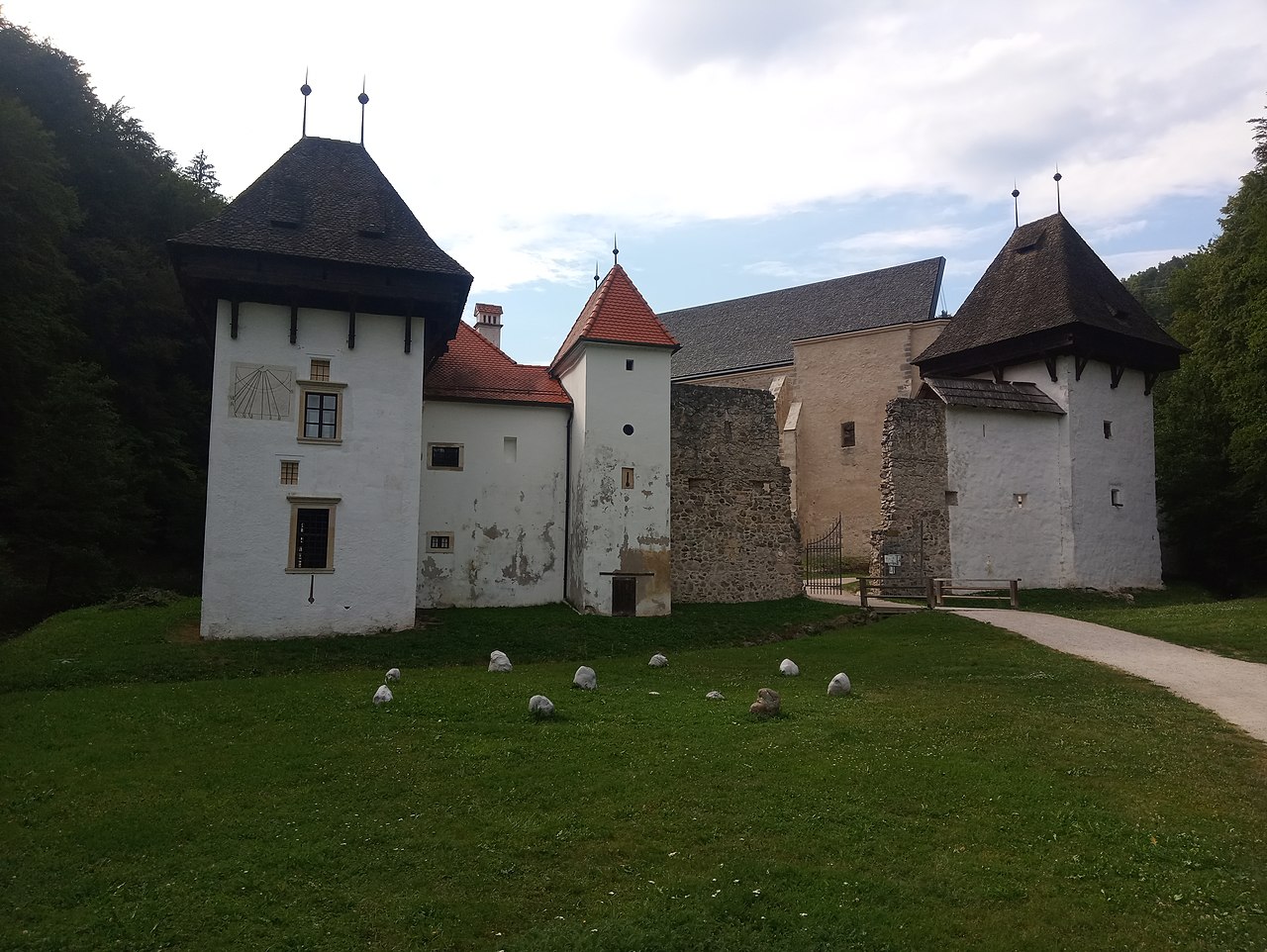
The Žiče Charterhouse, located in the narrow valley of the Žičnica Creek near Slovenske Konjice, was founded around 1160 by Ottokar III, Margrave of Styria. It holds historical significance as the first Carthusian monastery established outside the borders of France and Italy, serving as a vital center for religious life and manuscript production in the region.
The complex features a distinct architectural evolution, blending original Romanesque and Gothic elements with later Renaissance modifications. Although the monastery was suppressed in 1782 during the reforms of Emperor Joseph II, the site has undergone extensive restoration efforts to preserve its remaining structures, including the ruins of the St. John the Baptist Church and the restored Gastuž inn, which is one of the oldest in Slovenia.
Key Facts
- Materials
- Stone, Brick
- Civilization
- Carthusian Order
- Accessibility
- Accessible by road; some uneven terrain within the ruins
- Date(s)
- 1160 CE
- Condition
- Partially ruined, undergoing active restoration
- Original Function
- Monastic enclosure
- Key Figures
- Ottokar III of Styria, Emperor Joseph II
Foundation and Early Growth
12th CenturyFounded by Ottokar III, the monastery was established to provide a secluded environment for the Carthusian order. It quickly became a prominent spiritual and cultural hub, attracting monks from across Europe.
Golden Age of Manuscript Production
14th-15th CenturyDuring the late Middle Ages, the monastery became renowned for its scriptorium. The monks produced numerous illuminated manuscripts, many of which are now preserved in national archives.
Dissolution and Decline
1782As part of the Josephine reforms, the monastery was closed in 1782. The buildings were largely abandoned, leading to a period of significant structural decay and the loss of many interior furnishings.
Restoration and Modern Era
20th Century - PresentSystematic conservation efforts began in the late 20th century. Today, the site serves as a cultural monument, with ongoing work focused on stabilizing the church ruins and preserving the historic Gastuž inn.
Cultural Significance
The Žiče Charterhouse represents a pivotal moment in the expansion of the Carthusian order into Central Europe. It served as a bridge for cultural and religious exchange between the Mediterranean monastic traditions and the Slavic lands of the Holy Roman Empire.
Today, the site is a symbol of Slovenian cultural heritage, reflecting the historical influence of monastic orders on the region's literacy and architectural development. It remains a site of interest for historians studying medieval monastic life and the impact of Enlightenment-era secularization policies.
Interpretive Notes
Scholarly debates and areas of uncertainty
There is ongoing academic discussion regarding the original layout of the lower monastery and the extent of the scriptorium's influence on regional literacy. Additionally, the exact timeline of the transition from Romanesque to Gothic architectural phases within the church remains a subject of investigation due to the limited surviving documentation.
Visiting Information
Entry Rules
Open to the public for tours. Tickets are required for entry to the monastery complex. Visitors are encouraged to respect the quiet nature of the site.
Best Times to Visit
Spring and autumn offer the best conditions for exploring the outdoor ruins and the surrounding valley. Summer months are suitable but can be busy with cultural events.
Photography
Personal photography is permitted. Commercial photography requires prior authorization from the site management.
Preservation Notes
Visitors must remain on designated paths to protect the fragile masonry. Touching the ruins is prohibited to prevent further erosion of the stone surfaces.
Nearby POIs
11 shownSources & Further Reading
- [1]The Carthusians in Central Europe — James Hogg. Analecta Cartusiana (1995)
- [2]Žiče Charterhouse: History and Architecture — Marijan Zadnikar. Slovenian Academy of Sciences and Arts (1988)
Key Facts
- Materials
- Stone, Brick
- Civilization
- Carthusian Order
- Accessibility
- Accessible by road; some uneven terrain within the ruins
- Date(s)
- 1160 CE
- Condition
- Partially ruined, undergoing active restoration
- Original Function
- Monastic enclosure
- Key Figures
- Ottokar III of Styria, Emperor Joseph II