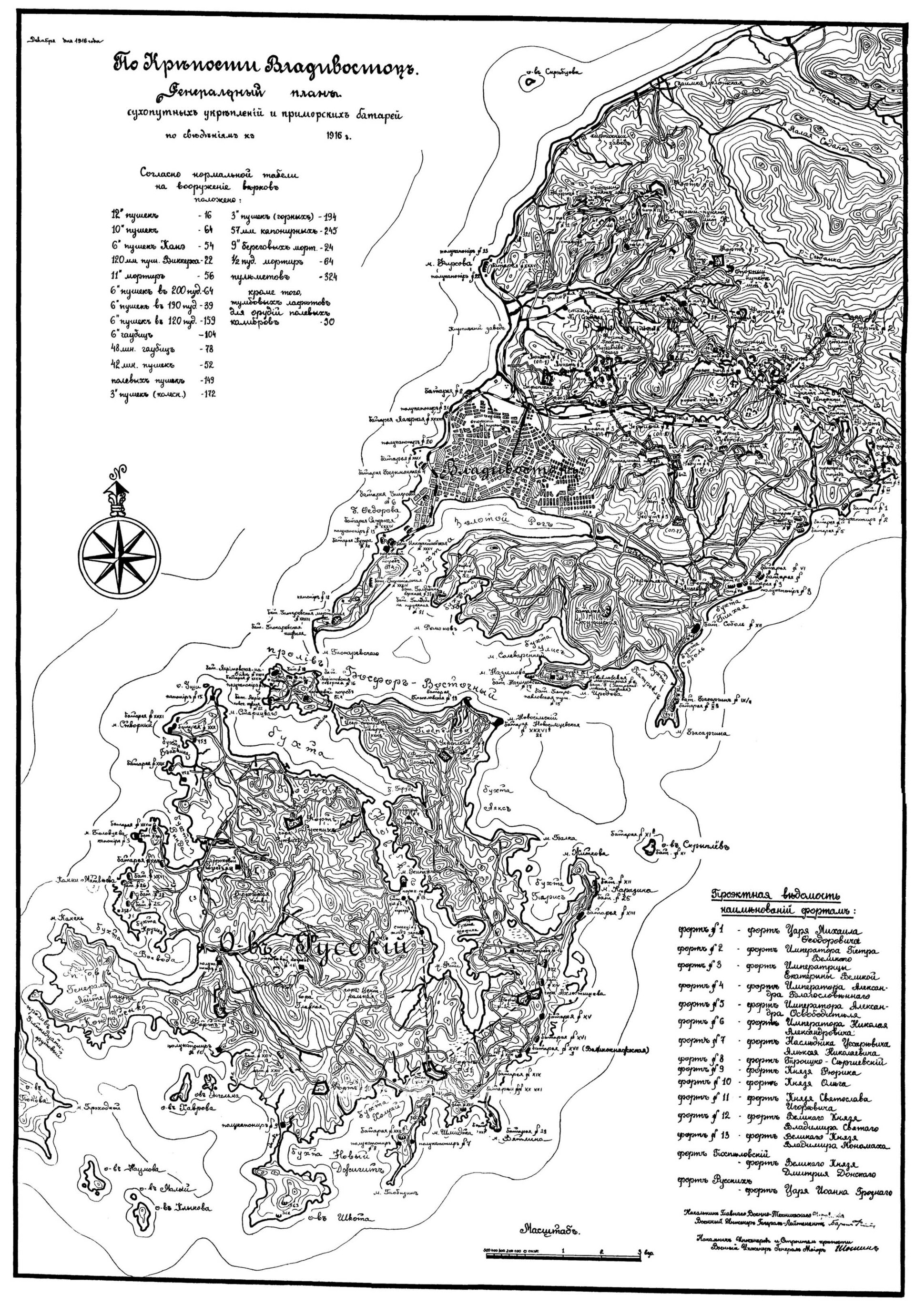
The Vladivostok Fortress is an extensive complex of military fortifications constructed between the late 19th and early 20th centuries to protect the Russian Empire's primary naval base on the Pacific coast. Designed to withstand a siege from both land and sea, the system includes a series of forts, batteries, and underground tunnels integrated into the rugged terrain surrounding the Golden Horn Bay.
Following the Russo-Japanese War, the fortress underwent significant expansion to become one of the most powerful maritime defensive systems in the world at the time. Today, the site serves as a museum complex, preserving the architectural and engineering legacy of Russian military fortification, with several batteries and forts open to the public for exploration.
Key Facts
- Materials
- Reinforced concrete, Stone, Steel
- Civilization
- Russian Empire
- Accessibility
- Variable; some areas involve steep terrain and unlit tunnels
- Date(s)
- 1889-1914
- Condition
- Partially preserved, museum site
- Original Function
- Coastal and land defense of the naval base
- Key Figures
- Konstantin Velichko, Nikolai Korotkevich
Initial Construction
1889-1904Following the establishment of Vladivostok as a major naval port, the Russian military began constructing a series of earthworks and batteries to secure the harbor against potential incursions.
Expansion and Modernization
1905-1914Lessons learned from the Russo-Japanese War prompted a massive upgrade. Engineers designed a sophisticated network of concrete forts and artillery batteries capable of repelling modern naval and infantry assaults.
Soviet Era and Decommissioning
1920s-1990sThe fortress remained a strategic asset throughout the Soviet period, though its role shifted as military technology evolved. Many sections were eventually decommissioned and transitioned into historical sites.
Museum Transformation
1990s-PresentThe Vladivostok Fortress Museum was established to manage the preservation of the surviving structures. Ongoing efforts focus on stabilizing the concrete works and providing public access to the tunnels and batteries.
Cultural Significance
The fortress is a defining element of Vladivostok's urban landscape and identity as a 'fortress city.' It represents the geopolitical importance of the Russian Far East and the engineering prowess of the late imperial period, serving as a tangible link to the region's military history.
Interpretive Notes
Scholarly debates and areas of uncertainty
Debates exist regarding the effectiveness of the fortress design against the rapid evolution of naval artillery during the early 20th century. Some historians argue the massive investment in static defenses diverted resources from mobile naval assets.
Visiting Information
Entry Rules
Open daily. Tickets are required for entry into specific fort interiors and museum exhibits. Some areas are accessible for free as part of public park spaces.
Best Times to Visit
Late spring to early autumn for better weather and accessibility to outdoor batteries. Avoid winter months due to icy conditions in tunnels and on steep paths.
Photography
Personal photography is permitted. Commercial photography requires prior authorization from the museum administration.
Preservation Notes
Many areas are structurally fragile. Visitors are advised to stay on marked paths and use caution in unlit tunnel sections. Do not climb on historical artillery pieces.
Nearby POIs
2 shownSources & Further Reading
- [1]The Vladivostok Fortress: History and Architecture — A. I. Romanov. Far Eastern Federal University Press (2015)
- [2]Russian Coastal Defenses in the Pacific — V. P. Ivanov. Military History Journal (2018)
Key Facts
- Materials
- Reinforced concrete, Stone, Steel
- Civilization
- Russian Empire
- Accessibility
- Variable; some areas involve steep terrain and unlit tunnels
- Date(s)
- 1889-1914
- Condition
- Partially preserved, museum site
- Original Function
- Coastal and land defense of the naval base
- Key Figures
- Konstantin Velichko, Nikolai Korotkevich