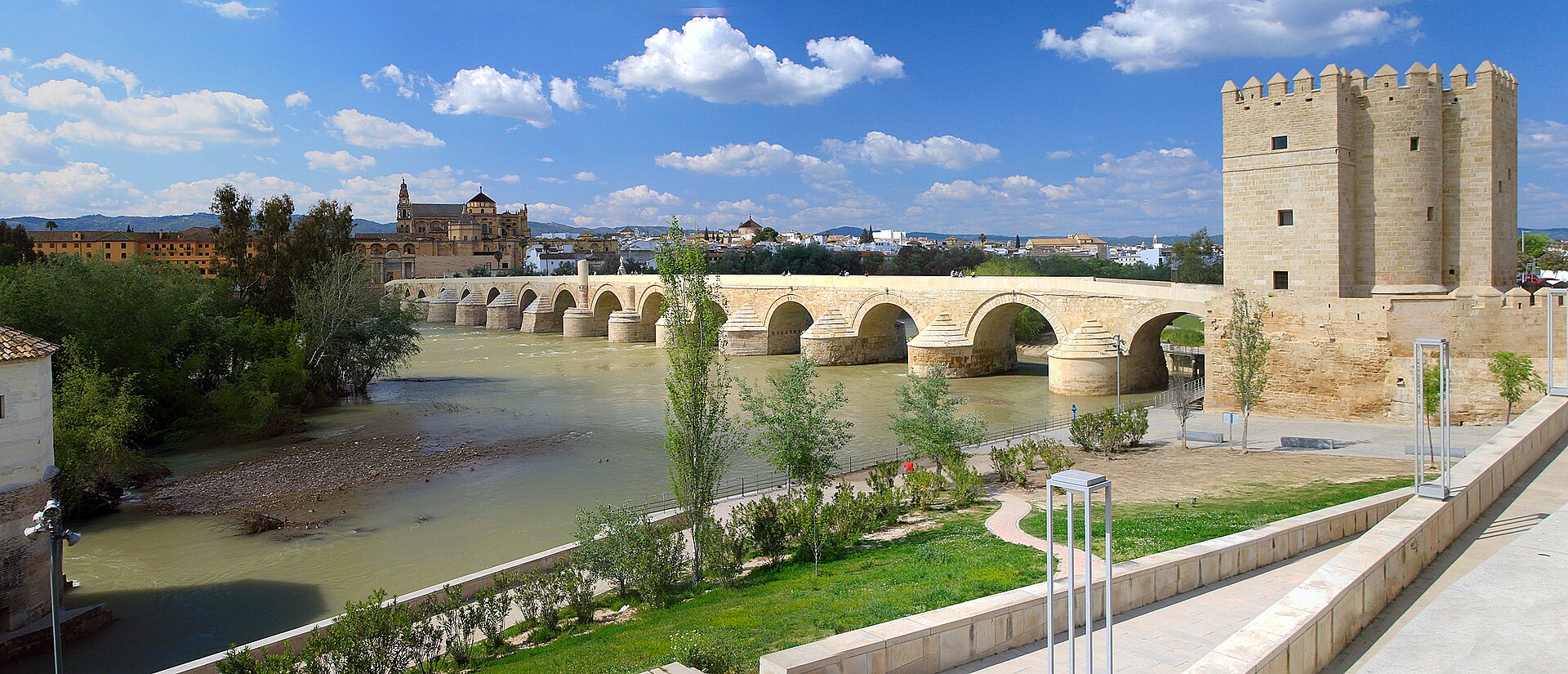
The Torre de la Calahorra is a fortified gate tower located at the southern end of the Roman Bridge in Córdoba, Spain. Originally constructed during the Almohad Caliphate in the late 12th century, the structure served as a defensive gateway to protect the city from southern incursions. It consists of two main towers connected by a central arch, reflecting the military architecture of the period.
Following the Reconquista, the tower underwent significant modifications, including the addition of a third tower in 1369 under Henry II of Castile. Throughout its history, it has functioned as a prison, a school for girls, and a military barracks. Today, it houses the Museo Vivo de Al-Andalus, which focuses on the historical coexistence of Islamic, Christian, and Jewish cultures in medieval Spain.
Key Facts
- Materials
- Stone, Brick
- Civilization
- Almohad
- Accessibility
- Limited due to historic architecture
- Date(s)
- 12th century
- Condition
- Restored and active as a museum
- Original Function
- Defensive gate tower
- Key Figures
- Henry II of Castile
Almohad Origins
12th centuryThe tower was built by the Almohad Caliphate to serve as a fortified gateway guarding the Roman Bridge, a critical entry point into the city of Córdoba.
Castilian Expansion
1369Following the Christian conquest of Córdoba, King Henry II of Castile ordered the expansion of the fortress, adding a third tower to strengthen the defensive capabilities of the gate.
Modern Transformation
20th century - presentAfter serving various roles including a prison and school, the tower was declared a National Monument in 1931. It was later restored to house the Museo Vivo de Al-Andalus, dedicated to the cultural history of the region.
Cultural Significance
The Torre de la Calahorra serves as a physical manifestation of the layered history of Córdoba. Its architecture reflects the transition from Islamic defensive strategies to Christian military fortification. In the modern era, it is a symbol of the 'Convivencia'—the period of relative religious tolerance in medieval Spain—which is the central theme of the museum housed within its walls.
Interpretive Notes
Scholarly debates and areas of uncertainty
There is ongoing academic discussion regarding the exact structural modifications made during the 14th-century expansion and the extent to which the original Almohad masonry was preserved or replaced during subsequent restorations.
Visiting Information
Entry Rules
Open daily. Tickets are required for museum entry. Visitors are advised to check official hours as they vary by season.
Best Times to Visit
Early morning or late afternoon to avoid peak heat and crowds on the Roman Bridge.
Photography
Personal photography is permitted in most areas; flash and tripods are prohibited inside the museum galleries.
Preservation Notes
The structure is a protected historic monument. Visitors must remain on designated paths and refrain from touching the historic masonry.
Nearby POIs
1 shownSources & Further Reading
- [1]The Calahorra Tower: A History of Córdoba's Gateway — Rafael Blanco Guzmán. Córdoba University Press (2015)
- [2]Islamic Architecture in Medieval Spain — Jerrilynn Dodds. Yale University Press (1992)
Key Facts
- Materials
- Stone, Brick
- Civilization
- Almohad
- Accessibility
- Limited due to historic architecture
- Date(s)
- 12th century
- Condition
- Restored and active as a museum
- Original Function
- Defensive gate tower
- Key Figures
- Henry II of Castile