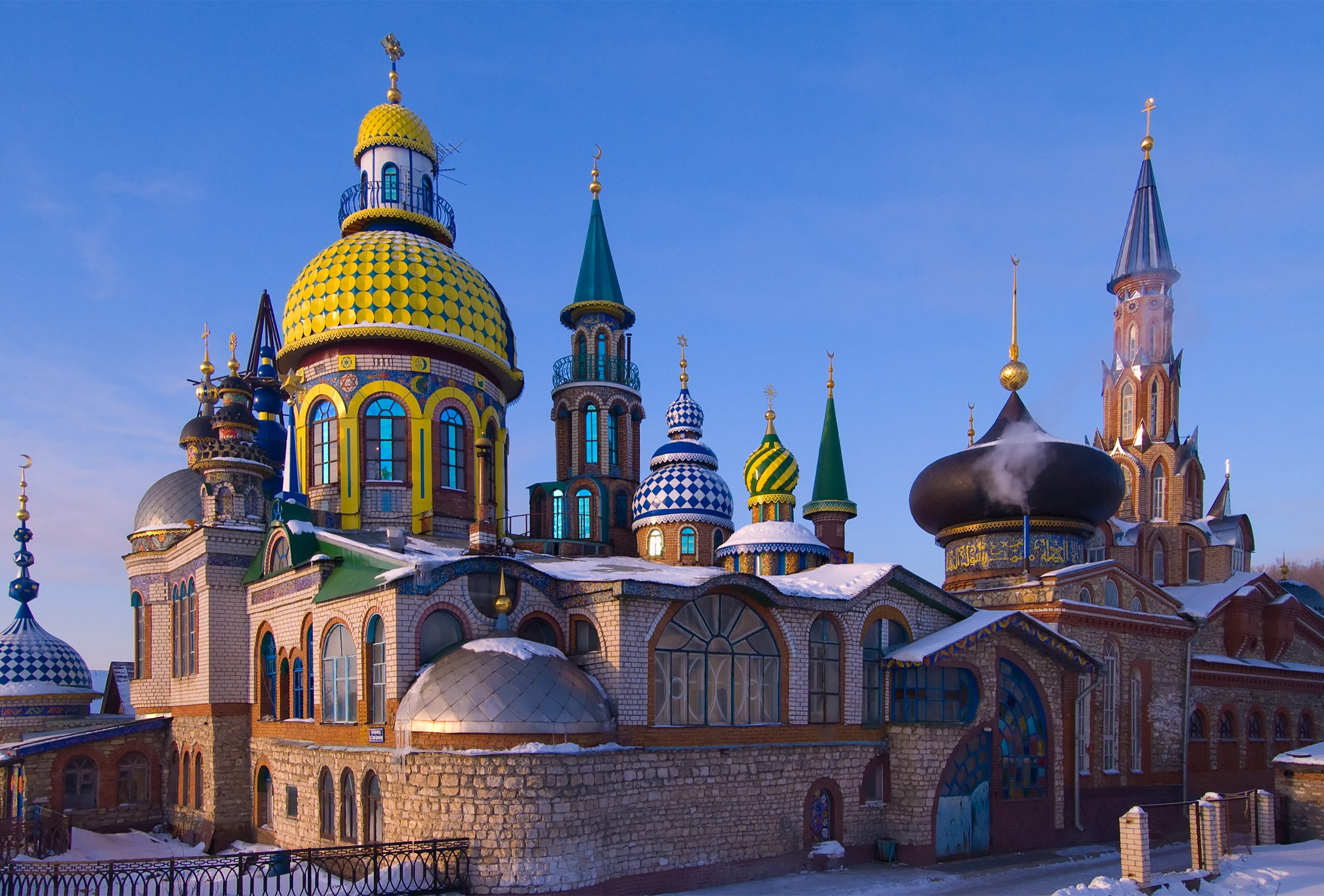
The Temple of All Religions, also known as the Universal Temple, is an architectural complex located in the Staroye Arakchino microdistrict of Kazan, Russia. Initiated in 1994 by artist and philanthropist Ildar Khanov, the structure is designed as a cultural center rather than a place of active worship for any specific denomination. It incorporates architectural motifs from sixteen different world religions and spiritual traditions, including Orthodox Christianity, Islam, Judaism, Buddhism, and various ancient cults.
The complex is characterized by its eclectic aesthetic, featuring a vibrant mix of domes, minarets, and spires that symbolize the peaceful coexistence of diverse faiths. Following Khanov's death in 2013, the site has continued to evolve as a museum and exhibition space, serving as a landmark for interfaith dialogue and artistic expression in the Republic of Tatarstan.
Key Facts
- Materials
- Brick, Concrete, Ceramic tiles, Metal
- Civilization
- Russian
- Accessibility
- Ground level access available
- Date(s)
- 1994 - present
- Condition
- Active, ongoing construction and maintenance
- Original Function
- Cultural center and interfaith monument
- Key Figures
- Ildar Khanov
Conception and Foundation
1994The project was initiated by Ildar Khanov, a local artist and healer, who envisioned a space that would unify the architectural symbols of the world's major religions to promote spiritual harmony.
Development and Expansion
1994-2013Over nearly two decades, Khanov led the construction of the complex, personally funding much of the work and utilizing volunteer labor to add new wings and decorative elements representing various faiths.
Post-Founder Era
2013-presentFollowing the death of Ildar Khanov, the management of the temple transitioned to his family and associates. The site has since been formalized as a museum and cultural venue, with ongoing efforts to complete the unfinished sections of the complex.
Cultural Significance
The Temple of All Religions serves as a unique symbol of the multi-ethnic and multi-confessional identity of Tatarstan. It reflects the region's historical tradition of tolerance between Orthodox Christian and Muslim communities, elevating this local reality into a global architectural statement of unity.
Interpretive Notes
Scholarly debates and areas of uncertainty
The site is often discussed in the context of 'outsider art' and the challenges of preserving non-canonical, evolving architectural projects. Scholars debate whether the temple should be viewed primarily as a religious monument or as a secular art installation, given that it does not host formal liturgical services for the religions it represents.
Visiting Information
Entry Rules
Open daily. Entry requires a small fee for maintenance. Visitors are expected to maintain respectful behavior as the site is considered a place of spiritual reflection.
Best Times to Visit
Late spring to early autumn for optimal weather, as much of the site's visual appeal is found in its exterior architecture and surrounding grounds.
Photography
Personal photography is permitted. Commercial photography or professional filming requires prior coordination with the administration.
Preservation Notes
The structure is a work-in-progress; some areas may be under active construction or renovation. Visitors should follow posted safety signage.
Nearby POIs
10 shownSources & Further Reading
- [1]The Temple of All Religions: A Symbol of Tolerance — Ildar Khanov Foundation. Kazan Cultural Review (2015)
- [2]Religious Architecture in Modern Russia — Elena V. Petrova. Journal of Slavic Studies (2018)
Key Facts
- Materials
- Brick, Concrete, Ceramic tiles, Metal
- Civilization
- Russian
- Accessibility
- Ground level access available
- Date(s)
- 1994 - present
- Condition
- Active, ongoing construction and maintenance
- Original Function
- Cultural center and interfaith monument
- Key Figures
- Ildar Khanov