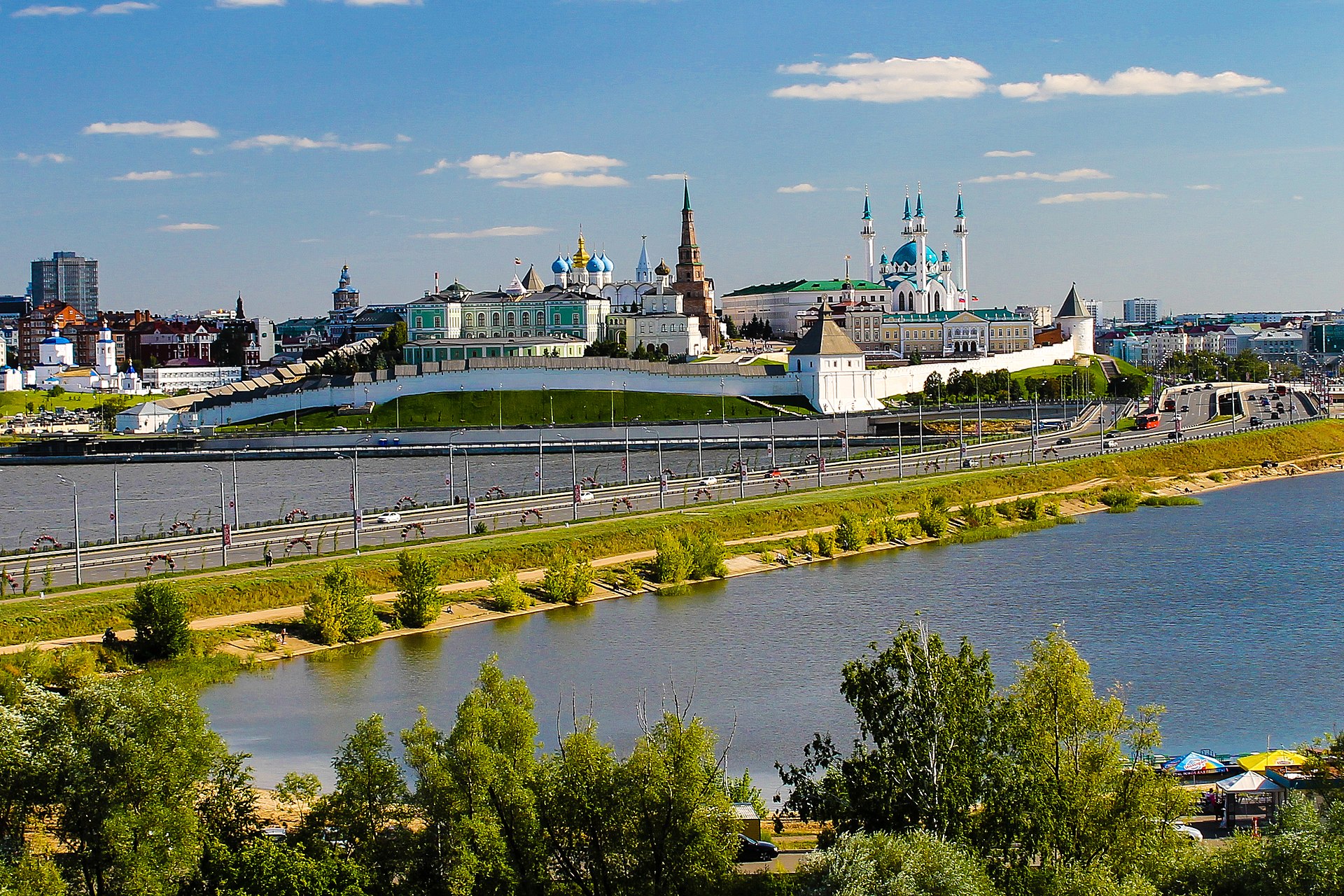
The Kazan Kremlin is a historic citadel located in the center of Kazan, Tatarstan, Russia. It serves as the primary historic fortress of the city, originally established as a defensive fortification for the Kazan Khanate before being rebuilt following the Siege of Kazan in 1552 by Ivan the Terrible. The site represents a unique synthesis of Tatar and Russian architectural traditions, reflecting the complex history of the Volga region.
The complex encompasses a variety of significant structures, including the Kul Sharif Mosque and the Annunciation Cathedral, which stand in close proximity as symbols of religious coexistence. The white-stone walls and towers, largely dating from the 16th and 17th centuries, enclose a site that has functioned as the administrative and spiritual heart of the region for centuries.
Key Facts
- Materials
- White limestone, Brick, Wood
- Civilization
- Kazan Khanate, Russian
- Accessibility
- Partially accessible; some areas feature cobblestone paths and steep inclines
- Date(s)
- 10th century - 16th century
- Condition
- Well-preserved, active cultural and administrative center
- Original Function
- Defensive citadel and royal residence
- Key Figures
- Ivan the Terrible, Qol Sharif, Postnik Yakovlev
Kazan Khanate Period
10th-16th centuryThe site was originally a fortified settlement of the Volga Bulgars and later became the capital of the Kazan Khanate. It featured wooden fortifications and served as the seat of the Tatar khans.
Russian Conquest and Reconstruction
1552-1600Following the capture of Kazan by Ivan the Terrible in 1552, the wooden fortifications were largely destroyed. The Tsar commissioned the construction of a new stone fortress, utilizing Pskov architects to integrate Russian defensive styles.
Imperial and Soviet Eras
18th-20th centuryThroughout the Russian Empire, the Kremlin served as the administrative center of the Kazan Governorate. During the Soviet period, many religious buildings were repurposed or closed, though the site remained a protected historic monument.
Modern Restoration
20th century - presentFollowing the collapse of the Soviet Union, the Kremlin underwent extensive restoration. The Kul Sharif Mosque was reconstructed and opened in 2005 to mark the millennium of Kazan, and the site was inscribed as a UNESCO World Heritage site in 2000.
Cultural Significance
The Kazan Kremlin is a profound symbol of the historical and cultural dialogue between the Islamic Tatar and Orthodox Russian traditions. It serves as a testament to the multi-ethnic and multi-confessional identity of Tatarstan, where the coexistence of the mosque and the cathedral within the same walls is viewed as a model of regional harmony.
Interpretive Notes
Scholarly debates and areas of uncertainty
There is ongoing academic discussion regarding the extent of the original Bulgar-era fortifications and the degree to which the 16th-century Russian reconstruction completely erased the architectural footprint of the Kazan Khanate.
Visiting Information
Entry Rules
The Kremlin grounds are open daily. Entry to the complex is free, though individual museums and the mosque may have specific operating hours and ticket requirements. Modest dress is requested when entering religious buildings.
Best Times to Visit
Late spring and early autumn offer the most comfortable weather for walking the extensive grounds. Avoid mid-winter due to extreme cold and ice on the historic pathways.
Photography
Personal photography is permitted throughout the grounds. Professional photography or filming may require prior authorization from the museum administration.
Preservation Notes
Visitors are advised to remain on designated paths to protect the historic masonry. The site is an active administrative area; please respect restricted zones near government buildings.
Nearby POIs
10 shownSources & Further Reading
- [1]
- [2]The Kazan Kremlin: A History of the Citadel — R. Khakimov. Tatar Book Publishing (2005)
Key Facts
- Materials
- White limestone, Brick, Wood
- Civilization
- Kazan Khanate, Russian
- Accessibility
- Partially accessible; some areas feature cobblestone paths and steep inclines
- Date(s)
- 10th century - 16th century
- Condition
- Well-preserved, active cultural and administrative center
- Original Function
- Defensive citadel and royal residence
- Key Figures
- Ivan the Terrible, Qol Sharif, Postnik Yakovlev