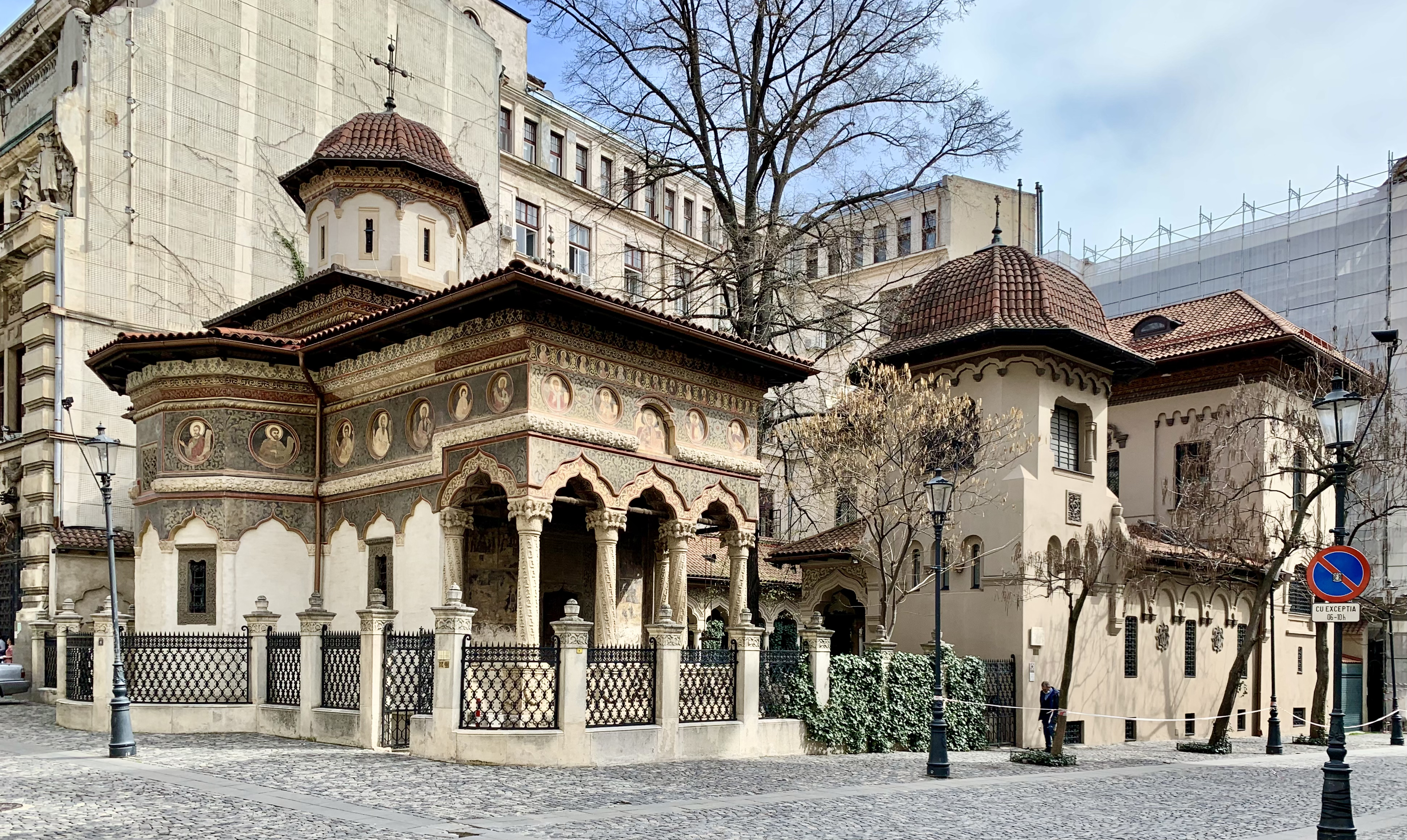
The Stavropoleos Monastery, also known as the Stavropoleos Church, is an Eastern Orthodox monastery located in central Bucharest, Romania. Built in 1724 during the Phanariot mandate of Nicolae Mavrocordatos, the church is a quintessential example of the Brâncovenesc architectural style, characterized by its intricate stone carvings, floral motifs, and balanced proportions.
The monastery complex includes a small courtyard containing a collection of 18th-century tombstones, which were relocated from the surrounding area during various urban development projects. Despite the demolition of the original inn and monastery annexes in the late 19th century, the church remains a significant cultural landmark and a center for Byzantine music and theological study.
Key Facts
- Materials
- Brick, Stone, Wood
- Civilization
- Wallachian
- Accessibility
- Ground level access, limited interior space
- Date(s)
- 1724
- Condition
- Active church and monastery
- Original Function
- Monastery and inn
- Key Figures
- Archimandrite Ioanichie Stratonikeas, Nicolae Mavrocordatos
Founding and Construction
1724The church was built by the Greek monk Ioanichie Stratonikeas, who arrived in Wallachia from Epirus. It was established as a monastery with an attached inn, a common practice for religious foundations of the era to ensure financial self-sufficiency.
Urban Transformation
19th CenturyDuring the late 19th century, the monastery's annexes and the inn were demolished due to urban planning initiatives in Bucharest. The church survived as a parish church, though it suffered damage from earthquakes and neglect.
Restoration and Modern Era
20th Century - PresentExtensive restoration work was carried out in the early 20th century by architect Ion Mincu, who sought to preserve the original Brâncovenesc aesthetic. Today, the monastery is known for its active choir specializing in Byzantine music and its library of religious manuscripts.
Cultural Significance
The Stavropoleos Monastery is a vital symbol of the Brâncovenesc style, a unique Romanian architectural synthesis of Byzantine, Ottoman, and late Renaissance elements. It serves as a rare surviving example of the urban monastery complexes that once defined the landscape of old Bucharest.
Beyond its architecture, the site is a hub for the preservation of Byzantine liturgical music. The monastery's choir is internationally recognized for its research and performance of traditional chants, maintaining a living link to the religious and cultural heritage of the Orthodox world.
Interpretive Notes
Scholarly debates and areas of uncertainty
There is ongoing academic discussion regarding the extent of the original 18th-century interior frescoes versus the later 20th-century repainting. Scholars debate how much of the current decorative program accurately reflects the original iconographic intent of the founder.
Visiting Information
Entry Rules
Open daily. Entry is free. Visitors are expected to maintain silence and dress modestly, covering shoulders and knees. Photography is permitted without flash.
Best Times to Visit
Weekday mornings to avoid the heavy weekend foot traffic in the Lipscani district. The courtyard is particularly quiet during early hours.
Photography
No flash photography inside the church. Tripods are not permitted without prior written permission from the monastery office.
Preservation Notes
The stone carvings are fragile; visitors are requested not to touch the exterior facades. The site is actively used for worship, so please respect ongoing services.
Nearby POIs
11 shown- Zlatari's Church0.1 km
- Choral Temple0.6 km
- Kretzulescu Church0.7 km
- Memorial of Rebirth0.8 km
- Royal Palace of Bucharest0.9 km
- National Museum of Art of Romania1 km
- Palace of Parliament1 km
- Catedrala Mantuirii Neamului1.5 km
- George Enescu National Museum2.1 km
- Museum of Senses Bucharest3.6 km
- Ceausescu House4.2 km
Sources & Further Reading
- [1]The Brâncovenesc Style in Wallachian Architecture — Vasile Drăguț. Meridiane Publishing House (1984)
- [2]Stavropoleos: A History of the Monastery — Gabriel Dumitru. Bucharest University Press (2012)
Key Facts
- Materials
- Brick, Stone, Wood
- Civilization
- Wallachian
- Accessibility
- Ground level access, limited interior space
- Date(s)
- 1724
- Condition
- Active church and monastery
- Original Function
- Monastery and inn
- Key Figures
- Archimandrite Ioanichie Stratonikeas, Nicolae Mavrocordatos
Nearby POIs
11 shown- Zlatari's Church0.1 km
- Choral Temple0.6 km
- Kretzulescu Church0.7 km
- Memorial of Rebirth0.8 km
- Royal Palace of Bucharest0.9 km
- National Museum of Art of Romania1 km
- Palace of Parliament1 km
- Catedrala Mantuirii Neamului1.5 km
- George Enescu National Museum2.1 km
- Museum of Senses Bucharest3.6 km
- Ceausescu House4.2 km