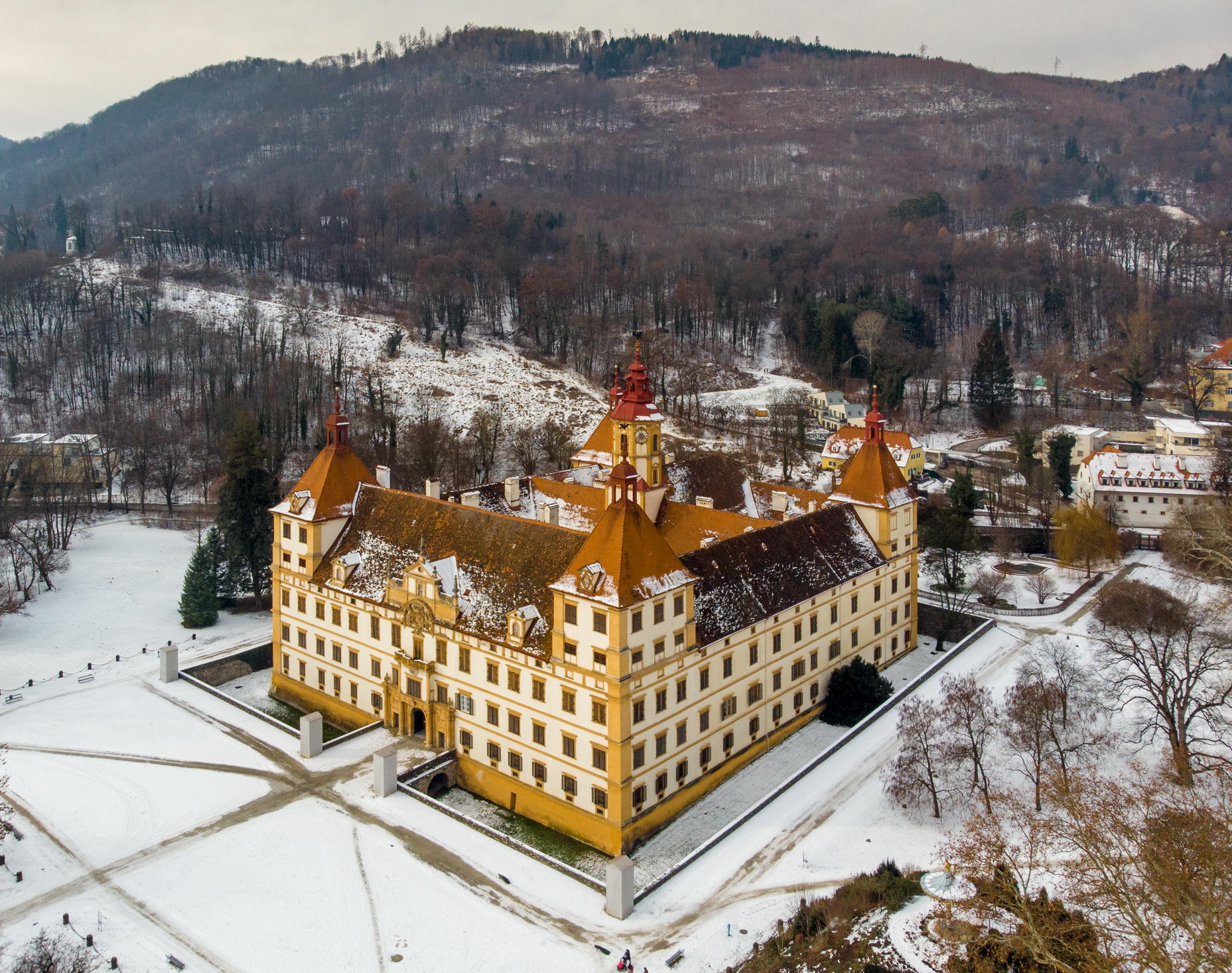
Schloss Eggenberg is the most significant Baroque palace complex in Styria, Austria. Commissioned by Hans Ulrich von Eggenberg in 1625, the palace was designed by court architect Giovanni Pietro de Pomis to reflect the Ptolemaic universe, incorporating complex astronomical and mathematical symbolism into its floor plan and decorative program.
The palace is renowned for its 24 preserved state rooms, which feature original 18th-century furnishings and elaborate ceiling frescoes. The surrounding gardens, originally laid out in the Baroque style and later transformed into an English landscape park, house a collection of peacocks and provide a setting for the palace's extensive art and archaeological collections, including the famous Roman-era Strettweg Cult Wagon.
Key Facts
- Materials
- Stone, Brick, Stucco, Wood
- Civilization
- Austrian / Habsburg Empire
- Accessibility
- Partially accessible; ground floor and gardens are wheelchair friendly
- Date(s)
- 1625-1635
- Condition
- Well-preserved, functions as a museum and cultural site
- Original Function
- Residential palace and symbol of dynastic power
- Key Figures
- Hans Ulrich von Eggenberg, Giovanni Pietro de Pomis, Johann Bernhard Fischer von Erlach
Foundation and Design
1625-1635Hans Ulrich von Eggenberg, a powerful advisor to Emperor Ferdinand II, commissioned the palace to serve as a residence that mirrored the cosmos. The design utilized a strict mathematical grid based on the calendar, with 365 windows, 31 rooms on each floor, and 24 state rooms.
Baroque Expansion
18th centuryThe interior underwent significant renovations in the mid-18th century under the direction of the Eggenberg family. This period saw the addition of the opulent Rococo-style state rooms and the completion of the extensive fresco cycles that define the palace's interior aesthetic.
Acquisition and Preservation
1939-presentThe palace and its grounds were acquired by the state of Styria in 1939. Following extensive restoration efforts in the post-war era, it was integrated into the Universalmuseum Joanneum. In 2010, it was inscribed as part of the UNESCO World Heritage site 'City of Graz – Historic Centre and Schloss Eggenberg'.
Cultural Significance
Schloss Eggenberg serves as a primary example of the 'planetary' architecture of the 17th century, where the physical structure of a building was intended to harmonize with the celestial order. It remains a vital repository of Styrian history, housing the Alte Galerie and the Archaeological Museum, which preserve regional heritage from prehistoric times to the modern era.
The palace is also a focal point for the study of Baroque court culture in the Habsburg lands. Its preservation allows for a rare, uninterrupted view into the lifestyle and intellectual preoccupations of the high nobility during the Counter-Reformation period.
Interpretive Notes
Scholarly debates and areas of uncertainty
While the astronomical symbolism of the palace is widely accepted, scholars continue to debate the extent to which the original design was influenced by Hermetic and alchemical traditions prevalent in the court of Ferdinand II. The exact attribution of certain secondary decorative elements remains a subject of ongoing art historical research.
Visiting Information
Entry Rules
Open to the public from April to October. Guided tours are required to access the state rooms. Tickets can be purchased at the entrance or online. Modest behavior is expected within the historical interiors.
Best Times to Visit
Late spring and early summer for the gardens. Weekdays are generally quieter for interior tours.
Photography
Photography is permitted in the gardens and museum galleries without flash. Photography is strictly prohibited inside the state rooms to protect the historical interiors.
Preservation Notes
Visitors must wear protective overshoes provided at the entrance when touring the state rooms. Touching of surfaces and furniture is strictly forbidden.
Nearby POIs
1 shownSources & Further Reading
- [1]
- [2]Baroque Architecture in Central Europe — John Stathatos. Academic Press Graz (2018)
Key Facts
- Materials
- Stone, Brick, Stucco, Wood
- Civilization
- Austrian / Habsburg Empire
- Accessibility
- Partially accessible; ground floor and gardens are wheelchair friendly
- Date(s)
- 1625-1635
- Condition
- Well-preserved, functions as a museum and cultural site
- Original Function
- Residential palace and symbol of dynastic power
- Key Figures
- Hans Ulrich von Eggenberg, Giovanni Pietro de Pomis, Johann Bernhard Fischer von Erlach