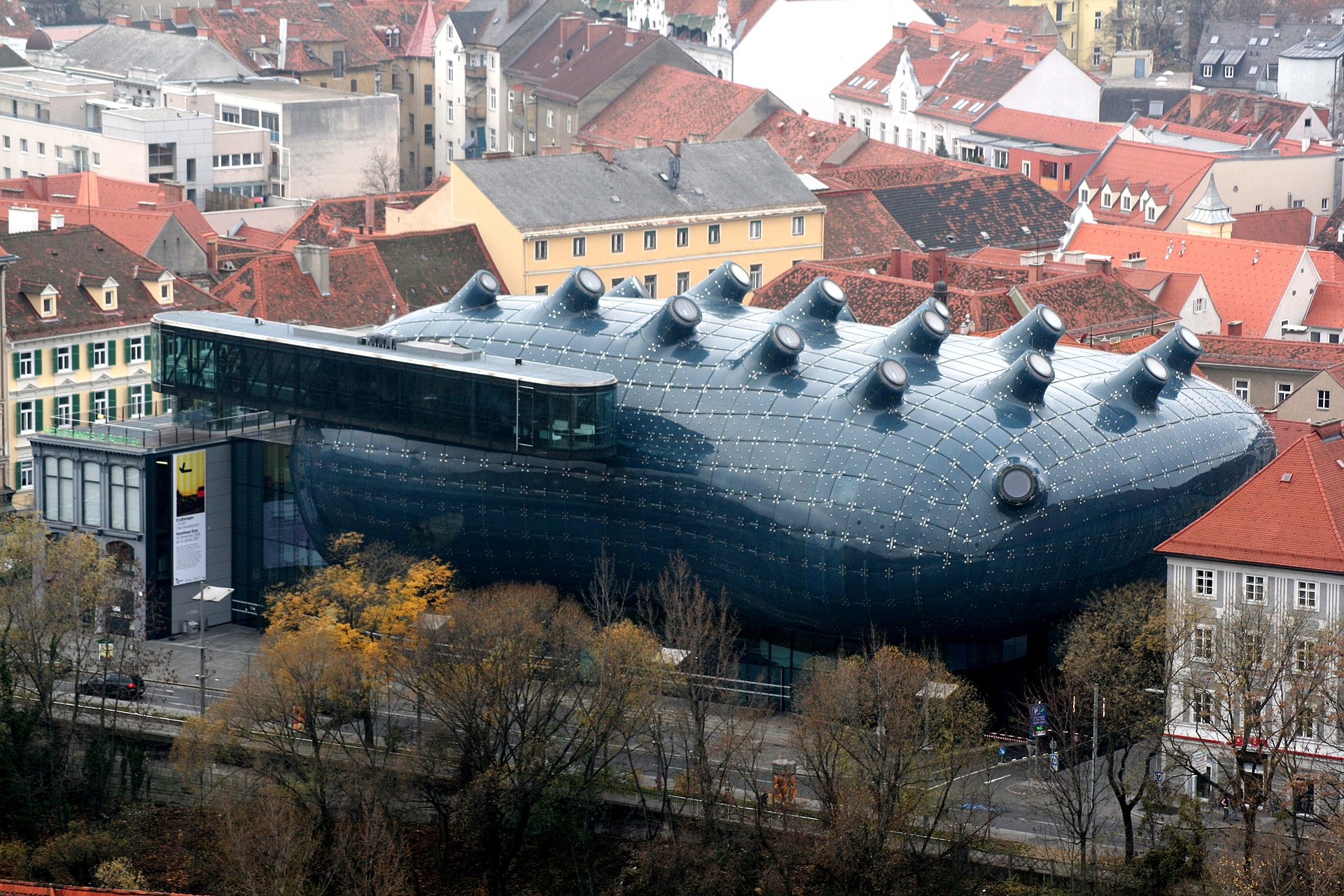
The Kunsthaus Graz is a contemporary art museum located in Graz, Austria, designed by architects Peter Cook and Colin Fournier. Opened in 2003 as part of the European Capital of Culture celebrations, the building is renowned for its biomorphic, blob-like architecture that contrasts sharply with the surrounding traditional red-roofed historic district.
The structure features a 'BIX' media façade, a programmable surface integrated into the building's skin that displays digital art and light installations. The museum does not maintain a permanent collection, instead focusing on rotating exhibitions of contemporary art, photography, and new media produced from the 1960s to the present.
Key Facts
- Materials
- Acrylic glass, Steel, Fluorescent rings
- Civilization
- Austrian
- Accessibility
- Fully wheelchair accessible
- Date(s)
- 2001-2003
- Condition
- Active, well-maintained
- Original Function
- Contemporary art museum
- Key Figures
- Peter Cook, Colin Fournier
Design and Commission
2000Following an international competition, the design by Peter Cook and Colin Fournier was selected for its innovative use of space and form. The project was conceived as a landmark for the 2003 European Capital of Culture.
Construction
2001-2003The building was constructed using a complex steel frame covered in blue acrylic panels. The design integrated the historic 'Iron House' (Eisernes Haus) into its entrance, preserving a piece of 19th-century industrial architecture.
Inauguration and Operation
2003-PresentThe museum opened in 2003 and has since functioned as a hub for international contemporary art. It continues to host temporary exhibitions and serves as a focal point for digital media art through its BIX façade.
Cultural Significance
The Kunsthaus Graz serves as a symbol of the city's transition toward a modern, design-oriented cultural identity. Its presence in the historic center sparked significant debate regarding the integration of avant-garde architecture within UNESCO World Heritage urban landscapes, ultimately becoming a widely recognized icon of Graz.
Interpretive Notes
Scholarly debates and areas of uncertainty
Architectural critics frequently debate the 'blob' aesthetic in relation to urban context. Some scholars argue the building is a successful example of 'contextual contrast,' while others contend that its alien form disrupts the historical continuity of the city's urban fabric.
Visiting Information
Entry Rules
Open Tuesday to Sunday. Tickets can be purchased on-site or online. Standard museum conduct applies; large bags must be stored in lockers.
Best Times to Visit
Evening hours are recommended to view the BIX media façade in operation. Weekdays generally offer fewer crowds than weekends.
Photography
Personal photography is permitted for non-commercial use. Flash and tripods are prohibited inside exhibition galleries.
Preservation Notes
The acrylic skin requires specialized maintenance to preserve its transparency and the integrity of the integrated light rings. Visitors are requested not to touch the exterior panels.
Nearby POIs
1 shownSources & Further Reading
- [1]Kunsthaus Graz: Architecture and Design — Peter Cook. Hatje Cantz (2003)
- [2]The Blob: Architecture and the Digital Revolution — Greg Lynn. Monacelli Press (2004)
Key Facts
- Materials
- Acrylic glass, Steel, Fluorescent rings
- Civilization
- Austrian
- Accessibility
- Fully wheelchair accessible
- Date(s)
- 2001-2003
- Condition
- Active, well-maintained
- Original Function
- Contemporary art museum
- Key Figures
- Peter Cook, Colin Fournier