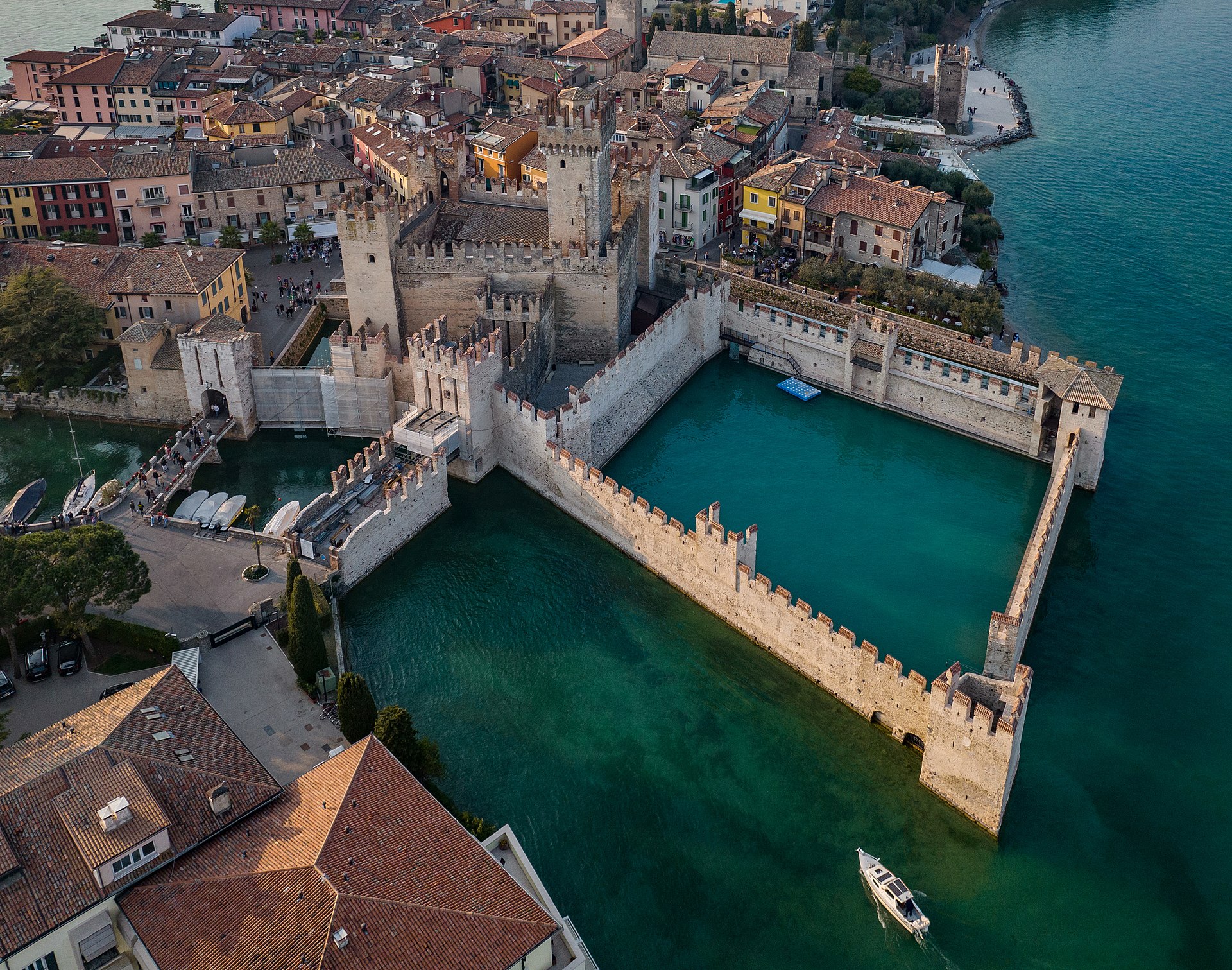
The Scaligero Castle of Sirmione is a 14th-century fortification located at the entrance to the Sirmione peninsula on Lake Garda. Built by the Scaliger family of Verona, the castle served as a strategic defensive structure to protect the town and control access to the lake. It is one of the most complete and well-preserved examples of medieval lakeside military architecture in Italy.
The structure is characterized by its distinctive swallowtail battlements, high curtain walls, and three corner towers. A unique feature of the castle is its fortified dock, which was designed to house the Scaliger fleet and provide a secure harbor for naval operations. The castle is surrounded by a moat and accessible via a drawbridge, reflecting the defensive engineering typical of the period.
Key Facts
- Materials
- Stone, Brick, Terracotta
- Civilization
- Scaliger (Veronese)
- Accessibility
- Ground floor accessible, upper levels require stairs
- Date(s)
- 14th century
- Condition
- Well-preserved, museum and public monument
- Original Function
- Defensive fortress and naval harbor
- Key Figures
- Mastino I della Scala, Cangrande I della Scala
Origins and Construction
13th-14th centuryThe castle was commissioned by the Scaliger family, the lords of Verona, to consolidate their control over the southern shores of Lake Garda. Construction began in the mid-13th century and was expanded throughout the 14th century to include the fortified harbor.
Military Significance
14th-15th centuryDuring the Scaliger rule, the fortress acted as a critical military outpost. Its design allowed for the rapid deployment of troops and naval vessels, ensuring the security of the trade routes on the lake and the defense of the Sirmione peninsula.
Venetian Rule and Decline
15th-18th centuryFollowing the expansion of the Republic of Venice into the region in 1405, the castle lost its primary strategic importance as the frontier shifted. It was repurposed for administrative and storage functions, which contributed to its survival through the centuries.
Modern Restoration
20th century - presentIn the early 20th century, the Italian state initiated extensive restoration works to stabilize the walls and towers. Today, it is managed by the Ministry of Culture and serves as a significant historical site and museum.
Cultural Significance
The Scaligero Castle is a symbol of the political and military influence of the Scaliger dynasty in Northern Italy. It represents the transition from feudal defensive structures to more sophisticated fortified harbors, reflecting the importance of naval power on Lake Garda during the Middle Ages.
Locally, the castle is the primary landmark of Sirmione and a focal point for the town's heritage. It is frequently cited in literature and art as a quintessential example of a medieval water castle, drawing visitors to explore the intersection of military history and the natural landscape of the lake.
Interpretive Notes
Scholarly debates and areas of uncertainty
There is ongoing academic discussion regarding the exact phases of the castle's construction, particularly the integration of the Roman-era materials found in the foundations. Scholars debate the extent to which the Scaligers repurposed existing Roman ruins versus constructing entirely new defensive works.
Visiting Information
Entry Rules
Open Tuesday through Sunday. Tickets are required for entry. Visitors are advised to check the official website for seasonal hours and potential closures during public holidays.
Best Times to Visit
Early morning or late afternoon to avoid peak tourist crowds and midday heat. Spring and autumn offer the most temperate weather for exploring the ramparts.
Photography
Personal photography is permitted throughout the site. Commercial photography requires prior authorization from the local cultural heritage office.
Preservation Notes
Visitors are requested to remain on designated paths and refrain from climbing on the battlements or touching the historical masonry. The site is subject to ongoing maintenance to preserve the structural integrity of the lakeside walls.
Nearby POIs
1 shownSources & Further Reading
- [1]Castelli e fortificazioni del Garda — G. P. Brogiolo. SAP Società Archeologica (2005)
- [2]The Scaligeri of Verona — A. M. Allen. Methuen & Co. (1910)
Key Facts
- Materials
- Stone, Brick, Terracotta
- Civilization
- Scaliger (Veronese)
- Accessibility
- Ground floor accessible, upper levels require stairs
- Date(s)
- 14th century
- Condition
- Well-preserved, museum and public monument
- Original Function
- Defensive fortress and naval harbor
- Key Figures
- Mastino I della Scala, Cangrande I della Scala