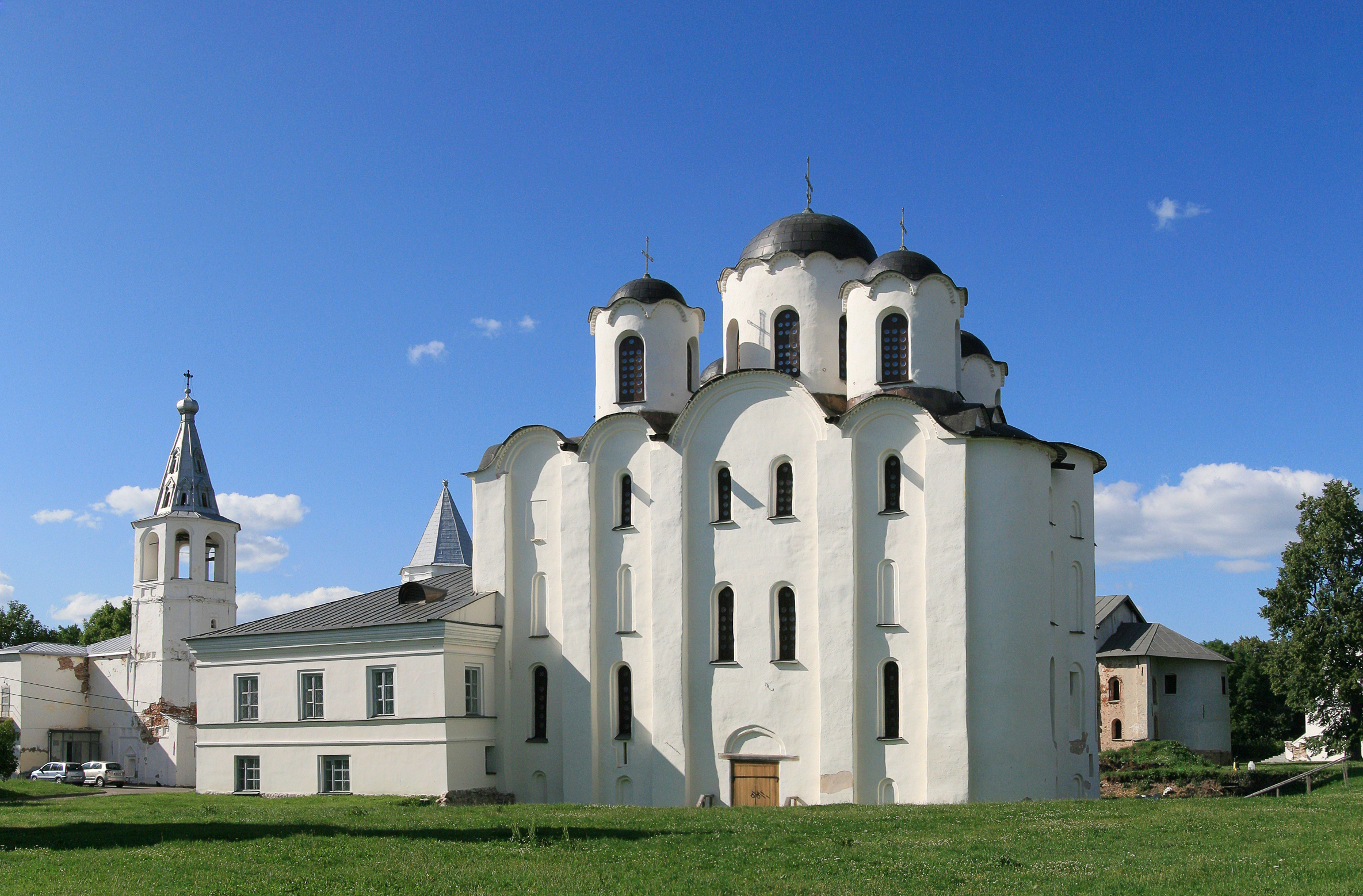
Saint Nicholas Cathedral, located in the Yaroslav's Court of Veliky Novgorod, is one of the oldest stone structures in Russia. Commissioned by Prince Mstislav the Great in 1113, the cathedral served as the primary church for the prince's residence and a central hub for the city's political and commercial life during the Novgorod Republic.
The architecture follows the traditional cross-in-square design characteristic of early Novgorod churches, featuring massive proportions and austere facades. Despite centuries of conflict and environmental degradation, the interior retains fragments of 12th-century frescoes, providing critical insight into the artistic and theological traditions of the medieval Russian Orthodox Church.
Key Facts
- Materials
- Limestone, Brick
- Civilization
- Kievan Rus
- Accessibility
- Ground level access, limited interior mobility
- Date(s)
- 1113-1136 CE
- Condition
- Restored, museum and exhibition space
- Original Function
- Princely cathedral
- Key Figures
- Mstislav the Great, Vsevolod Mstislavich
Founding and Early Years
1113-1136The cathedral was founded by Prince Mstislav the Great in 1113. It was built as a grand stone structure to solidify the prince's authority in Novgorod and to serve as a family burial site for the ruling dynasty.
Novgorod Republic Era
12th-15th centuryDuring the height of the Novgorod Republic, the cathedral functioned as a central landmark in the Yaroslav's Court, the city's main marketplace and political center. It witnessed the rise of the veche (popular assembly) and the city's independence.
Soviet Era and Restoration
20th centuryFollowing the Russian Revolution, the cathedral was closed for religious services and repurposed. Extensive restoration work in the mid-20th century stabilized the structure and uncovered significant medieval frescoes that had been obscured by later layers of paint.
Cultural Significance
Saint Nicholas Cathedral is a cornerstone of Novgorod's architectural heritage, representing the transition of Byzantine influence into the distinct regional style of the Novgorod Republic. It remains a symbol of the city's historical autonomy and its role as a bridge between Northern Europe and the Byzantine world.
Today, the site is part of the UNESCO World Heritage listing for the Historic Monuments of Novgorod and Surroundings. It serves as a vital educational site for understanding the development of Russian medieval art and statehood.
Interpretive Notes
Scholarly debates and areas of uncertainty
The exact sequence of the construction phases and the identity of the master builders remain subjects of academic discussion. Some scholars argue that the architectural style shows direct influence from Kievan masters, while others point to local Novgorod innovations that diverged from the southern traditions.
Visiting Information
Entry Rules
Open to the public as a museum. Modest dress is recommended. Entry fees apply for museum exhibitions.
Best Times to Visit
Late spring and early autumn offer the best weather for exploring the surrounding Yaroslav's Court complex.
Photography
Personal photography is permitted without flash. Professional photography requires prior authorization from the museum administration.
Preservation Notes
The interior frescoes are highly sensitive to humidity and light. Visitors are requested to refrain from touching the walls and to follow all posted conservation guidelines.
Nearby POIs
11 shown- Novgorod Detinets0.7 km
- Church of the Transfiguration on Ilyina Street0.7 km
- Millennium of Russia0.7 km
- Cathedral of Saint Sophia0.7 km
- Novgorodskiy Muzey-Zapovednik0.7 km
- Chamber of Facets0.8 km
- Eternal Flame of Glory0.8 km
- Desyatinny Monastery1.2 km
- Nereditsa Church2.7 km
- Vitoslavlitsy Museum3.1 km
- Yuriev Monastery3.4 km
Sources & Further Reading
- [1]The Architecture of Novgorod — William Craft Brumfield. University of Washington Press (1993)
- [2]
Key Facts
- Materials
- Limestone, Brick
- Civilization
- Kievan Rus
- Accessibility
- Ground level access, limited interior mobility
- Date(s)
- 1113-1136 CE
- Condition
- Restored, museum and exhibition space
- Original Function
- Princely cathedral
- Key Figures
- Mstislav the Great, Vsevolod Mstislavich
Nearby POIs
11 shown- Novgorod Detinets0.7 km
- Church of the Transfiguration on Ilyina Street0.7 km
- Millennium of Russia0.7 km
- Cathedral of Saint Sophia0.7 km
- Novgorodskiy Muzey-Zapovednik0.7 km
- Chamber of Facets0.8 km
- Eternal Flame of Glory0.8 km
- Desyatinny Monastery1.2 km
- Nereditsa Church2.7 km
- Vitoslavlitsy Museum3.1 km
- Yuriev Monastery3.4 km