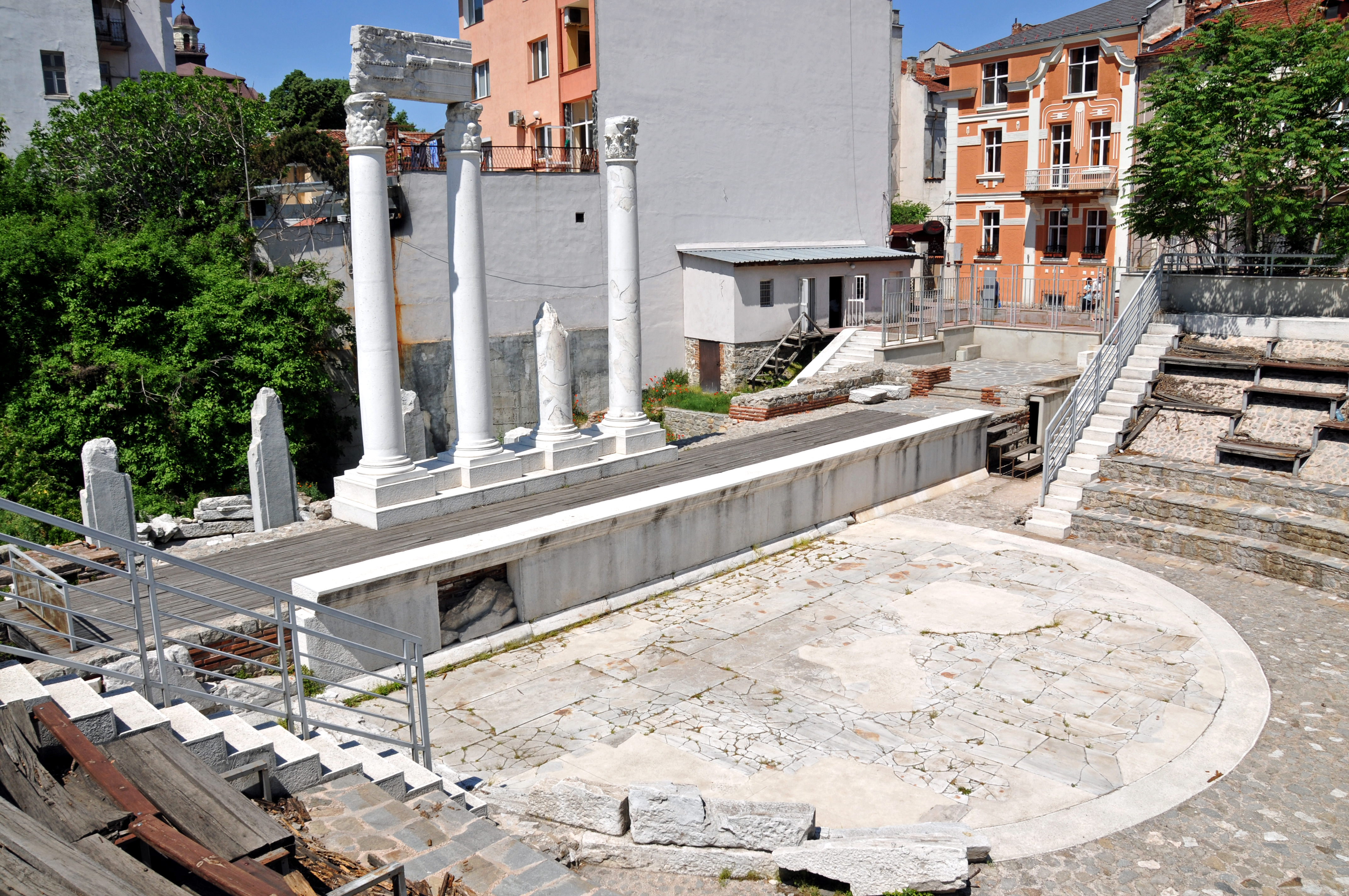
The Roman Forum of Philippopolis served as the administrative, commercial, and social heart of the ancient city, known today as Plovdiv. Constructed during the 1st century CE, the complex was strategically located at the intersection of the city's main thoroughfares, functioning as the primary site for public gatherings, legal proceedings, and trade.
The site encompasses an area of approximately 20 hectares, featuring a central square surrounded by public buildings, including a bouleuterion (council chamber) and a library. Although the forum underwent several modifications throughout the Roman period, it remains one of the most significant examples of Roman urban planning in the Balkans, providing critical insight into the civic life of the province of Thrace.
Key Facts
- Materials
- Marble, Limestone, Brick
- Civilization
- Roman
- Accessibility
- Ground level, partially pedestrianized
- Date(s)
- 1st century CE
- Condition
- Partially excavated and integrated into the modern urban landscape
- Original Function
- Administrative and commercial center
- Key Figures
- Emperor Domitian, Emperor Hadrian
Establishment
1st century CEThe forum was established following the Roman annexation of the region. It was designed to reflect the architectural standards of the empire, serving as a symbol of Roman authority and cultural integration in the Thracian capital.
Expansion and Peak
2nd century CEDuring the 2nd century, the complex saw significant expansion. New public buildings were added, and the square was paved with marble, reflecting the city's growing wealth and status as a major trade hub along the Via Militaris.
Decline and Rediscovery
4th century - 20th centuryFollowing the decline of the Roman Empire and subsequent invasions, the forum fell into disuse and was gradually buried under later urban layers. Systematic archaeological excavations began in the 1970s, revealing the extent of the complex beneath the modern city center.
Cultural Significance
The Roman Forum of Philippopolis is a cornerstone of Plovdiv's identity as one of the oldest continuously inhabited cities in Europe. It represents the transition of the city from a Thracian settlement to a major Roman metropolis, illustrating the synthesis of local and imperial cultures.
Today, the site is a focal point for urban heritage management. Its integration into the modern city center allows residents and visitors to engage directly with the ancient history of the region, serving as a venue for cultural events and public education.
Interpretive Notes
Scholarly debates and areas of uncertainty
There is ongoing academic discussion regarding the exact layout of the forum's northern section, as modern urban development has limited the ability to conduct full-scale excavations. Scholars also debate the extent to which the forum's architecture incorporated pre-existing Thracian spatial concepts versus strictly adhering to Vitruvian Roman standards.
Visiting Information
Entry Rules
The site is located in an open public space and is accessible 24/7. No entry fee is required.
Best Times to Visit
Early morning or late afternoon to avoid direct sun exposure, as the site is an open-air excavation with limited shade.
Photography
Personal photography is permitted. Commercial photography requires authorization from the Plovdiv Regional Archaeological Museum.
Preservation Notes
Visitors are requested to remain on designated walkways and avoid climbing on ancient masonry. The site is subject to ongoing conservation efforts to protect exposed stone from weathering.
Nearby POIs
11 shown- Bishop's Basilica of Philippopolis0.3 km
- Ancient Theatre of Philippopolis0.5 km
- Plovdiv Clock Tower0.6 km
- Plovdiv Regional History Museum0.6 km
- Ancient Stadium of Philipopolis0.7 km
- Djumaya Mosque0.7 km
- Small Basilica Archeological Site0.8 km
- Hindliyan's House0.9 km
- Balabanov's House0.9 km
- House of Nedkovich0.9 km
- Plovdiv Regional Ethnographic Museum0.9 km
Sources & Further Reading
- [1]The Roman Forum of Philippopolis — Kezhova, M.. Archaeological Institute and Museum, Sofia (2015)View
- [2]Urban Development in Roman Thrace — Ivanov, R.. University of Sofia Press (2008)
Key Facts
- Materials
- Marble, Limestone, Brick
- Civilization
- Roman
- Accessibility
- Ground level, partially pedestrianized
- Date(s)
- 1st century CE
- Condition
- Partially excavated and integrated into the modern urban landscape
- Original Function
- Administrative and commercial center
- Key Figures
- Emperor Domitian, Emperor Hadrian
Nearby POIs
11 shown- Bishop's Basilica of Philippopolis0.3 km
- Ancient Theatre of Philippopolis0.5 km
- Plovdiv Clock Tower0.6 km
- Plovdiv Regional History Museum0.6 km
- Ancient Stadium of Philipopolis0.7 km
- Djumaya Mosque0.7 km
- Small Basilica Archeological Site0.8 km
- Hindliyan's House0.9 km
- Balabanov's House0.9 km
- House of Nedkovich0.9 km
- Plovdiv Regional Ethnographic Museum0.9 km