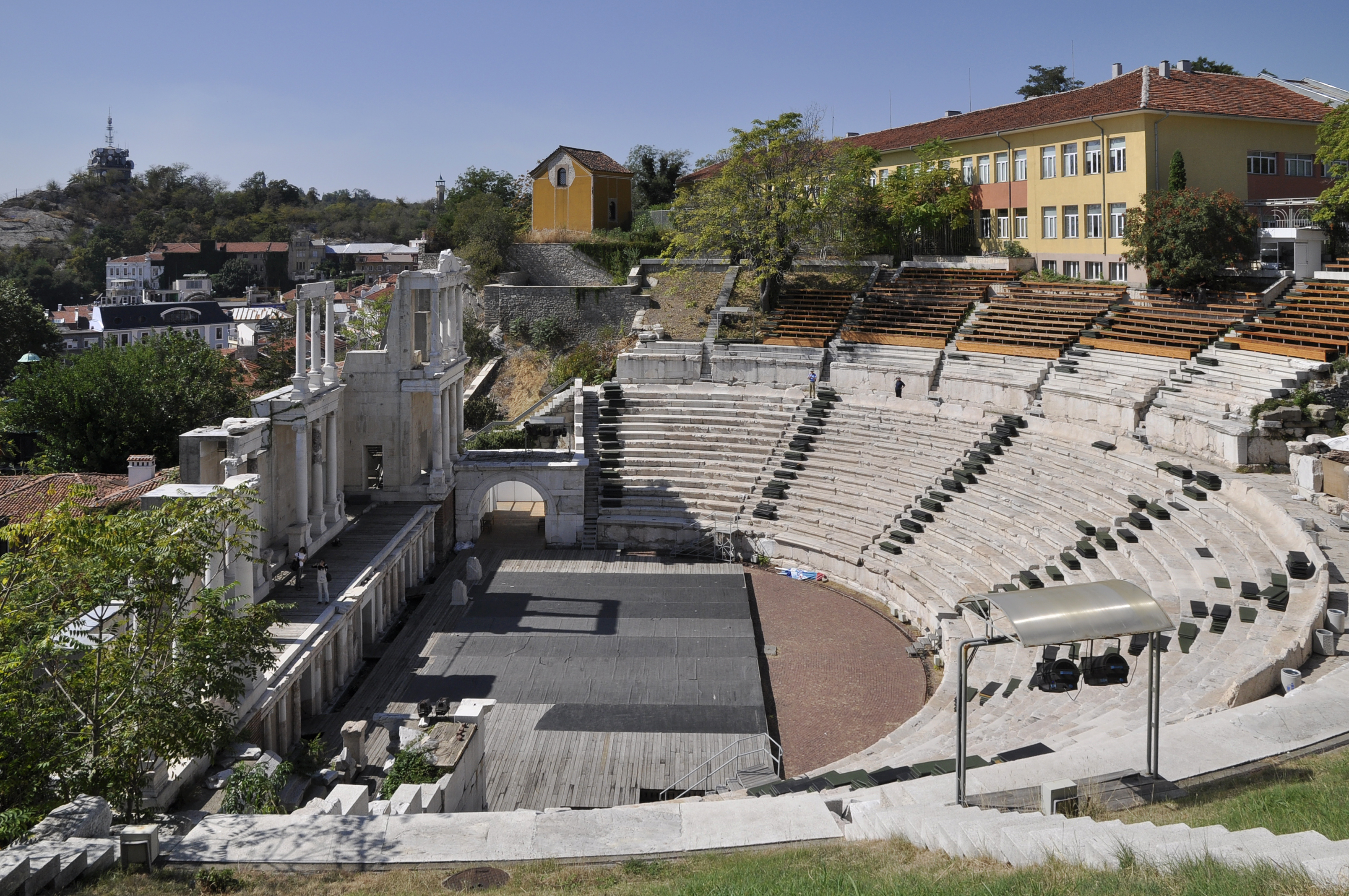
The Ancient Theatre of Philippopolis is one of the world's best-preserved ancient Roman theatres, located in the city center of Plovdiv, Bulgaria. Constructed in the 1st century CE during the reign of Emperor Domitian, the structure is built into the natural slope between two hills, utilizing the topography to support its semi-circular seating arrangement. The theatre was designed to accommodate approximately 3,500 spectators and served as a central venue for civic gatherings, theatrical performances, and gladiatorial games.
The site features a well-preserved stage building (scaenae frons) decorated with marble columns and statues, as well as distinct tiers of marble seating. Following its rediscovery in the 1970s after a landslide, the theatre underwent extensive restoration. Today, it functions as a prominent cultural venue, hosting opera performances, concerts, and theatrical productions, while remaining a significant archaeological landmark of the Roman province of Thrace.
Key Facts
- Materials
- Marble, Stone, Brick
- Civilization
- Roman
- Accessibility
- Limited due to steep terrain and original stone steps
- Date(s)
- 1st century CE
- Condition
- Restored and active venue
- Original Function
- Theatrical performances and civic assemblies
- Key Figures
- Emperor Domitian
Construction and Roman Era
1st century CEThe theatre was commissioned during the reign of Emperor Domitian. It was strategically positioned to overlook the ancient city of Philippopolis, serving as a focal point for the social and cultural life of the Roman provincial capital.
Destruction and Burial
4th century CEThe structure suffered significant damage during the invasion of the Goths in 250 CE. It remained in a state of disrepair and was eventually buried under earth and debris, which protected the marble elements from further degradation over the subsequent centuries.
Discovery and Restoration
1972-1981The theatre was rediscovered following a landslide in 1972. A major archaeological excavation and restoration project was undertaken, led by Bulgarian experts, which successfully reconstructed the seating tiers and the stage building using original materials.
Cultural Significance
The theatre is a symbol of Plovdiv's long history as one of the oldest continuously inhabited cities in Europe. It represents the integration of Roman architectural standards into the Thracian landscape and serves as a vital link between the city's ancient past and its modern identity as a cultural hub.
Interpretive Notes
Scholarly debates and areas of uncertainty
There is ongoing discussion regarding the extent of the 20th-century reconstruction, specifically concerning the degree to which modern materials were integrated with original Roman marble to ensure the structural integrity required for modern public performances.
Visiting Information
Entry Rules
Open daily for visitors. Tickets are required for entry. The site is an active performance venue, so access may be restricted during rehearsals or scheduled evening events.
Best Times to Visit
Early morning or late afternoon to avoid direct sun, as there is minimal shade within the seating area.
Photography
Personal photography is permitted. Professional or commercial photography requires prior authorization from the Plovdiv Regional Archaeological Museum.
Preservation Notes
Visitors are requested to stay within marked areas and avoid walking on the fragile original marble seating where restricted. The site is subject to ongoing maintenance to preserve the stone against weathering.
Nearby POIs
11 shown- Plovdiv Regional History Museum0.2 km
- Djumaya Mosque0.3 km
- Ancient Stadium of Philipopolis0.3 km
- Bishop's Basilica of Philippopolis0.3 km
- Hindliyan's House0.3 km
- Balabanov's House0.4 km
- Plovdiv Clock Tower0.4 km
- Plovdiv Regional Ethnographic Museum0.4 km
- House of Nedkovich0.4 km
- Roman Forum of Philippopolis0.5 km
- Small Basilica Archeological Site0.6 km
Sources & Further Reading
- [1]The Ancient Theatre of Philippopolis — Plovdiv Regional Archaeological Museum. Official Archaeological Portal of Plovdiv (2021)View
- [2]Roman Theatres: An Architectural Study — Frank Sear. Oxford University Press (2006)
Key Facts
- Materials
- Marble, Stone, Brick
- Civilization
- Roman
- Accessibility
- Limited due to steep terrain and original stone steps
- Date(s)
- 1st century CE
- Condition
- Restored and active venue
- Original Function
- Theatrical performances and civic assemblies
- Key Figures
- Emperor Domitian
Nearby POIs
11 shown- Plovdiv Regional History Museum0.2 km
- Djumaya Mosque0.3 km
- Ancient Stadium of Philipopolis0.3 km
- Bishop's Basilica of Philippopolis0.3 km
- Hindliyan's House0.3 km
- Balabanov's House0.4 km
- Plovdiv Clock Tower0.4 km
- Plovdiv Regional Ethnographic Museum0.4 km
- House of Nedkovich0.4 km
- Roman Forum of Philippopolis0.5 km
- Small Basilica Archeological Site0.6 km