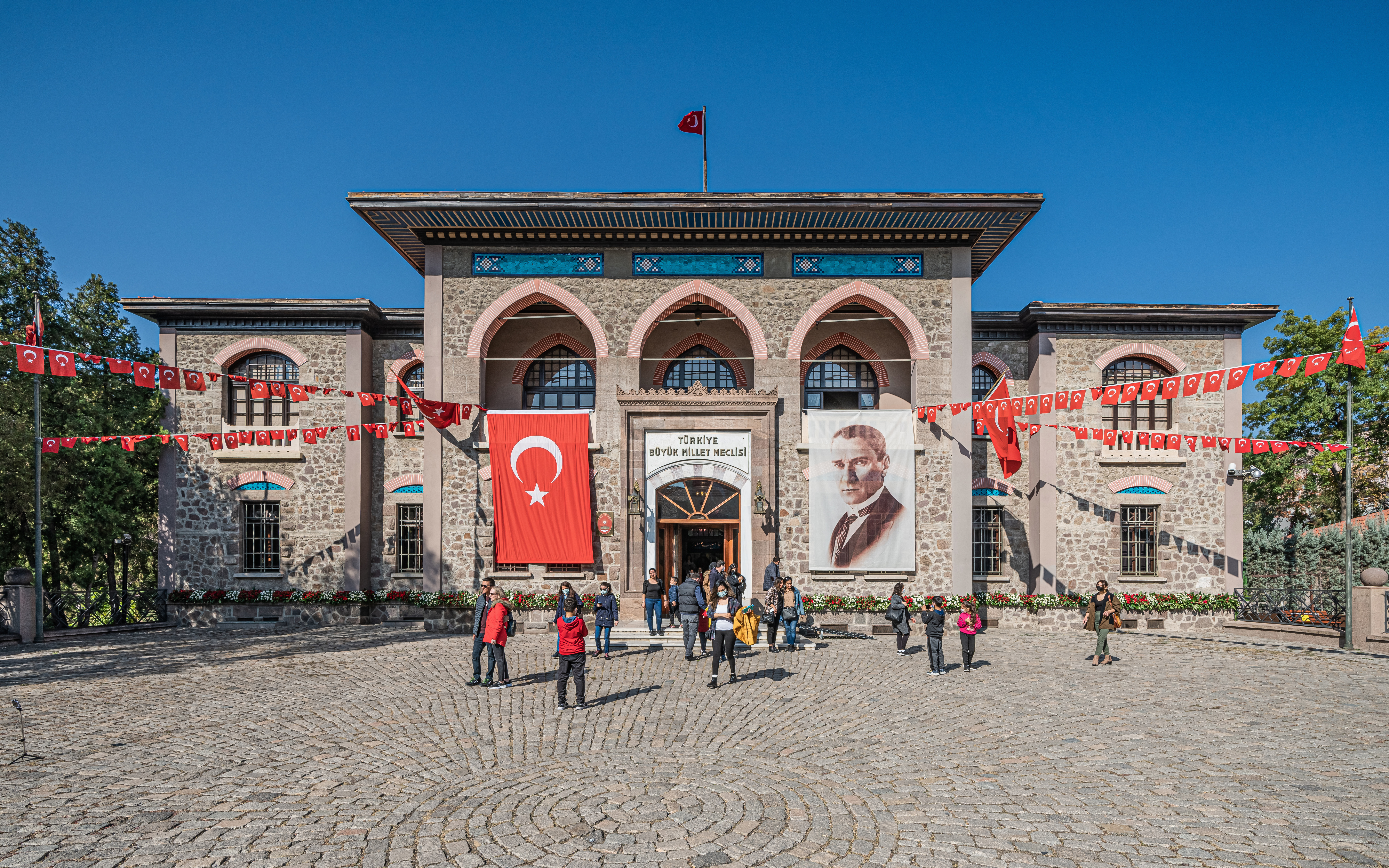
The Republic Museum, housed in the second building of the Grand National Assembly of Turkey, served as the legislative heart of the nation from 1924 to 1960. It was here that many of the foundational laws and reforms of the modern Turkish Republic were debated and enacted following the transition from the Ottoman Empire.
Today, the museum preserves the historical atmosphere of the early parliamentary era. The collection includes personal belongings of Mustafa Kemal Atatürk, official documents, photographs, and the original assembly hall, providing a comprehensive look at the political and social transformation of Turkey during the 1920s and 1930s.
Key Facts
- Materials
- Stone, Brick, Wood
- Civilization
- Republic of Turkey
- Accessibility
- Ground floor accessible
- Date(s)
- 1923
- Condition
- Well-preserved museum
- Original Function
- Second Grand National Assembly of Turkey
- Key Figures
- Mustafa Kemal Atatürk, Vedat Tek
Construction and Early Use
1923The building was designed by architect Vedat Tek and completed in 1923. It was specifically commissioned to serve as the headquarters for the Grand National Assembly, replacing the smaller, more cramped first parliament building nearby.
Legislative Center
1924-1960For thirty-six years, the building functioned as the center of Turkish political life. It hosted critical sessions that solidified the secular reforms, the adoption of the Turkish Civil Code, and the transition to a multi-party political system.
Conversion to Museum
1981-presentFollowing the relocation of the parliament to a larger complex, the building was repurposed. It opened as the Republic Museum in 1981, coinciding with the centennial of Atatürk's birth, to commemorate the founding era of the Republic.
Cultural Significance
The Republic Museum is a primary site of national memory in Turkey. It symbolizes the shift from imperial rule to national sovereignty and the establishment of secular democratic institutions. It remains a focal point for educational visits and national commemorations regarding the War of Independence and the subsequent modernization efforts.
Interpretive Notes
Scholarly debates and areas of uncertainty
Discussions among historians often focus on the architectural transition from Ottoman-era 'National Architectural Renaissance' styles to the more functionalist requirements of the new Republic, and how the building's layout reflects the evolving power dynamics of the early parliament.
Visiting Information
Entry Rules
Open Tuesday through Sunday. Entry requires a ticket or a valid museum pass. Visitors must pass through security screening at the entrance.
Best Times to Visit
Weekday mornings are generally quieter. The museum is particularly significant during national holidays such as October 29th (Republic Day).
Photography
Photography is permitted in most areas, but the use of flash and tripods is prohibited to protect sensitive historical documents and artifacts.
Nearby POIs
18 shownSources & Further Reading
- [1]The Grand National Assembly of Turkey: A Historical Overview — TBMM Press. Turkish Grand National Assembly Publications (2015)View
- [2]Modern Turkey: A History — Erik J. Zürcher. I.B. Tauris (2017)
Key Facts
- Materials
- Stone, Brick, Wood
- Civilization
- Republic of Turkey
- Accessibility
- Ground floor accessible