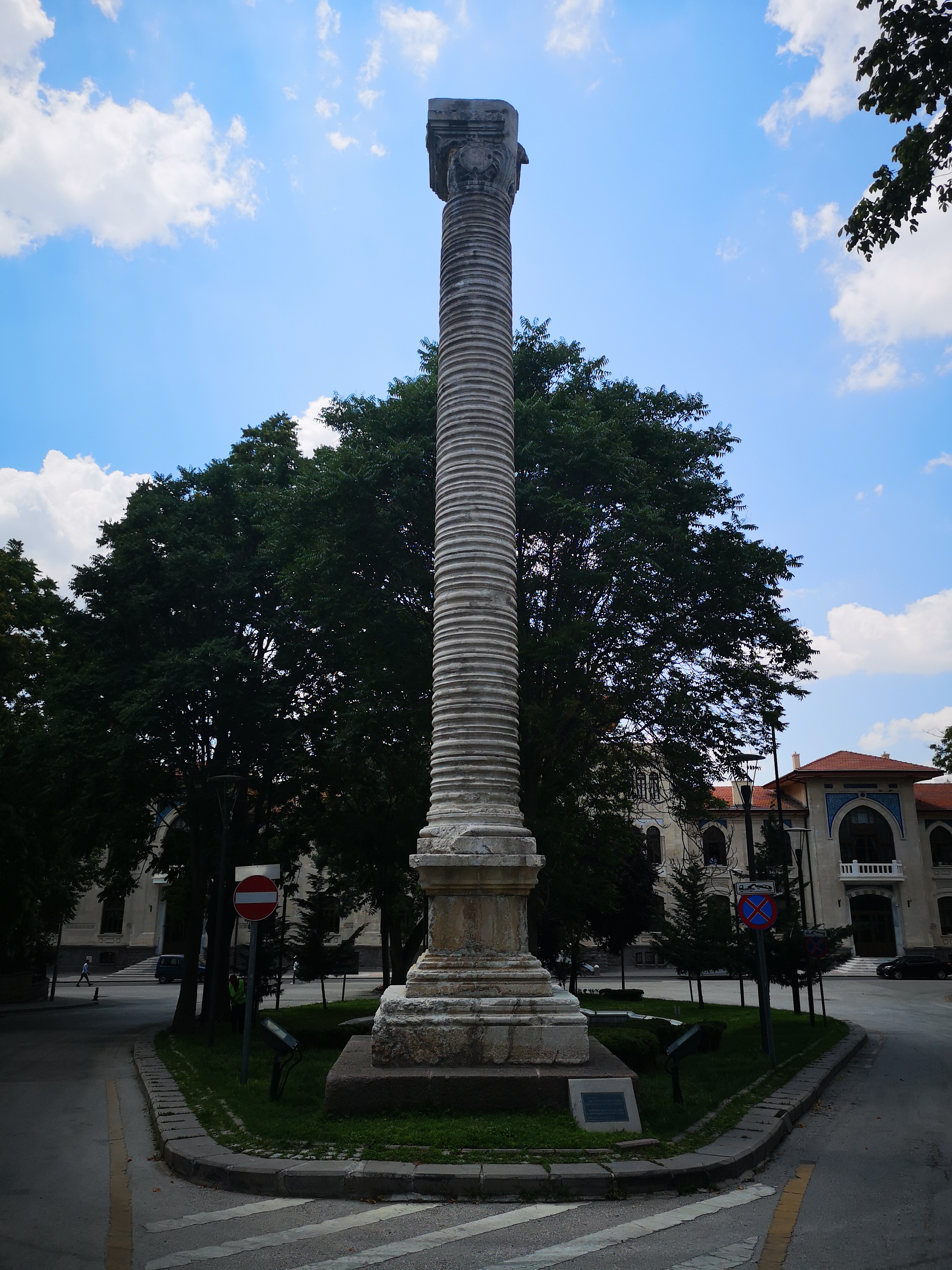
The Column of Julianus is a solitary Roman monument located in the Ulus district of Ankara, Turkey. Erected in the 4th century CE, it was built to commemorate the visit of the Roman Emperor Julian the Apostate to Ancyra (modern-day Ankara) in 362 CE during his campaign against the Sassanid Empire.
The monument consists of a single fluted column standing approximately 15 meters high, topped with a distinct Corinthian capital. While the original inscription or statue that once crowned the column has been lost, the structure remains a significant landmark of the city's Roman heritage, having been relocated slightly from its original position to its current site in the 1930s.
Key Facts
- Materials
- Stone, Marble
- Civilization
- Roman
- Accessibility
- Open to public view at street level
- Date(s)
- 362 CE
- Condition
- Well-preserved, standing in a public square
- Original Function
- Commemorative monument
- Key Figures
- Emperor Julian the Apostate
Imperial Visit
362 CEThe column was commissioned to honor the arrival of Emperor Julian in Ancyra. Julian, the last non-Christian Roman emperor, was traveling through the eastern provinces to prepare for his military expedition against the Sassanids.
Byzantine and Ottoman Eras
4th-19th centuryThroughout the centuries, the column remained a prominent feature of the city's landscape. It survived the various transitions of power in the region, often serving as a local landmark for travelers and residents.
Modern Relocation
1934During the urban planning and modernization of Ankara in the early Turkish Republic, the column was moved from its original location to its current position in front of the Ankara Governorate building to preserve it amidst city development.
Cultural Significance
The Column of Julianus serves as a tangible link to Ankara's history as a major administrative center in the Roman province of Galatia. It is one of the few remaining Roman-era structures in the city center and is locally referred to as 'Belkıs Minaresi' (Queen of Sheba's Minaret) by residents, reflecting a long-standing folk tradition regarding its origin.
Interpretive Notes
Scholarly debates and areas of uncertainty
There is minor scholarly discussion regarding the exact original placement of the column within the Roman city grid of Ancyra, as the 1934 relocation removed it from its primary archaeological context.
Visiting Information
Entry Rules
The site is located in an open public square and is accessible 24 hours a day at no cost.
Best Times to Visit
Daylight hours are recommended for viewing the details of the Corinthian capital.
Photography
None; the site is in a public space.
Nearby POIs
18 shownSources & Further Reading
- [1]Ankara: The History of the City — C. S. Lightfoot. British Institute of Archaeology at Ankara (1996)
- [2]
Key Facts
- Materials
- Stone, Marble
- Civilization
- Roman
- Accessibility
- Open to public view at street level