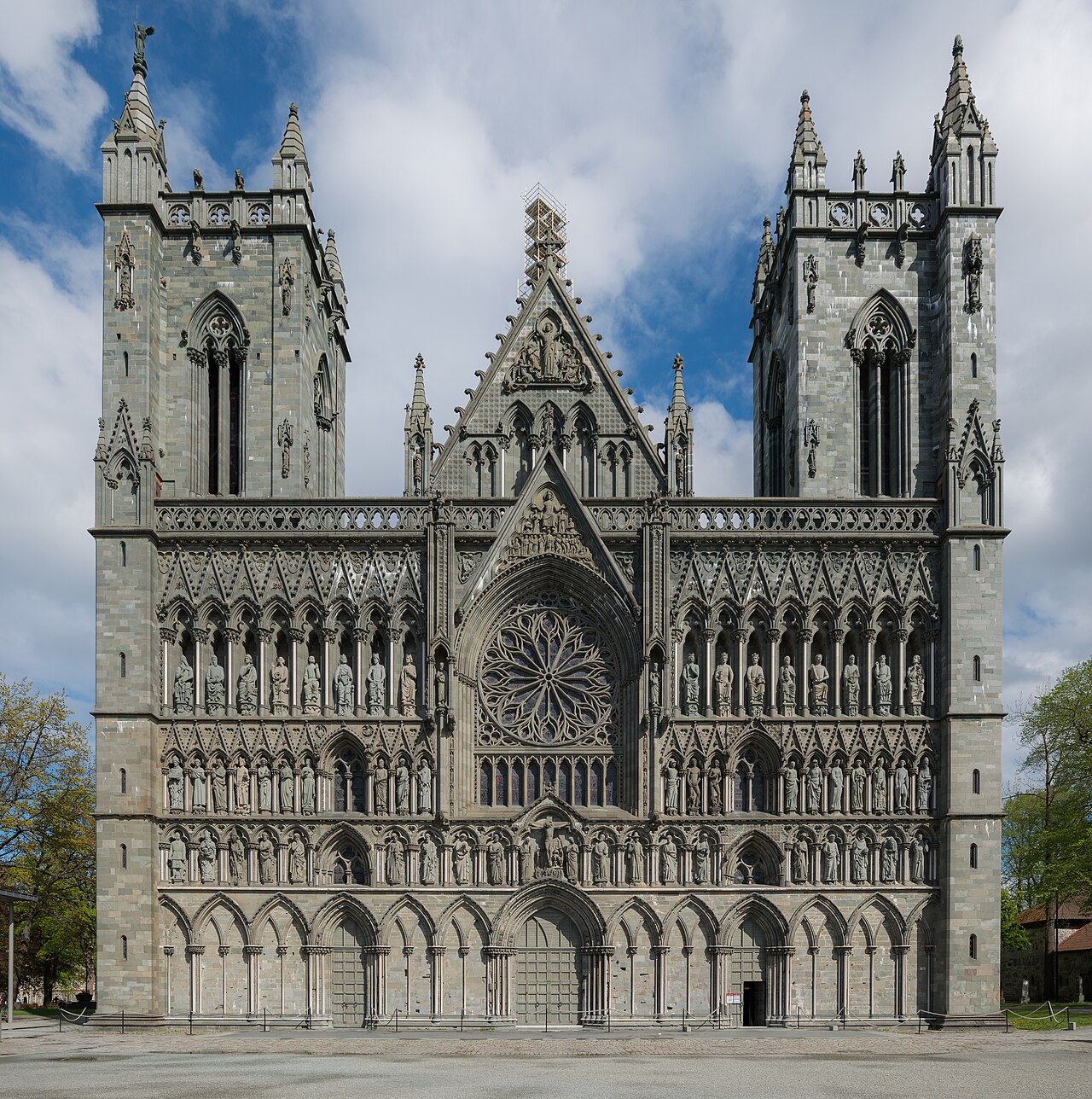
Nidaros Cathedral is a Church of Norway cathedral located in the city of Trondheim. It is built over the burial site of King Olav II, who became the patron saint of Norway following his death at the Battle of Stiklestad in 1030. The cathedral serves as the traditional location for the consecration of new Norwegian monarchs and remains a significant destination for pilgrims traveling the St. Olav's Way.
The structure is a complex architectural blend, featuring a Romanesque nave and a Gothic choir and transept. Construction began in 1070, with major expansions occurring throughout the 12th and 13th centuries. Despite suffering multiple fires throughout its history, the cathedral has undergone extensive restoration efforts, particularly during the late 19th and 20th centuries, to return it to its medieval appearance.
Key Facts
- Materials
- Soapstone, Marble
- Civilization
- Medieval Norwegian
- Accessibility
- Wheelchair accessible via designated entrances
- Date(s)
- 1070 - 1300
- Condition
- Well-preserved, active cathedral
- Original Function
- Cathedral and royal burial site
- Key Figures
- Saint Olav, Archbishop Øystein Erlendsson
Foundations and Saint Olav
11th centuryFollowing the canonization of King Olav II, his remains were interred at the site. A small wooden chapel was initially constructed, which was later replaced by a stone church commissioned by King Olav Kyrre.
Gothic Expansion
12th-13th centuryArchbishop Øystein Erlendsson initiated the construction of the Gothic choir and transepts, drawing inspiration from English Gothic architecture. This period established the cathedral as the spiritual center of the Norwegian kingdom.
Fire and Restoration
16th-19th centuryThe cathedral suffered severe damage from multiple fires, leading to long periods of decay. Significant restoration work began in 1869 under architect Christian Christie, who aimed to restore the building to its medieval glory.
Modern Era
20th century - presentThe cathedral continues to serve as the site for royal coronations and consecrations. Ongoing maintenance is managed by the Nidaros Cathedral Restoration Workshop, which preserves the intricate stone carvings and structural integrity.
Cultural Significance
Nidaros Cathedral is the national sanctuary of Norway and the northernmost medieval cathedral in the world. It represents the historical intersection of Norwegian monarchy and the Christian faith, serving as a symbol of national identity and continuity.
As the final destination of the St. Olav pilgrimage routes, the site maintains a living tradition of pilgrimage that connects modern travelers with the medieval history of Northern Europe.
Interpretive Notes
Scholarly debates and areas of uncertainty
The extent to which the 19th-century restoration accurately reflects the original medieval design remains a subject of discussion among architectural historians. Some argue that the restoration introduced interpretations that were not present in the original 13th-century structure.
Visiting Information
Entry Rules
Open daily for visitors. Entry is ticketed for the cathedral and the Archbishop's Palace museum. Modest dress is requested as it is an active place of worship.
Best Times to Visit
Summer months offer the best weather for exploring the surrounding grounds, while the St. Olav Festival in late July provides a deep cultural experience.
Photography
Photography is permitted for personal use without flash. Tripods and commercial filming require prior authorization.
Preservation Notes
Do not touch the stone carvings or historical artifacts. Follow all signage regarding restricted areas during services.
Nearby POIs
9 shownSources & Further Reading
- [1]Nidaros Cathedral: The St. Olav's Church — Øystein Ekroll. Nidaros Cathedral Restoration Workshop (2015)
- [2]The Medieval Architecture of Norway — T.E. Christiansen. Scandinavian University Press (1998)
Key Facts
- Materials
- Soapstone, Marble
- Civilization
- Medieval Norwegian
- Accessibility
- Wheelchair accessible via designated entrances
- Date(s)
- 1070 - 1300
- Condition
- Well-preserved, active cathedral
- Original Function
- Cathedral and royal burial site
- Key Figures
- Saint Olav, Archbishop Øystein Erlendsson