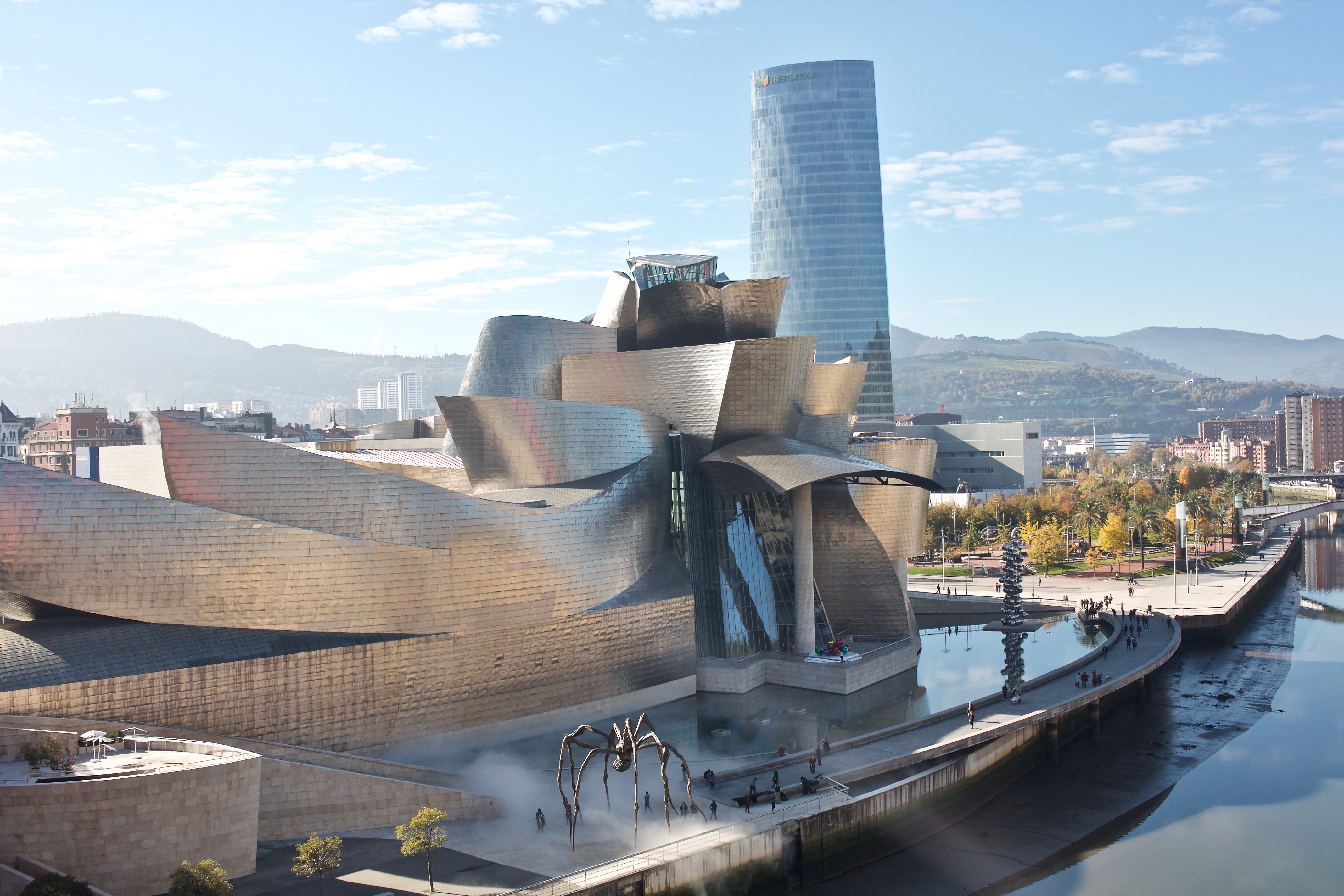
The Guggenheim Museum Bilbao is a museum of modern and contemporary art designed by Canadian-American architect Frank Gehry. Located in Bilbao, Spain, it is situated alongside the Nervión River and is widely considered one of the most important works of contemporary architecture. The building's design is characterized by its complex, swirling forms and titanium-clad exterior, which reflect the industrial heritage of the city.
Opened in 1997, the museum was a central component of the 'Bilbao Effect,' a strategy of urban regeneration that transformed the city from an industrial port into a global cultural destination. The interior features a large, light-filled atrium that connects the various galleries, housing a diverse collection of 20th-century and contemporary art, including large-scale installations and site-specific works.
Key Facts
- Materials
- Titanium, Limestone, Glass, Steel
- Civilization
- Modern
- Accessibility
- Fully wheelchair accessible
- Date(s)
- 1993-1997
- Condition
- Active
- Original Function
- Art Museum
- Key Figures
- Frank Gehry, Thomas Krens
Urban Regeneration
1990sThe museum was conceived as part of a broader urban renewal project for Bilbao, which had suffered from the decline of its traditional shipbuilding and steel industries. The Basque government and the Solomon R. Guggenheim Foundation partnered to create a landmark institution to revitalize the city's economy.
Design and Construction
1993-1997Frank Gehry was selected as the architect, utilizing advanced CATIA software to model the complex, non-Euclidean curves of the structure. Construction began in 1993, with the building officially opening to the public in October 1997.
Global Impact
1997-PresentSince its opening, the museum has become a global icon of architecture and a catalyst for cultural tourism. It continues to host major international exhibitions and maintains a significant permanent collection of contemporary art.
Cultural Significance
The museum is a symbol of the 'Bilbao Effect,' demonstrating the power of iconic architecture to transform the economic and social fabric of a city. It serves as a focal point for contemporary art in the Basque Country and has fundamentally altered the international perception of Bilbao.
Interpretive Notes
Scholarly debates and areas of uncertainty
The 'Bilbao Effect' remains a subject of debate in urban planning and architectural theory. Critics often discuss whether the focus on 'starchitecture' provides long-term sustainable benefits for local communities or if it prioritizes aesthetic spectacle over functional urban integration.
Visiting Information
Entry Rules
Open Tuesday through Sunday. Tickets can be purchased online or at the museum entrance. Visitors are subject to security screening upon entry.
Best Times to Visit
Weekday mornings are generally less crowded than weekends. The museum is particularly busy during the summer tourist season.
Photography
Personal photography is permitted in most galleries without flash or tripods. Specific exhibitions may have restrictions; please check signage at the entrance of each gallery.
Preservation Notes
Do not touch the artworks or the building's interior surfaces. Large bags and backpacks must be stored in the cloakroom.
Nearby POIs
1 shownKey Facts
- Materials
- Titanium, Limestone, Glass, Steel
- Civilization
- Modern
- Accessibility
- Fully wheelchair accessible
- Date(s)
- 1993-1997
- Condition
- Active
- Original Function
- Art Museum
- Key Figures
- Frank Gehry, Thomas Krens