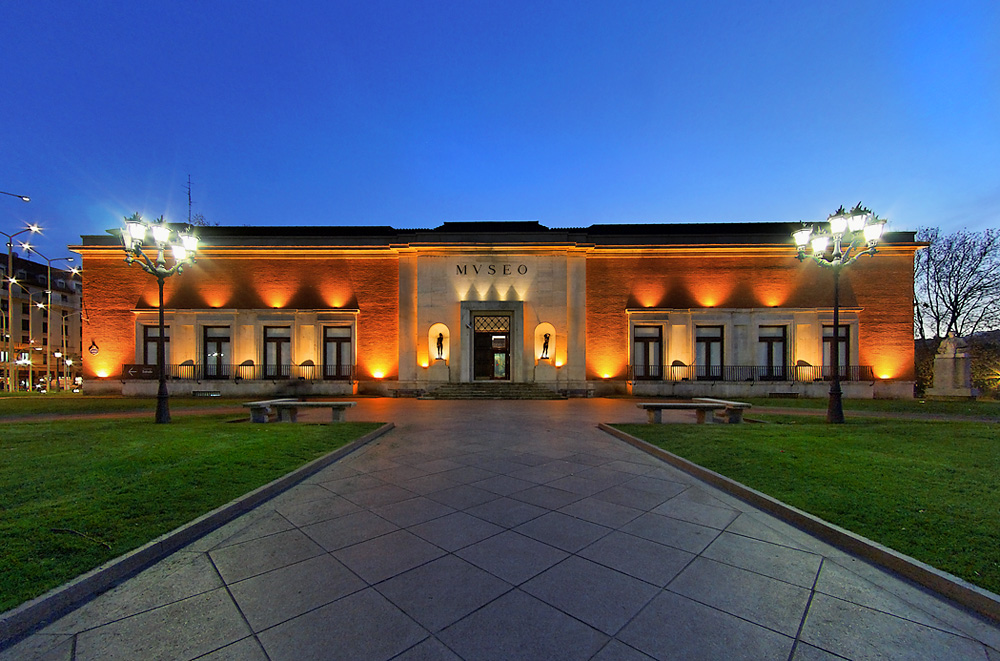
The Museo de Bellas Artes de Bilbao is a premier art institution located in the city of Bilbao, Spain. Established in 1908, it serves as the second-largest and most visited museum in the Basque Country, housing an extensive collection that spans from the 12th century to the present day.
The museum's collection is noted for its breadth, featuring significant works by Spanish masters such as El Greco, Goya, and Zurbarán, alongside a strong representation of Basque artists and international modern art. The facility itself is a composite of three distinct architectural phases, reflecting the evolution of the institution throughout the 20th century.
Key Facts
- Materials
- Stone, Concrete, Glass, Steel
- Civilization
- Spanish/Basque
- Accessibility
- Fully wheelchair accessible
- Date(s)
- 1908 (founding), 1945 (current main building), 2001 (extension)
- Condition
- Active, well-maintained
- Original Function
- Fine Arts Museum
- Key Figures
- Francisco de Goya, El Greco, Ignacio Zuloaga, Eduardo Chillida
Founding and Early Years
1908-1914The museum was founded in 1908 through the merger of the Museum of Fine Arts and the Museum of Modern Art. It initially occupied temporary spaces before moving into a dedicated building in 1914.
Expansion and Consolidation
1945-1970In 1945, the current neoclassical-style main building was inaugurated. During the following decades, the museum consolidated its collection, becoming one of the most important art repositories in Spain outside of Madrid.
Modernization and Extension
2001-PresentA major architectural expansion was completed in 2001, designed to modernize the facilities and integrate the various wings of the museum into a cohesive visitor experience.
Cultural Significance
The museum is a cornerstone of Basque cultural identity, acting as a bridge between local artistic traditions and the broader European art canon. It plays a vital role in the preservation of Basque heritage while maintaining a global perspective through its diverse temporary exhibitions.
Interpretive Notes
Scholarly debates and areas of uncertainty
Discussions often center on the balance between the museum's role as a regional Basque institution versus its status as a national-level Spanish museum, particularly regarding acquisition priorities and the representation of Basque versus international artists.
Visiting Information
Entry Rules
Open daily except Tuesdays. Tickets can be purchased online or at the box office. Concessions available for students, seniors, and groups.
Best Times to Visit
Weekday mornings are generally quieter. The museum is less crowded than the nearby Guggenheim, allowing for a more focused viewing experience.
Photography
Personal photography is permitted without flash or tripods. Commercial photography requires prior authorization from the museum administration.
Preservation Notes
Maintain a respectful distance from all artworks. Large bags and backpacks must be stored in the provided lockers.
Nearby POIs
1 shownSources & Further Reading
- [1]Museo de Bellas Artes de Bilbao: The Collection — Javier Viar. Museo de Bellas Artes de Bilbao (2011)View
- [2]Art Museums of Spain — Maria Dolores Jimenez-Blanco. Editorial Nerea (2015)
Key Facts
- Materials
- Stone, Concrete, Glass, Steel
- Civilization
- Spanish/Basque
- Accessibility
- Fully wheelchair accessible
- Date(s)
- 1908 (founding), 1945 (current main building), 2001 (extension)
- Condition
- Active, well-maintained
- Original Function
- Fine Arts Museum
- Key Figures
- Francisco de Goya, El Greco, Ignacio Zuloaga, Eduardo Chillida