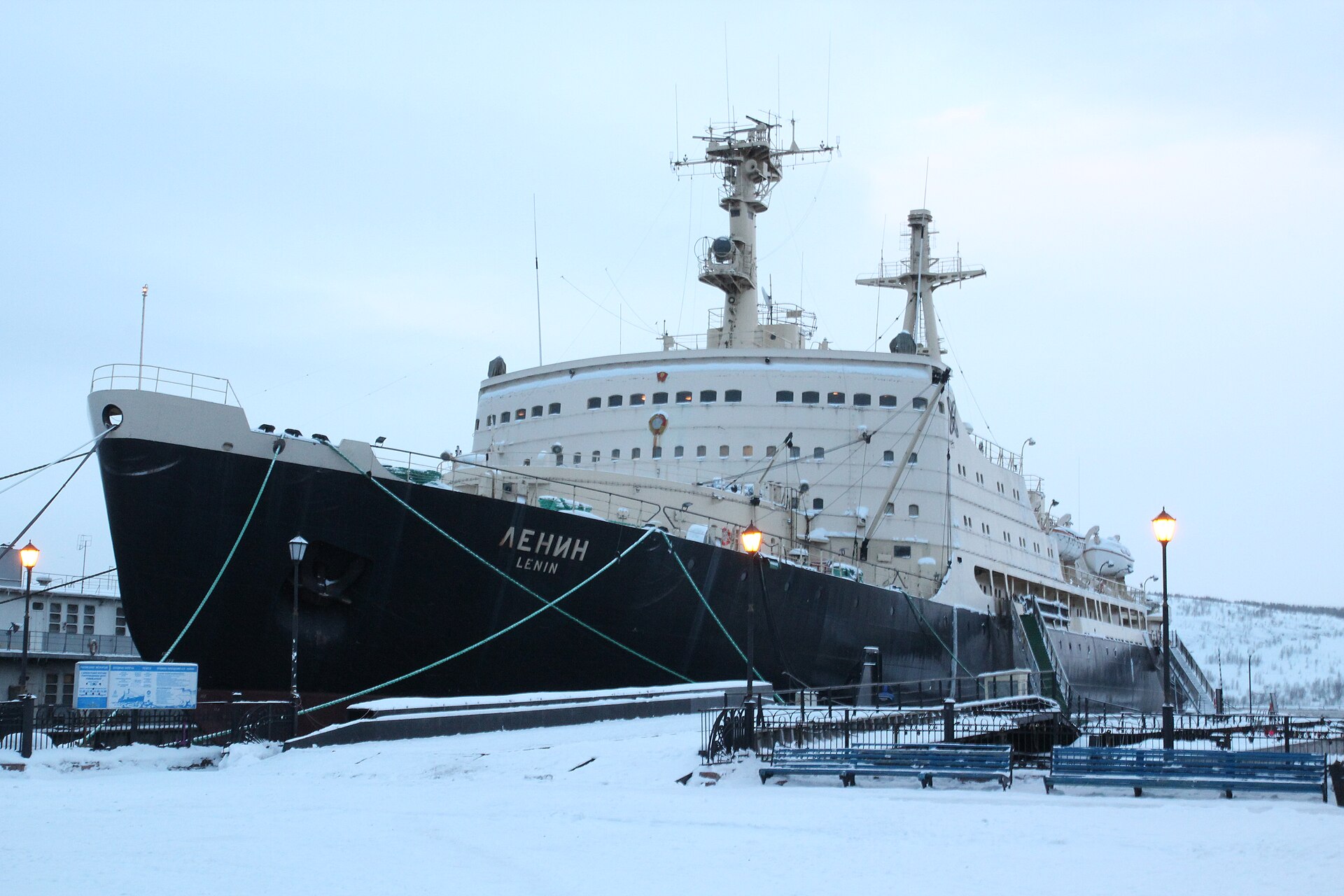
The Lenin was the world's first nuclear-powered surface ship and the first nuclear-powered civilian vessel. Launched in 1957 by the Soviet Union, it was designed to clear sea routes for cargo ships along the Northern Sea Route, utilizing its immense power to navigate through thick Arctic ice that would be impassable for conventional vessels.
After thirty years of service, the vessel was decommissioned in 1989 following the removal of its nuclear reactors. It was subsequently converted into a museum ship permanently moored in Murmansk, serving as a testament to Soviet maritime engineering and the history of nuclear propulsion in the Arctic.
Key Facts
- Materials
- Steel, Nuclear reactor components
- Civilization
- Soviet Union
- Accessibility
- Guided tours only, involves steep stairs and narrow passages
- Date(s)
- 1956-1959
- Condition
- Museum ship, well-preserved
- Original Function
- Nuclear-powered icebreaker
- Key Figures
- Igor Kurchatov, Anatoly Alexandrov
Design and Launch
1956-1959The Lenin was constructed at the Admiralty Shipyard in Leningrad. It represented a major technological milestone for the Soviet Union, demonstrating the feasibility of nuclear power for civilian maritime applications.
Operational Service
1959-1989During its three decades of operation, the ship played a critical role in extending the navigation season in the Arctic. It underwent significant repairs and reactor upgrades in the 1970s following technical incidents.
Conversion to Museum
1989-PresentFollowing its decommissioning, the ship was saved from scrapping and relocated to Murmansk. It now functions as an educational center and museum, showcasing the history of the Northern Sea Route.
Cultural Significance
The Lenin is a symbol of Soviet technological ambition and the 'Atomic Age' optimism of the mid-20th century. It remains a focal point of maritime heritage in Murmansk, representing the strategic importance of the Arctic to the Russian state.
Interpretive Notes
Scholarly debates and areas of uncertainty
Debates persist regarding the environmental legacy of the ship's early nuclear operations and the long-term safety protocols maintained during its transition from an active vessel to a public museum.
Visiting Information
Entry Rules
Access is strictly via guided tour. Tickets must be purchased in advance. Passport or valid identification is required for entry.
Best Times to Visit
Summer months (June-August) offer the most comfortable weather for visiting the Murmansk port area.
Photography
Personal photography is permitted in most areas of the museum, though specific technical areas may be restricted.
Preservation Notes
The vessel is maintained as a historic monument. Visitors must follow the guide's instructions at all times and remain within designated tour areas.
Nearby POIs
1 shownSources & Further Reading
- [1]The First Nuclear-Powered Icebreaker: Lenin — Valery Blinov. Maritime Heritage Journal (2015)
- [2]Soviet Nuclear Propulsion: A History — Pavel Podvig. Russian Atomic Energy Archive (2019)
Key Facts
- Materials
- Steel, Nuclear reactor components
- Civilization
- Soviet Union
- Accessibility
- Guided tours only, involves steep stairs and narrow passages
- Date(s)
- 1956-1959
- Condition
- Museum ship, well-preserved
- Original Function
- Nuclear-powered icebreaker
- Key Figures
- Igor Kurchatov, Anatoly Alexandrov