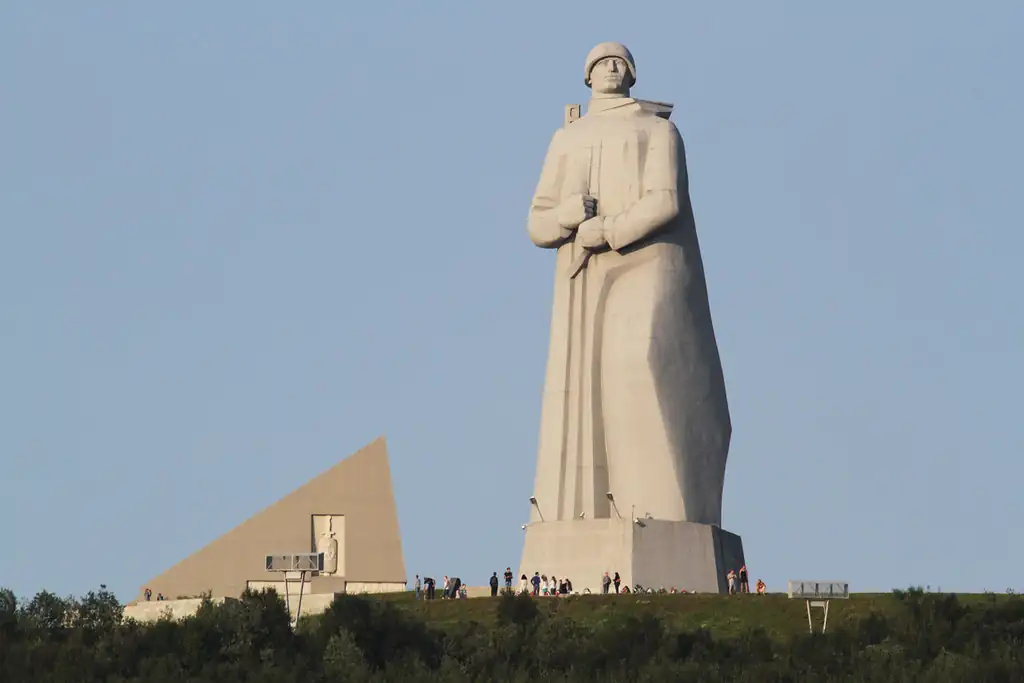
The Alyosha Monument, officially known as the Monument to the Defenders of the Soviet Arctic during the Great Patriotic War, is a massive memorial located in Murmansk, Russia. Standing at a total height of 42.5 meters, it features a 35.5-meter tall statue of a soldier wearing a cloak, overlooking the Kola Bay. It is one of the tallest statues in Russia and serves as a prominent landmark dedicated to the soldiers, sailors, and airmen who defended the Arctic region during World War II.
The monument was inaugurated on October 19, 1974, to commemorate the 30th anniversary of the defeat of Nazi forces in the Arctic. The site includes an eternal flame, a granite pyramid representing a half-mast flag, and a memorial wall. It remains a focal point for commemorative events, particularly on Victory Day, and is deeply integrated into the city's landscape and collective memory.
Key Facts
- Materials
- Reinforced concrete, Granite
- Civilization
- Soviet
- Accessibility
- Accessible via stairs and paved paths
- Date(s)
- 1969-1974
- Condition
- Well-maintained
- Original Function
- War memorial
- Key Figures
- I. D. Brodsky, I. A. Pokrovsky, R. A. Kiselev
Conception and Design
1960sThe initiative to build a monument in Murmansk began in the 1960s to honor the defenders of the Arctic. Architect I. A. Pokrovsky and sculptor I. D. Brodsky were selected to lead the design, aiming to create a figure that embodied the stoicism of the Soviet soldier.
Construction
1969-1974Construction took five years to complete. The statue was erected on a hill overlooking the city and the port, requiring significant engineering to ensure stability against the harsh Arctic winds and climate of the Kola Peninsula.
Inauguration
1974The monument was officially unveiled on October 19, 1974. The ceremony was attended by veterans, local officials, and citizens, marking the 30th anniversary of the liberation of the Soviet Arctic from German forces.
Modern Significance
21st CenturyToday, the monument is a protected cultural heritage site of regional importance. It continues to undergo periodic maintenance to preserve the concrete structure and the surrounding memorial complex.
Cultural Significance
The Alyosha Monument is a symbol of Murmansk and the resilience of the Soviet people during the Arctic campaign of World War II. It represents the strategic importance of the Murmansk port, which served as a vital gateway for Allied convoys. The statue's gaze toward the west, where the fiercest battles took place, reinforces its role as a silent guardian of the city.
For the local population, the monument is a primary site for remembrance. It is a tradition for newlyweds to visit the site, and it serves as the central location for annual Victory Day celebrations, reflecting the enduring impact of the war on regional identity.
Interpretive Notes
Scholarly debates and areas of uncertainty
There is limited scholarly debate regarding the monument itself, though historians often discuss the broader historiography of the 'Great Patriotic War' in the Arctic and the extent to which the monument reflects official Soviet state narratives versus the lived experiences of the soldiers who fought in the harsh conditions of the northern front.
Visiting Information
Entry Rules
Open to the public 24 hours a day. No entry fee. Visitors are expected to maintain a respectful demeanor as it is a memorial site.
Best Times to Visit
Summer months for clear views of the Kola Bay. Winter visits are possible but require caution due to extreme cold and icy conditions on the hill.
Photography
Personal photography is permitted. Commercial photography or large-scale filming may require local municipal authorization.
Preservation Notes
The site is maintained by the city of Murmansk. Visitors should stay on designated paths and refrain from climbing on the memorial structures.
Nearby POIs
1 shownSources & Further Reading
- [1]The Great Patriotic War in the Arctic — Dmitry Khazanov. Russian Historical Society (2015)
- [2]Monuments of the Kola Peninsula — V. P. Petrov. Murmansk Book Publishing (1988)
Key Facts
- Materials
- Reinforced concrete, Granite
- Civilization
- Soviet
- Accessibility
- Accessible via stairs and paved paths
- Date(s)
- 1969-1974
- Condition
- Well-maintained
- Original Function
- War memorial
- Key Figures
- I. D. Brodsky, I. A. Pokrovsky, R. A. Kiselev