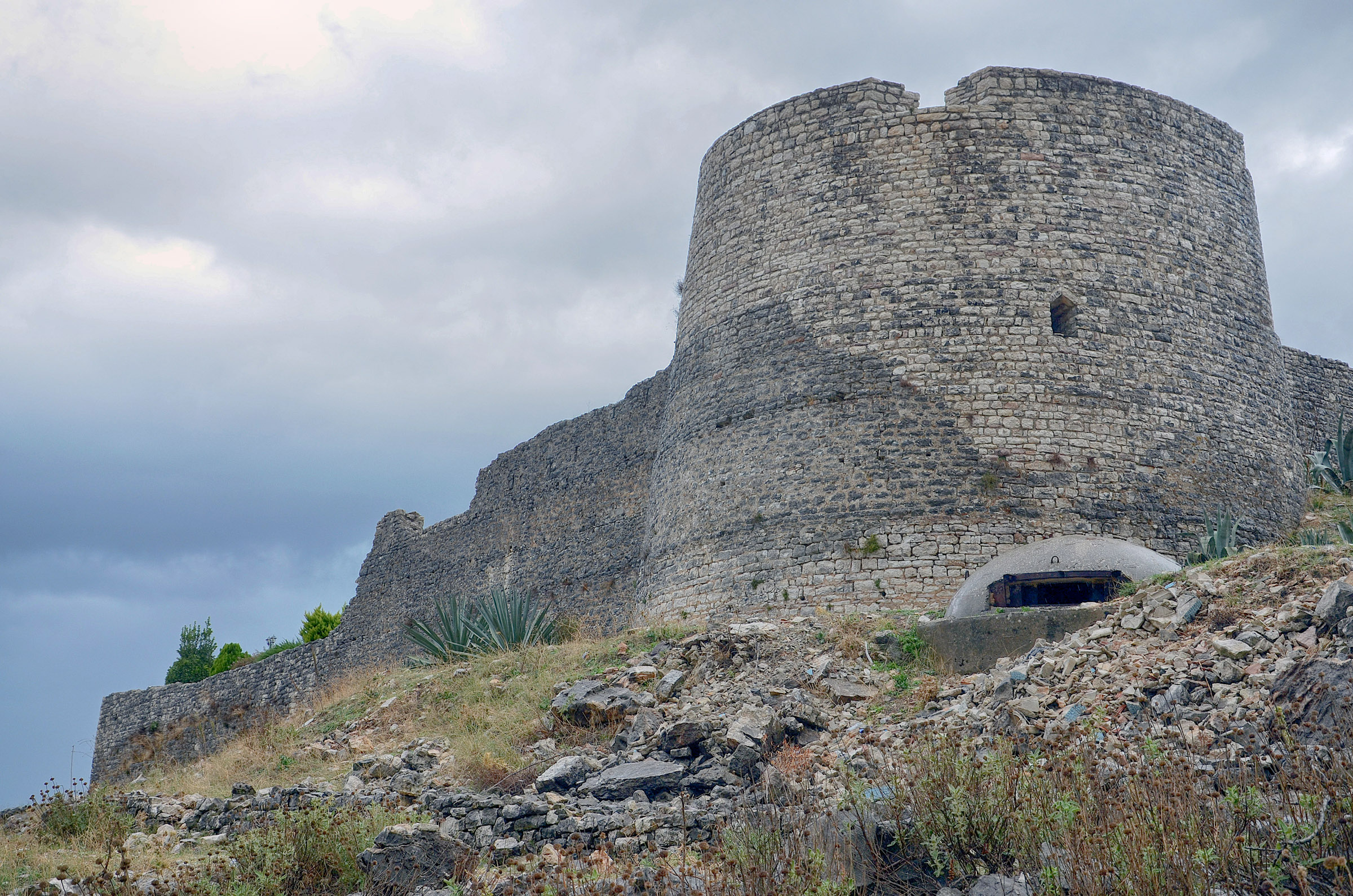
Lëkurësi Castle is a 16th-century fortification situated on a strategic hilltop overlooking the city of Saranda and the Ionian Sea. It was commissioned in 1537 by Sultan Suleiman the Magnificent to control the passage between the port of Saranda and the Butrint region, serving as a critical military outpost during the Ottoman campaigns against Corfu.
The structure features a square plan with two round towers at its corners. While much of the original fortification has fallen into ruin, the site remains a significant landmark due to its commanding position and the panoramic views it provides of the Albanian Riviera and the Greek island of Corfu.
Key Facts
- Materials
- Stone, Mortar
- Civilization
- Ottoman
- Accessibility
- Accessible by road; steep terrain
- Date(s)
- 1537
- Condition
- Partially ruined, partially restored for commercial use
- Original Function
- Military fortress
- Key Figures
- Suleiman the Magnificent
Strategic Foundation
1537The castle was built by Sultan Suleiman the Magnificent during his campaign against the Venetian-held island of Corfu. Its location was chosen to provide a clear vantage point over the Ionian coast and to secure the supply lines for the Ottoman forces.
Military Utility
16th-18th centuryFor several centuries, the fortress served as a garrison for Ottoman troops. It played a vital role in regional defense and the administration of the surrounding coastal territories, though its importance waned as the Ottoman military focus shifted.
Modern Era
20th century - presentFollowing years of neglect, the site was partially restored in the late 20th century. Today, it functions primarily as a tourist destination, with a restaurant operating within the castle walls, while the remaining ruins are preserved as a historical site.
Cultural Significance
Lëkurësi Castle serves as a physical reminder of the Ottoman Empire's influence on the Ionian coast. It is a central point of interest for the city of Saranda, representing the historical intersection of maritime trade and military defense in the region.
Locally, the site is valued for its contribution to the tourism economy and its role as a landmark that defines the skyline above the modern city, bridging the gap between the area's medieval history and its current status as a coastal resort hub.
Interpretive Notes
Scholarly debates and areas of uncertainty
There is limited academic debate regarding the site, though some architectural historians discuss the extent to which the modern commercial restoration has obscured original Ottoman construction techniques and structural integrity.
Visiting Information
Entry Rules
The site is open to the public. There is no entry fee to walk around the exterior ruins, though the area is occupied by a private restaurant.
Best Times to Visit
Sunset is the most popular time to visit for the panoramic views of the Ionian Sea and the city lights of Saranda.
Photography
None; personal photography is permitted throughout the site.
Preservation Notes
Visitors are advised to exercise caution around the ruins, as some walls are unstable. Please remain on designated paths and do not climb on the historical masonry.
Nearby POIs
4 shownSources & Further Reading
- [1]The Ottoman Empire and the Balkans — Fikret Adanir. Cambridge University Press (2006)
- [2]Albania: A Guide to the Country — Gillian Gloyer. Bradt Travel Guides (2018)
Key Facts
- Materials
- Stone, Mortar
- Civilization
- Ottoman
- Accessibility
- Accessible by road; steep terrain
- Date(s)
- 1537
- Condition
- Partially ruined, partially restored for commercial use
- Original Function
- Military fortress
- Key Figures
- Suleiman the Magnificent