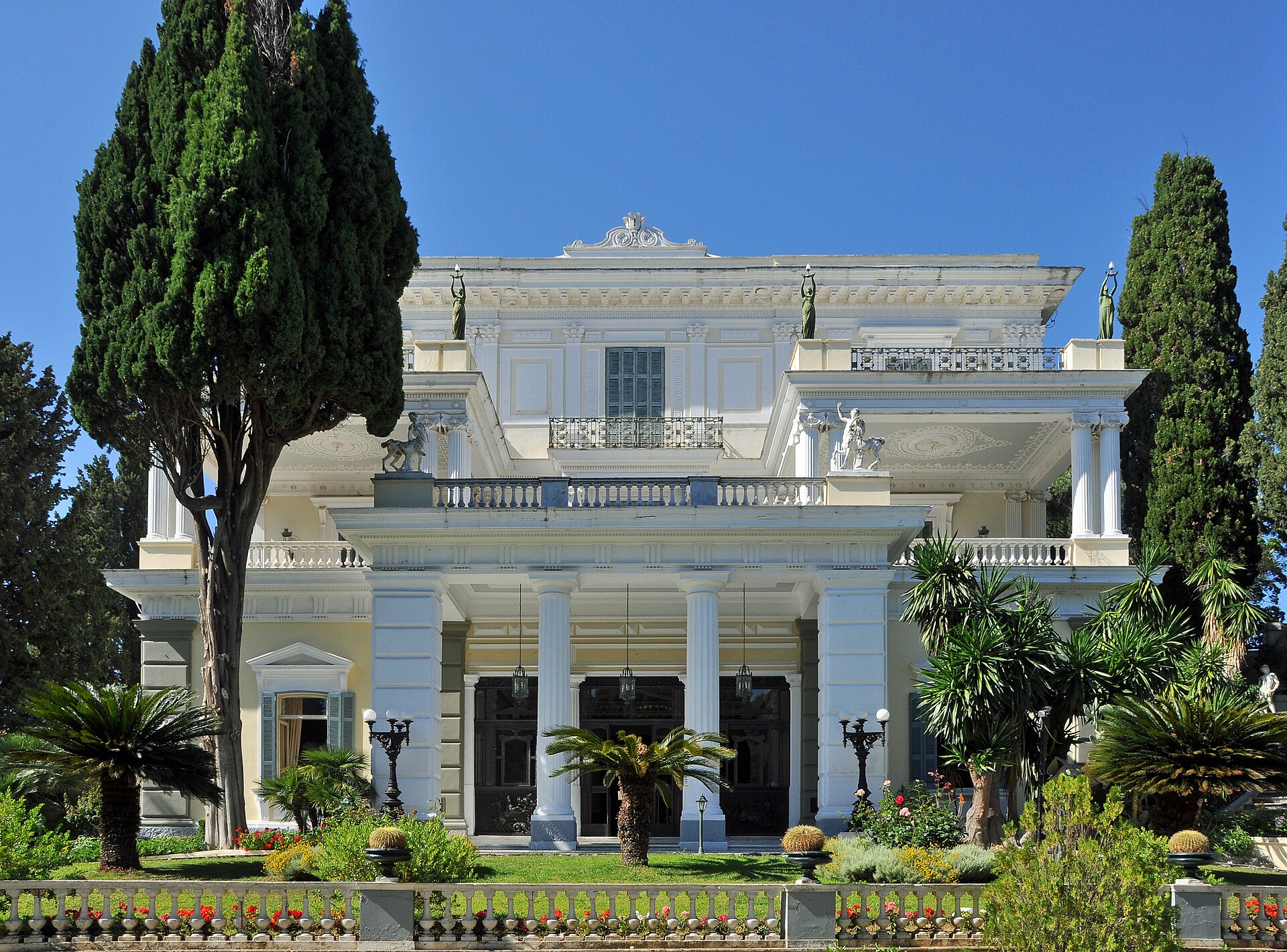
The Achilleion is a palace located in Gastouri on the island of Corfu, commissioned by Empress Elisabeth of Austria in 1890. Designed by Italian architect Raffaele Carito, the structure was built as a summer retreat for the Empress, who sought a refuge from the rigid protocols of the Viennese court. The palace is dedicated to the mythical hero Achilles, reflecting Elisabeth's deep fascination with Greek mythology and the Homeric epics.
The architecture is heavily influenced by the Pompeian style, featuring extensive use of marble, ornate colonnades, and terraced gardens overlooking the Ionian Sea. Following the Empress's death, the palace was purchased by Kaiser Wilhelm II of Germany in 1907, who utilized it as a diplomatic base. Today, the site serves as a museum, preserving the original furnishings, art, and the iconic statue of 'Dying Achilles' that defines its central courtyard.
Key Facts
- Materials
- Marble, Stone, Bronze
- Civilization
- Austro-Hungarian
- Accessibility
- Partially accessible; some steep garden paths and stairs
- Date(s)
- 1890-1891
- Condition
- Well-preserved museum
- Original Function
- Summer palace and private retreat
- Key Figures
- Empress Elisabeth of Austria, Kaiser Wilhelm II
Commission and Construction
1890-1891Empress Elisabeth, grieving the loss of her son Crown Prince Rudolf, sought solace in Corfu. She commissioned the palace to be built on the site of a former villa owned by the diplomat Petros Vrailas Armenis, naming it after her favorite hero, Achilles.
The Imperial Era
1891-1898The palace became a sanctuary for the Empress, who spent significant time here studying Greek language and philosophy. The gardens were adorned with numerous statues of mythological figures, most notably the 'Dying Achilles' by Ernst Herter.
Kaiser Wilhelm II Ownership
1907-1914After the Empress's assassination, the palace remained vacant until it was purchased by Kaiser Wilhelm II. He used the estate for diplomatic meetings and added his own aesthetic touches, including the removal of some of Elisabeth's statues and the addition of his own.
World Wars and Public Use
1914-1960sDuring the World Wars, the palace was used as a military hospital and headquarters. It suffered from looting and neglect during these periods before being restored and converted into a museum and casino in the mid-20th century.
Cultural Significance
The Achilleion stands as a physical manifestation of the 19th-century European fascination with Hellenism. It represents the intersection of imperial power and personal escapism, serving as a unique architectural landmark that blends neoclassical design with the romanticized ideals of the Victorian era.
Interpretive Notes
Scholarly debates and areas of uncertainty
Debate persists regarding the extent to which Kaiser Wilhelm II's modifications compromised the original architectural vision of Empress Elisabeth. Some historians argue his changes were purely political, while others suggest they were a continuation of the palace's role as a site of European aristocratic cultural exchange.
Visiting Information
Entry Rules
Open daily. Tickets are required for entry. Visitors are expected to dress respectfully as the site is a significant cultural monument. Audio guides are available at the entrance.
Best Times to Visit
Early morning or late afternoon to avoid the heat and the peak arrival times of cruise ship excursions.
Photography
Personal photography is permitted in the gardens and most interior rooms. Flash photography is prohibited inside the museum to protect the artifacts.
Preservation Notes
The palace is currently undergoing periodic maintenance to preserve the delicate marble statues and original interior frescoes. Visitors are requested to remain on marked paths and refrain from touching the exhibits.
Nearby POIs
2 shownSources & Further Reading
- [1]The Achilleion: A Palace for the Empress — Brigitte Hamann. Austrian National Archives (1998)
- [2]Corfu: History and Architecture — Nikos V. Tomadakis. Ionian University Press (2012)
Key Facts
- Materials
- Marble, Stone, Bronze
- Civilization
- Austro-Hungarian
- Accessibility
- Partially accessible; some steep garden paths and stairs
- Date(s)
- 1890-1891
- Condition
- Well-preserved museum
- Original Function
- Summer palace and private retreat
- Key Figures
- Empress Elisabeth of Austria, Kaiser Wilhelm II