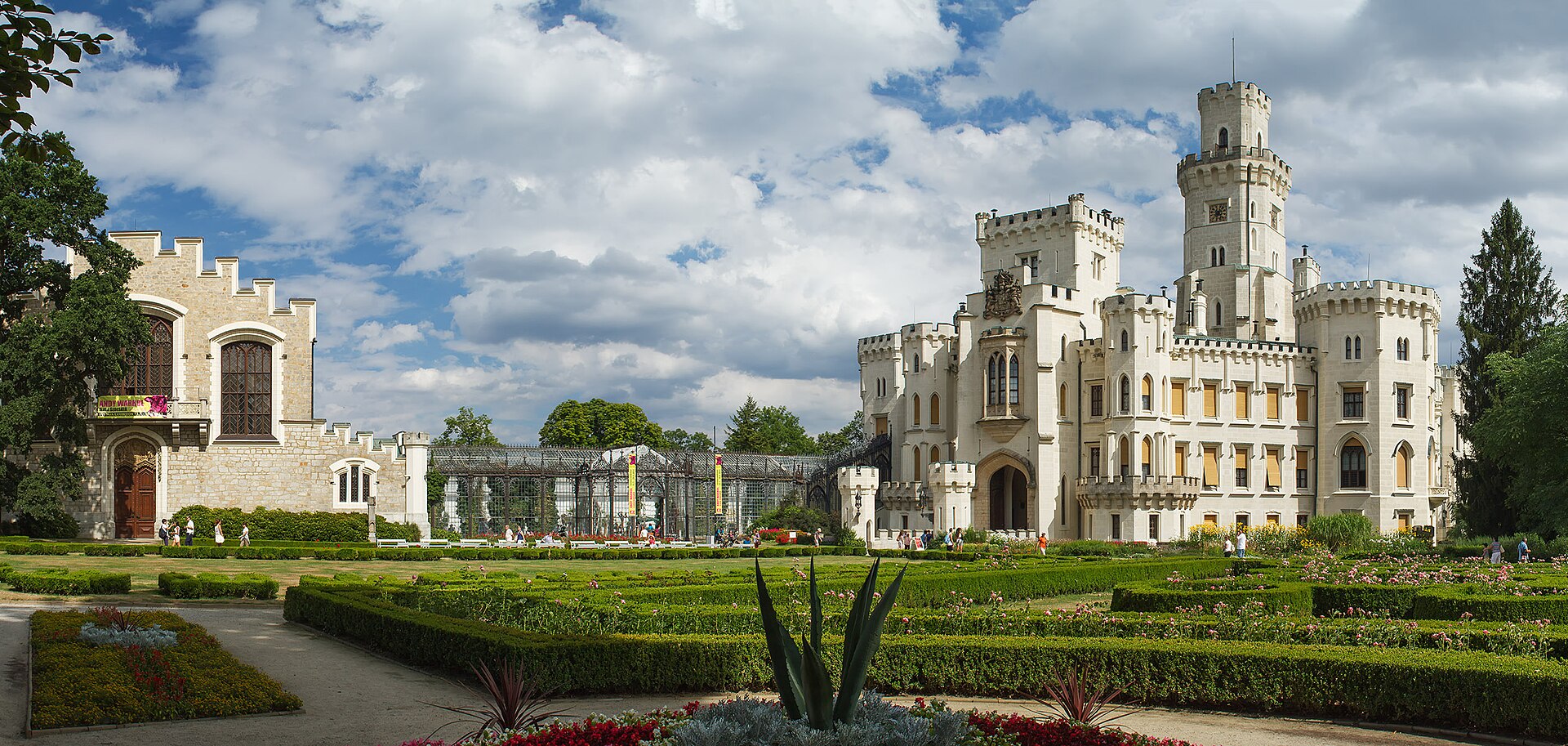
Hluboká Castle is a historic château located in the South Bohemian region of the Czech Republic. Originally founded in the 13th century as a royal castle, it underwent several architectural transformations over the centuries. The current appearance of the castle is primarily the result of a major 19th-century reconstruction commissioned by the House of Schwarzenberg, which modeled the structure after Windsor Castle in England.
The castle is celebrated for its elaborate Romantic-style architecture, featuring white facades, intricate stone carvings, and extensive crenelated towers. It houses a significant collection of historical furniture, tapestries, porcelain, and weaponry, and is surrounded by a vast English-style park that spans several hectares.
Key Facts
- Materials
- Stone, Brick, Wood
- Civilization
- Bohemian
- Accessibility
- Grounds are accessible; interior tours involve stairs
- Date(s)
- 13th century (original), 1840-1871 (current form)
- Condition
- Well-preserved, museum and cultural site
- Original Function
- Royal fortress
- Key Figures
- House of Schwarzenberg, Franz Beer
Foundations and Early History
13th centuryThe castle was established in the mid-13th century by King Ottokar II of Bohemia as a strategic royal fortress. It served as a key administrative and defensive point in the region.
Renaissance and Baroque Transformations
16th-18th centuryFollowing its acquisition by various noble families, the castle was rebuilt in the Renaissance style in the 16th century. Later, in the 18th century, Adam Franz von Schwarzenberg commissioned a Baroque renovation to modernize the residence.
Romantic Reconstruction
1840-1871Under the direction of Prince Johann Adolf II of Schwarzenberg and his wife Princess Eleonore, the castle was completely transformed into its current Neo-Gothic appearance. Architect Franz Beer led the project, drawing heavy inspiration from the English Windsor Castle.
Modern Era
20th century - presentThe castle was confiscated by the state in 1947 following the post-war nationalization of aristocratic properties. It has since been maintained as a public museum and a prominent cultural landmark.
Cultural Significance
Hluboká Castle serves as a primary example of 19th-century Romantic historicism in Central Europe. It represents the wealth and influence of the Schwarzenberg family, who were among the most powerful noble houses in the Habsburg Empire. Today, it is a symbol of South Bohemian heritage and a major destination for architectural tourism.
Interpretive Notes
Scholarly debates and areas of uncertainty
Discussions among architectural historians often focus on the extent to which the 19th-century reconstruction erased the original medieval and Baroque structural integrity, and whether the 'Windsor-style' aesthetic was an authentic expression of local identity or an imported trend of the era.
Visiting Information
Entry Rules
Open to the public for guided tours. Tickets are required for interior access. The castle grounds are accessible throughout the year, while interior tours operate on a seasonal schedule.
Best Times to Visit
Late spring and early autumn offer the best weather for exploring the extensive castle gardens. Summer months are peak tourist season, so visiting on weekdays is recommended to avoid crowds.
Photography
Photography is generally permitted in the gardens. Interior photography is restricted or prohibited during guided tours to protect the art collections.
Preservation Notes
Visitors are required to follow marked paths in the gardens and refrain from touching historical artifacts or furniture within the castle interiors.
Nearby POIs
2 shownSources & Further Reading
- [1]Hluboká nad Vltavou: The Castle — National Heritage Institute. Czech Republic Ministry of Culture (2021)View
- [2]Castles and Chateaux of Bohemia — Jaroslav Kadlec. Prague Publishing (2015)
Key Facts
- Materials
- Stone, Brick, Wood
- Civilization
- Bohemian
- Accessibility
- Grounds are accessible; interior tours involve stairs
- Date(s)
- 13th century (original), 1840-1871 (current form)
- Condition
- Well-preserved, museum and cultural site
- Original Function
- Royal fortress
- Key Figures
- House of Schwarzenberg, Franz Beer