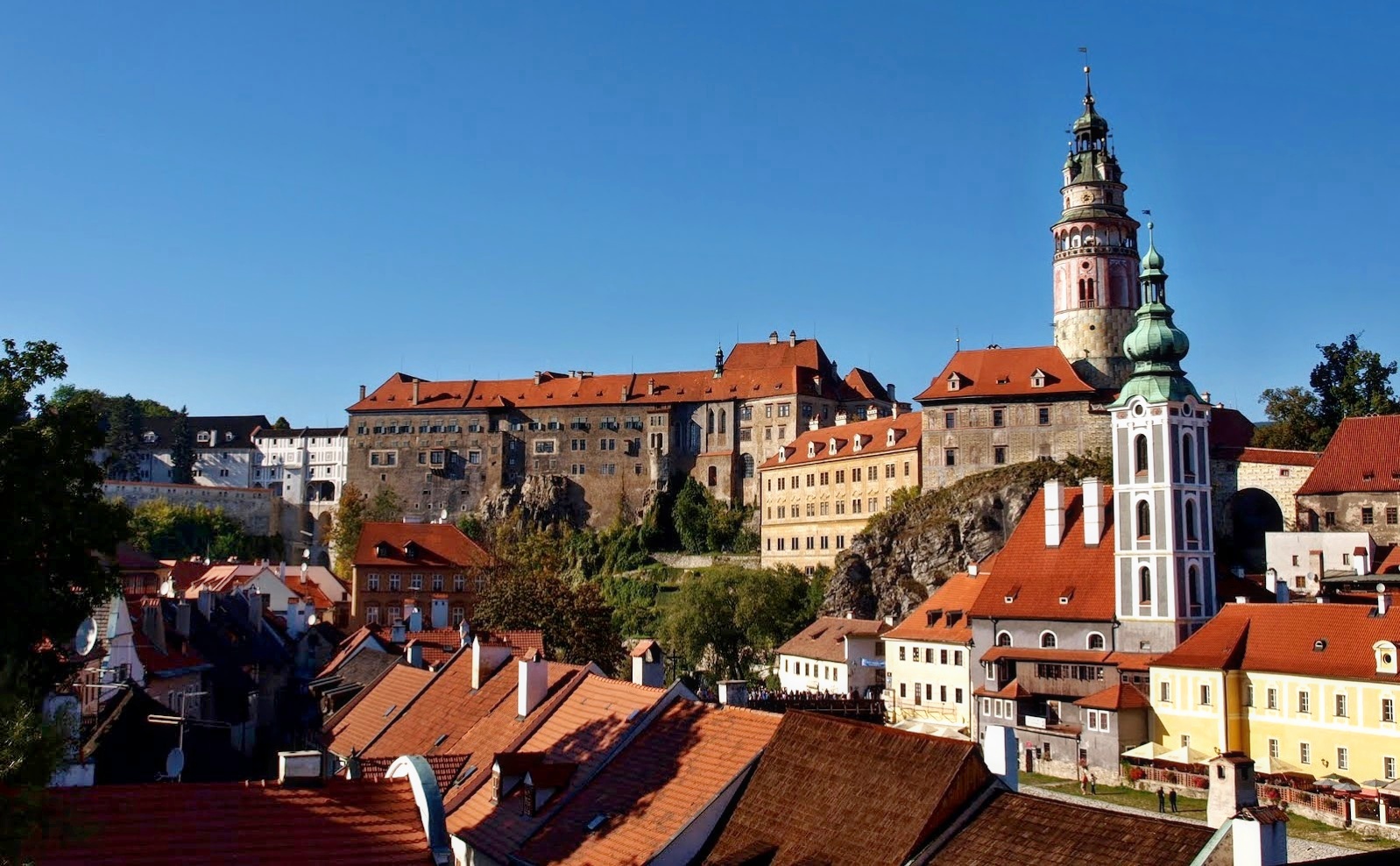
Český Krumlov Castle is a sprawling complex located in the South Bohemian region of the Czech Republic. Originally established in the 13th century, the site evolved over several hundred years to incorporate Gothic, Renaissance, and Baroque architectural styles. It comprises 40 distinct buildings and palaces, five courtyards, and extensive gardens, all situated on a rocky promontory overlooking the Vltava River.
The castle is particularly noted for its well-preserved Baroque theater, one of only a few remaining in the world with its original stage machinery, scenery, and costumes intact. As a central landmark of the town, the complex serves as a primary example of Central European aristocratic residential architecture from the Middle Ages through the 19th century.
Key Facts
- Materials
- Stone, Brick, Timber
- Civilization
- Bohemian
- Accessibility
- Partial; some areas involve steep inclines and cobblestones
- Date(s)
- 1240 CE - 19th century
- Condition
- Well-preserved, museum and cultural site
- Original Function
- Fortified residence
- Key Figures
- House of Rosenberg, House of Eggenberg, House of Schwarzenberg
Foundations and the House of Rosenberg
13th - 16th centuryThe castle was founded around 1240 by the Vítkovci family. It later became the seat of the powerful House of Rosenberg, who transformed the original Gothic fortress into a grand Renaissance residence during the 16th century.
Baroque Expansion
17th - 18th centuryFollowing the acquisition by the Eggenberg and later the Schwarzenberg families, the castle underwent significant Baroque renovations. This period saw the construction of the famous Baroque theater and the expansion of the castle gardens.
Modern Era and Preservation
20th century - presentThe castle was nationalized in the mid-20th century. Extensive restoration efforts have since focused on preserving the unique theater technology and the structural integrity of the vast complex, which was designated a UNESCO World Heritage site in 1992.
Cultural Significance
The castle is the defining cultural symbol of South Bohemia and represents the historical power of the Bohemian nobility. Its preservation provides a rare window into the daily life and artistic patronage of the European aristocracy over seven centuries.
The Baroque theater is of immense international importance, serving as a primary source for historians studying 18th-century stagecraft and performance culture.
Interpretive Notes
Scholarly debates and areas of uncertainty
Debates exist regarding the extent of the original 13th-century Gothic footprint, as subsequent Renaissance and Baroque layers significantly obscured the initial fortifications. Additionally, there is ongoing scholarly discussion regarding the optimal balance between tourism management and the preservation of the fragile 18th-century stage machinery in the Baroque theater.
Visiting Information
Entry Rules
The castle grounds are generally open to the public. Access to specific interiors, the tower, and the Baroque theater requires a purchased ticket. Guided tours are mandatory for certain sections of the palace.
Best Times to Visit
Late spring and early autumn offer the best balance of manageable crowds and pleasant weather for exploring the extensive courtyards and gardens.
Photography
Photography is generally permitted in the courtyards and gardens. Interior photography is strictly prohibited in most exhibition rooms to protect historical artifacts.
Preservation Notes
The site is highly sensitive to foot traffic. Visitors are required to stay on marked paths and refrain from touching wall paintings or historical furniture. The Baroque theater is subject to strict environmental controls and is only accessible via specialized tours.
Nearby POIs
2 shownSources & Further Reading
- [1]Český Krumlov: A History of the Castle — Pavel Slavko. National Heritage Institute (2015)
- [2]The Baroque Theater of Český Krumlov — Jiří Bláha. State Castle and Chateau Český Krumlov (2018)
Key Facts
- Materials
- Stone, Brick, Timber
- Civilization
- Bohemian
- Accessibility
- Partial; some areas involve steep inclines and cobblestones
- Date(s)
- 1240 CE - 19th century
- Condition
- Well-preserved, museum and cultural site
- Original Function
- Fortified residence
- Key Figures
- House of Rosenberg, House of Eggenberg, House of Schwarzenberg