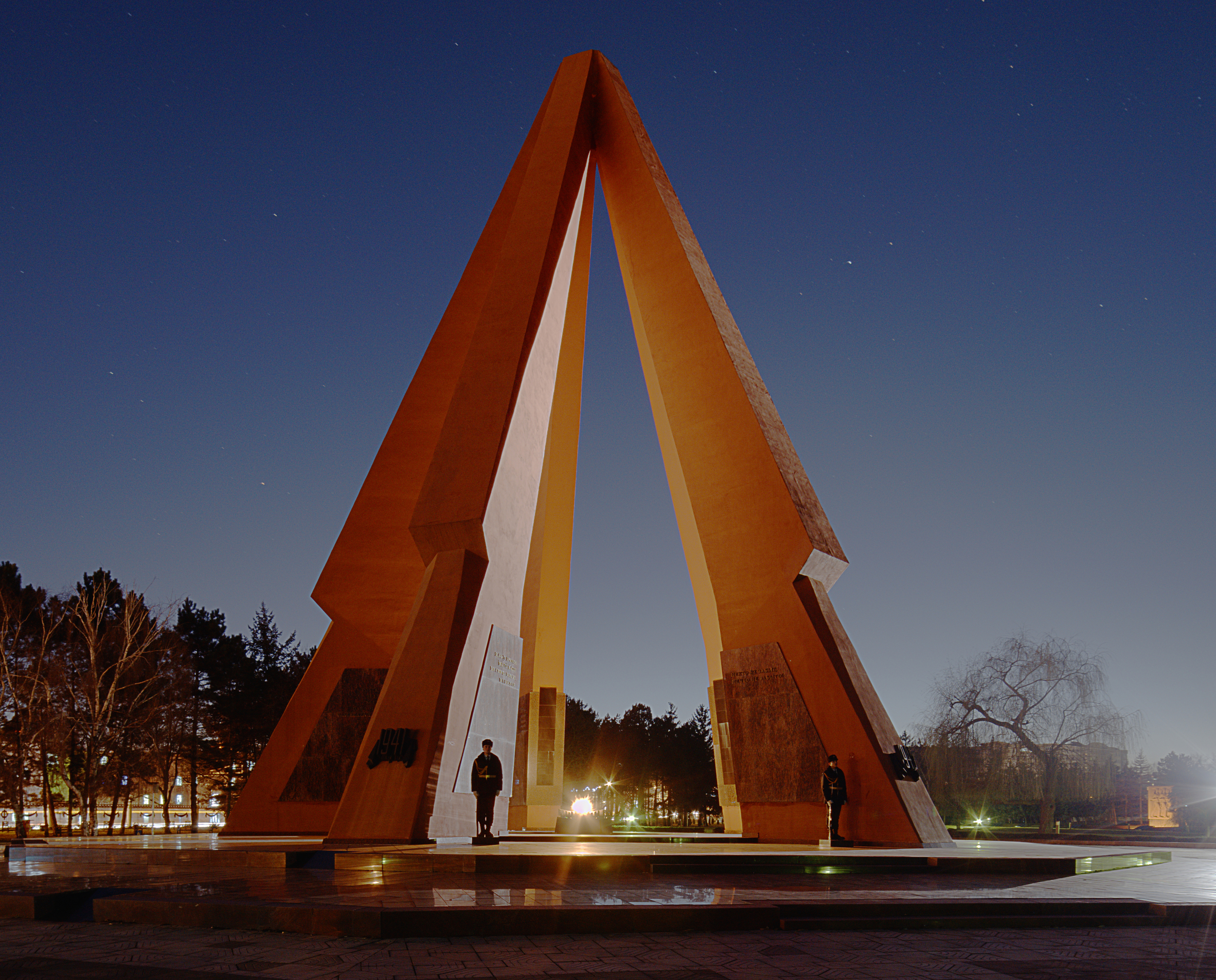
The Eternity Memorial Complex is a prominent monument located in Chișinău, Moldova, dedicated to the Soviet soldiers who perished during the Second World War and the subsequent liberation of the city. The site is anchored by a 25-meter-high stone pyramid composed of five stylized rifles, which converge at the top to protect an eternal flame burning at its center.
Surrounding the central pyramid are granite slabs inscribed with the names of fallen soldiers, arranged in a formal, solemn layout. The complex serves as a significant site for state ceremonies and public commemorations, reflecting the complex historical memory of the region regarding the Soviet era and the impact of the war on the Moldovan population.
Key Facts
- Materials
- Stone, Granite, Bronze
- Civilization
- Soviet
- Accessibility
- Ground level, paved pathways
- Date(s)
- 1975
- Condition
- Well-maintained, active memorial site
- Original Function
- War memorial
- Key Figures
- A. Maiko, A. Gorbunov, A. Ovseannikov
Inauguration
1975The memorial was inaugurated on May 9, 1975, to mark the 30th anniversary of the victory over Nazi Germany. It was designed by architects A. Maiko and A. Gorbunov, and sculptor A. Ovseannikov.
Post-Independence Status
1991-2006Following Moldova's independence in 1991, the site underwent periods of neglect and debate regarding its ideological significance. It remained a focal point for veterans' organizations and commemorative events.
Renovation
2006In 2006, the complex underwent a significant restoration process. The site was officially reopened with updated landscaping and structural repairs to the central pyramid and the surrounding granite plaques.
Cultural Significance
The complex serves as the primary site for official state commemorations of Victory Day in Moldova. It represents a tangible link to the Soviet past, functioning as a space where the national narrative of the Second World War is performed and maintained through annual wreath-laying ceremonies by government officials and veterans.
Interpretive Notes
Scholarly debates and areas of uncertainty
There is ongoing academic and public discourse regarding the memorial's role in the context of Moldova's post-Soviet identity. Debates often center on whether the monument should be viewed strictly as a tribute to the fallen or as a symbol of Soviet occupation, reflecting the broader tensions in Moldovan historiography.
Visiting Information
Entry Rules
Open to the public 24 hours a day. No entry fee. Visitors are expected to maintain a respectful demeanor as it is a site of mourning and commemoration.
Best Times to Visit
May 9th (Victory Day) for major commemorative events, though the site is crowded. Early mornings on weekdays offer the most quiet atmosphere for viewing the architecture.
Photography
Personal photography is permitted. Commercial photography or filming requires authorization from the municipal authorities.
Preservation Notes
The site is under municipal protection. Visitors are requested to stay on designated paths and refrain from climbing on the memorial structures.
Nearby POIs
11 shown- Military History Museum0.9 km
- Ciuflea Monastery1.1 km
- National Museum of Romanian Literature1.3 km
- Chisinau Water Tower1.4 km
- National History Museum of Moldova1.5 km
- Triumphal Arch1.7 km
- Stephen the Great Monument1.8 km
- National Museum of Ethnography and Natural History1.8 km
- Nativity Cathedral1.9 km
- National Museum of Fine Arts of Moldova2.2 km
- House-Museum of Alexander Pushkin2.5 km
Sources & Further Reading
- [1]The Politics of Memory in Post-Soviet Moldova — Igor Cașu. Journal of Soviet and Post-Soviet Politics and Society (2015)
- [2]Monuments of Chișinău: A Historical Guide — Vasile Malanețchi. National Museum of History of Moldova (2010)
Key Facts
- Materials
- Stone, Granite, Bronze
- Civilization
- Soviet
- Accessibility
- Ground level, paved pathways
- Date(s)
- 1975
- Condition
- Well-maintained, active memorial site
- Original Function
- War memorial
- Key Figures
- A. Maiko, A. Gorbunov, A. Ovseannikov
Nearby POIs
11 shown- Military History Museum0.9 km
- Ciuflea Monastery1.1 km
- National Museum of Romanian Literature1.3 km
- Chisinau Water Tower1.4 km
- National History Museum of Moldova1.5 km
- Triumphal Arch1.7 km
- Stephen the Great Monument1.8 km
- National Museum of Ethnography and Natural History1.8 km
- Nativity Cathedral1.9 km
- National Museum of Fine Arts of Moldova2.2 km
- House-Museum of Alexander Pushkin2.5 km