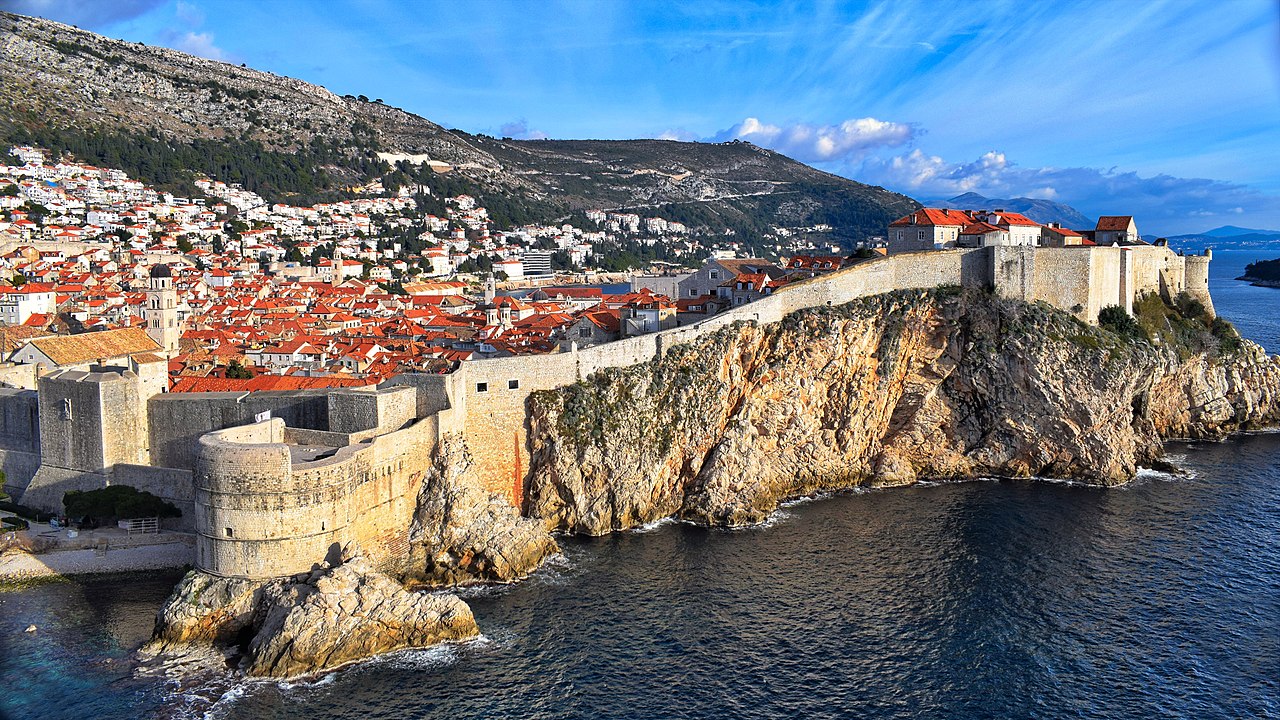
The Walls of Dubrovnik are a series of defensive stone fortifications that surround the historic Old Town of Dubrovnik in southern Croatia. Constructed primarily between the 13th and 17th centuries, the system consists of a main city wall, several forts, bastions, and towers designed to protect the maritime Republic of Ragusa from land and sea-based threats.
The walls reach a height of up to 25 meters and a thickness of up to 6 meters on the landward side, while the seaward walls are generally thinner. The complex includes major defensive structures such as the Minčeta Tower, Bokar Fortress, and the Lovrijenac Fortress, which stands on a separate cliff outside the main circuit. Today, the walls serve as one of the most significant examples of medieval fortification architecture in Europe.
Key Facts
- Materials
- Limestone, Stone
- Civilization
- Republic of Ragusa
- Accessibility
- Limited; involves steep stairs and uneven stone surfaces
- Date(s)
- 13th - 17th century
- Condition
- Well-preserved and maintained
- Original Function
- Defensive fortifications
- Key Figures
- Michelozzo di Bartolomeo, Juraj Dalmatinac
Early Foundations
9th - 12th centuryThe earliest fortifications were likely wooden palisades. Following the consolidation of the city, stone walls began to replace these structures to protect the growing trade hub from Byzantine and Venetian interests.
Expansion and Strengthening
13th - 15th centuryAs the Republic of Ragusa grew in power, the walls were significantly expanded. The threat of Ottoman expansion in the 15th century prompted the construction of advanced bastions and the reinforcement of the landward walls.
Renaissance Upgrades
16th centuryArchitects such as Michelozzo were hired to modernize the defenses against the threat of gunpowder artillery. This period saw the addition of casemates and the strengthening of the Minčeta Tower.
Modern Preservation
20th century - presentFollowing the 1979 earthquake and the 1991-1992 Siege of Dubrovnik, extensive restoration efforts were undertaken to repair damage and preserve the structural integrity of the walls for future generations.
Cultural Significance
The walls are the primary symbol of Dubrovnik's historical independence as the Republic of Ragusa. They represent the city's long-standing diplomatic and military efforts to maintain sovereignty amidst the competing interests of the Ottoman and Venetian empires.
In contemporary culture, the walls are central to the city's identity and tourism economy. They are frequently recognized globally as a landmark of medieval urban planning and have become a focal point for international heritage conservation efforts.
Interpretive Notes
Scholarly debates and areas of uncertainty
There is ongoing academic discussion regarding the extent to which the walls were influenced by Italian military architecture versus indigenous Ragusan engineering. While the input of Renaissance architects like Michelozzo is documented, the degree of local adaptation remains a subject of study.
Visiting Information
Entry Rules
Ticketed entry required. The walls are open daily, with hours varying by season. Visitors are advised to wear comfortable walking shoes due to the uneven terrain.
Best Times to Visit
Early morning or late afternoon to avoid peak heat and cruise ship crowds. The walls are particularly significant during the Dubrovnik Summer Festival in July and August.
Photography
Personal photography is permitted. Commercial photography or drone usage requires a permit from the Society of Friends of Dubrovnik Antiquities.
Preservation Notes
The walls are a protected monument. Do not climb on parapets, touch historical carvings, or leave litter. Restoration work is ongoing; some sections may be temporarily restricted.
Nearby POIs
11 shownSources & Further Reading
- [1]Dubrovnik: A History — Robin Harris. Saqi Books (2003)
- [2]The Walls of Dubrovnik: A Guide to the Fortifications — Society of Friends of Dubrovnik Antiquities. Dubrovnik Heritage Press (2015)
Key Facts
- Materials
- Limestone, Stone
- Civilization
- Republic of Ragusa
- Accessibility
- Limited; involves steep stairs and uneven stone surfaces
- Date(s)
- 13th - 17th century
- Condition
- Well-preserved and maintained
- Original Function
- Defensive fortifications
- Key Figures
- Michelozzo di Bartolomeo, Juraj Dalmatinac