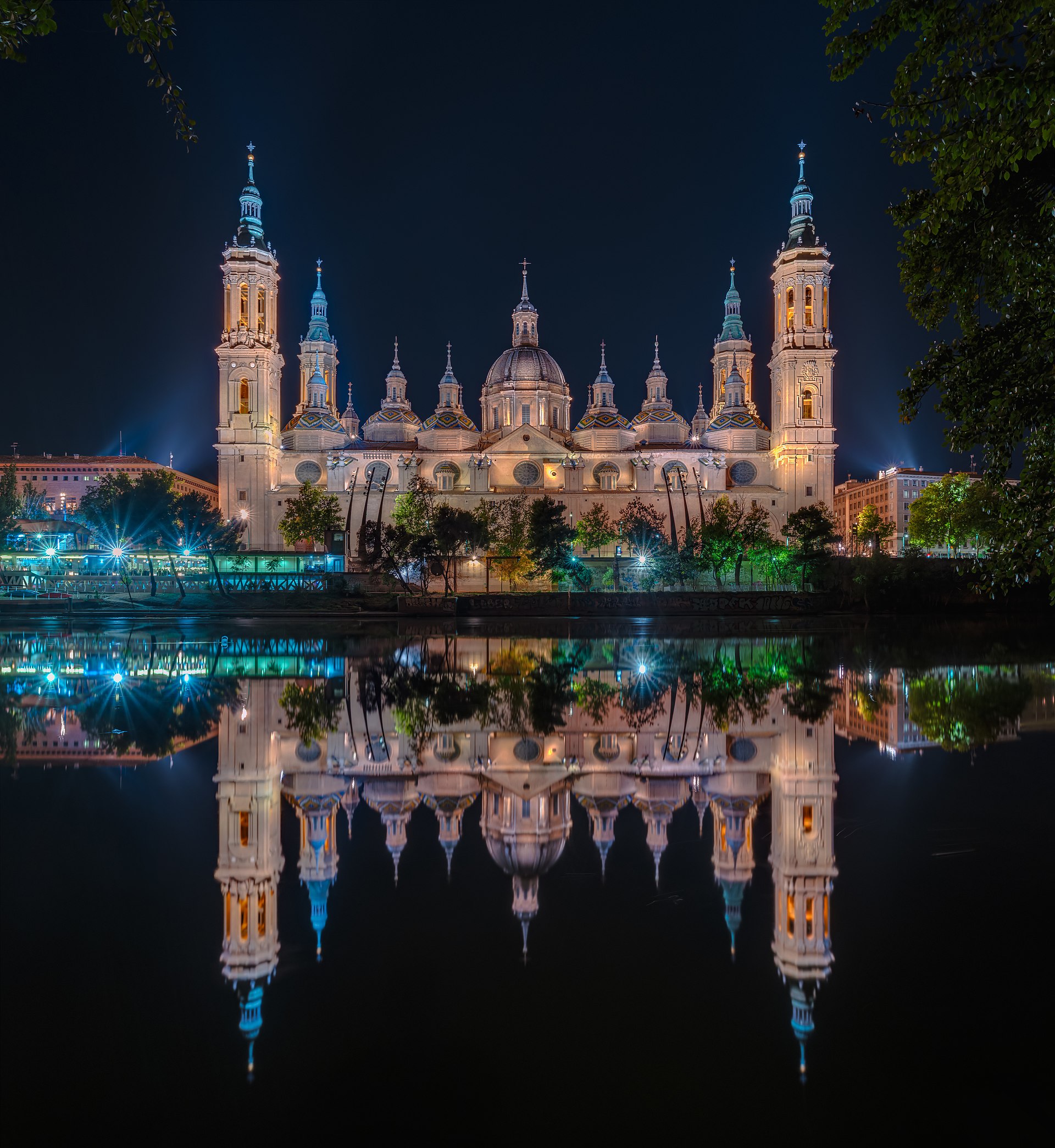
The Cathedral-Basilica of Our Lady of the Pillar is a monumental Roman Catholic church located in Zaragoza, Spain. It is widely considered the first church in history dedicated to the Virgin Mary, marking the site where, according to tradition, the Virgin appeared to the Apostle James the Greater in 40 CE, leaving behind a jasper pillar as a sign of her presence.
The current structure is a masterpiece of Baroque architecture, characterized by its eleven domes and four corner towers. Construction of the present basilica began in 1681 under the direction of Francisco de Herrera the Younger and continued through the 18th century, with significant contributions by Ventura Rodríguez, who designed the Santa Capilla, the ornate chapel housing the sacred pillar and the statue of the Virgin.
Key Facts
- Materials
- Brick, Stone, Marble, Jasper
- Civilization
- Spanish
- Accessibility
- Wheelchair accessible with designated entrances
- Date(s)
- 1681–1872
- Condition
- Active place of worship and major pilgrimage destination
- Original Function
- Pilgrimage site and cathedral
- Key Figures
- Apostle James the Greater, Francisco de Herrera the Younger, Ventura Rodríguez, Francisco Goya
Legendary Origins
1st Century CEAccording to local tradition, the Virgin Mary appeared to Saint James the Greater on the banks of the Ebro River in 40 CE. She reportedly instructed him to build a church in her honor and left a jasper pillar as a relic, which remains the focal point of the basilica today.
Medieval Predecessors
12th–17th CenturyFollowing the Reconquista of Zaragoza in 1118, a Romanesque church was built on the site. This was later replaced by a Gothic-Mudéjar structure, which served the city until the 17th century when the growing number of pilgrims necessitated a larger, more grand edifice.
Baroque Construction
1681–1754The current basilica was commissioned to accommodate the massive influx of pilgrims. The design focused on a grand rectangular plan with multiple domes. The project was a collaborative effort involving several prominent architects of the era, reflecting the transition from late Baroque to Neoclassical styles.
Modern Era and Restoration
19th Century–PresentThe final towers were completed in the 20th century, finalizing the iconic silhouette of the basilica. The site has undergone various restoration projects to preserve its intricate frescoes—some painted by a young Francisco Goya—and its structural integrity.
Cultural Significance
The Basilica is the spiritual heart of Zaragoza and a symbol of Hispanic identity. It is the site of the Fiestas del Pilar, one of Spain's most important religious and cultural festivals, which culminates in the 'Offering of Flowers' to the Virgin. The site serves as a bridge between ancient Christian tradition and modern Spanish national heritage.
Historically, the basilica has been a site of intense devotion for the Spanish monarchy and military. Its survival during the Spanish Civil War, when several bombs were dropped on the basilica but failed to detonate, is often cited by locals as a miraculous event, further cementing its status as a protected and sacred space.
Interpretive Notes
Scholarly debates and areas of uncertainty
The historical veracity of the apparition of the Virgin Mary to Saint James remains a subject of theological and historical debate. While the tradition is central to the identity of the Spanish Church, historians note the lack of contemporary documentation from the 1st century, suggesting the narrative evolved during the medieval period to bolster the legitimacy of the Iberian Church.
Visiting Information
Entry Rules
Open daily to the public. Entry to the main nave is free, though specific chapels or the museum may require a ticket. Modest dress is required; visitors are asked to maintain silence as it is an active place of worship.
Best Times to Visit
Early morning or late afternoon to avoid peak tourist crowds. The festival of El Pilar in mid-October is the most significant time to visit, though the site is extremely crowded during this period.
Photography
Photography is permitted in the main areas without flash. Photography is strictly prohibited inside the Santa Capilla and during religious services.
Preservation Notes
The basilica is a protected cultural heritage site. Visitors are requested not to touch the marble surfaces or the sacred pillar. Restoration work is ongoing; some areas may be temporarily restricted.
Nearby POIs
1 shownSources & Further Reading
- [1]The Cathedral-Basilica of Our Lady of the Pillar — Zaragoza Tourism Board. Zaragoza City Council (2021)View
- [2]Baroque Architecture in Spain — George Kubler. Yale University Press (1959)
Key Facts
- Materials
- Brick, Stone, Marble, Jasper
- Civilization
- Spanish
- Accessibility
- Wheelchair accessible with designated entrances
- Date(s)
- 1681–1872
- Condition
- Active place of worship and major pilgrimage destination
- Original Function
- Pilgrimage site and cathedral
- Key Figures
- Apostle James the Greater, Francisco de Herrera the Younger, Ventura Rodríguez, Francisco Goya