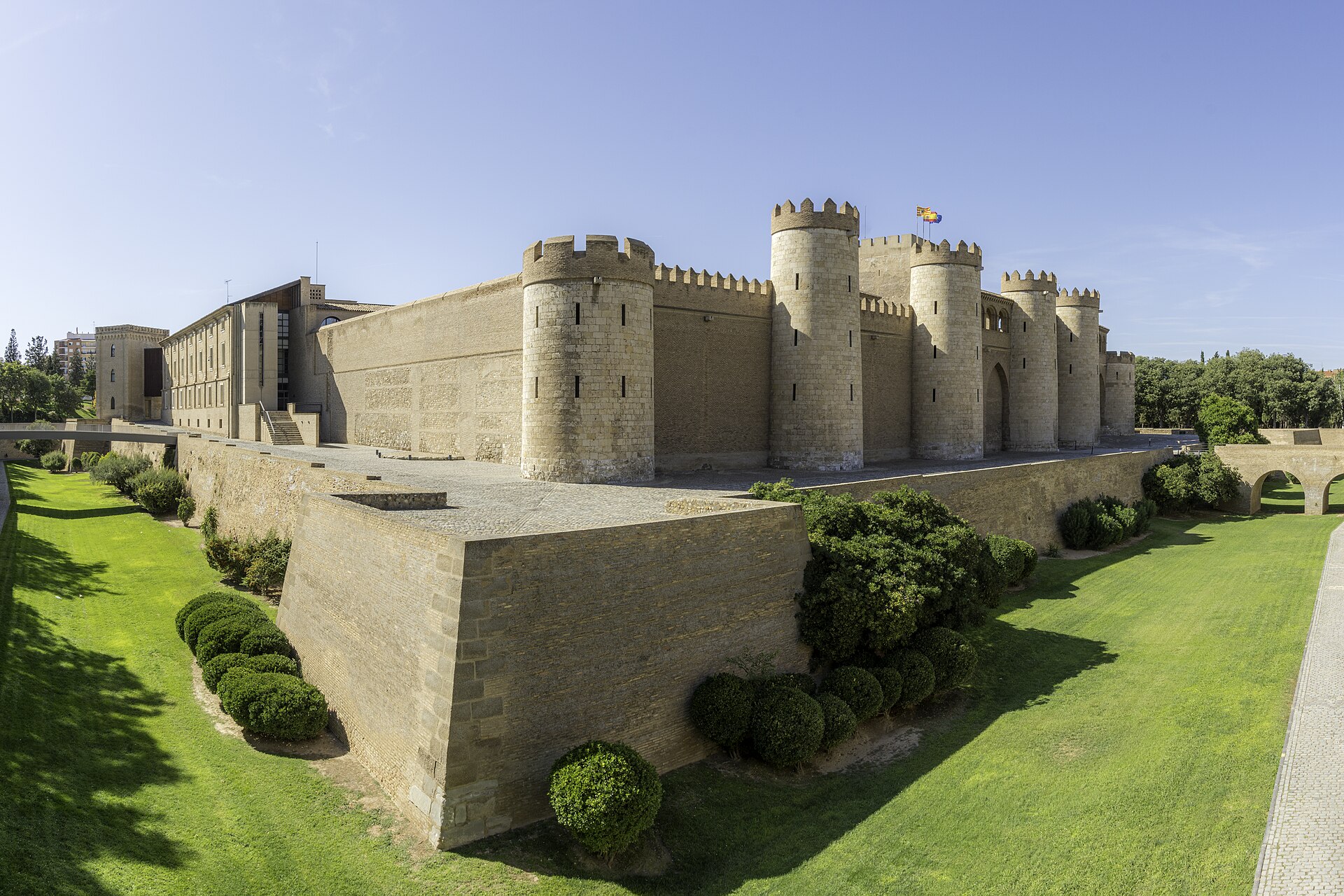
The Aljafería is a fortified medieval Islamic palace built during the second half of the 11th century in the Taifa of Zaragoza. It served as the residence of the Banu Hud dynasty and stands as one of the most significant examples of Hispano-Muslim architecture, showcasing the intricate decorative techniques of the era, including complex interlacing arches and ornate stucco work.
Following the Christian conquest of Zaragoza in 1118, the palace became the residence of the Kings of Aragon. Over the centuries, it underwent significant modifications, including the addition of the Palace of the Catholic Monarchs and its later use as a headquarters for the Spanish Inquisition and a military barracks. Today, it serves as the seat of the Cortes of Aragon, the regional parliament.
Key Facts
- Materials
- Brick, Stucco, Marble, Wood
- Civilization
- Taifa of Zaragoza / Kingdom of Aragon
- Accessibility
- Wheelchair accessible in most public areas
- Date(s)
- 11th century
- Condition
- Restored and active as a legislative building
- Original Function
- Residential palace and fortress
- Key Figures
- Al-Muqtadir, Peter IV of Aragon, Isabella I of Castile, Ferdinand II of Aragon
Islamic Origins
11th centuryCommissioned by the Taifa king Al-Muqtadir, the palace was designed as a 'Palace of Joy' (Qasr al-Surur). It featured a central courtyard, reflecting pools, and the iconic prayer hall with its polylobed arches.
Christian Transformation
12th-15th centuryAfter Alfonso I of Aragon captured the city, the palace was adapted for Christian monarchs. Peter IV of Aragon significantly expanded the site, adding Gothic-style royal apartments while preserving the earlier Islamic core.
Royal and Inquisition Use
15th-18th centuryThe Catholic Monarchs added a new palace wing in the Mudéjar style. Later, the site was repurposed by the Inquisition, which utilized the building as its tribunal headquarters, leading to structural changes and the addition of prison cells.
Modern Restoration
20th century - presentFollowing decades of military use, the palace underwent extensive restoration starting in the 1940s. It was declared a National Monument in 1931 and now functions as the home of the Aragonese parliament.
Cultural Significance
The Aljafería is a unique architectural synthesis, representing the coexistence and layering of Islamic, Mudéjar, and Gothic styles. It is a symbol of the complex history of the Iberian Peninsula, illustrating the transition from Islamic rule to the consolidation of the Spanish monarchy.
As the seat of the Cortes of Aragon, the palace remains a living part of Spanish political life, bridging the gap between medieval heritage and modern democratic governance.
Interpretive Notes
Scholarly debates and areas of uncertainty
There is ongoing academic discussion regarding the extent of the original 11th-century layout, as many of the Islamic decorative elements were obscured or removed during the Christian and Inquisition-era renovations. Reconstructions of the original garden and water features remain speculative based on archaeological traces.
Visiting Information
Entry Rules
Open daily for guided and self-guided tours. Access may be restricted during parliamentary sessions. Tickets can be purchased at the entrance.
Best Times to Visit
Spring and autumn offer the most comfortable temperatures for exploring the outdoor courtyards. Weekday mornings are generally less crowded than weekends.
Photography
Personal photography is permitted throughout the palace. Flash and tripods are prohibited in the interior galleries.
Preservation Notes
The site is a protected heritage monument. Visitors must refrain from touching the stucco carvings and stay within designated visitor paths to protect the fragile medieval surfaces.
Nearby POIs
1 shownSources & Further Reading
- [1]The Aljafería of Zaragoza — Bernabé Cabañero Subiza. Zaragoza Provincial Council (1998)
- [2]Islamic Architecture in Spain — Jerrilynn Dodds. Yale University Press (1992)
Key Facts
- Materials
- Brick, Stucco, Marble, Wood
- Civilization
- Taifa of Zaragoza / Kingdom of Aragon
- Accessibility
- Wheelchair accessible in most public areas
- Date(s)
- 11th century
- Condition
- Restored and active as a legislative building
- Original Function
- Residential palace and fortress
- Key Figures
- Al-Muqtadir, Peter IV of Aragon, Isabella I of Castile, Ferdinand II of Aragon