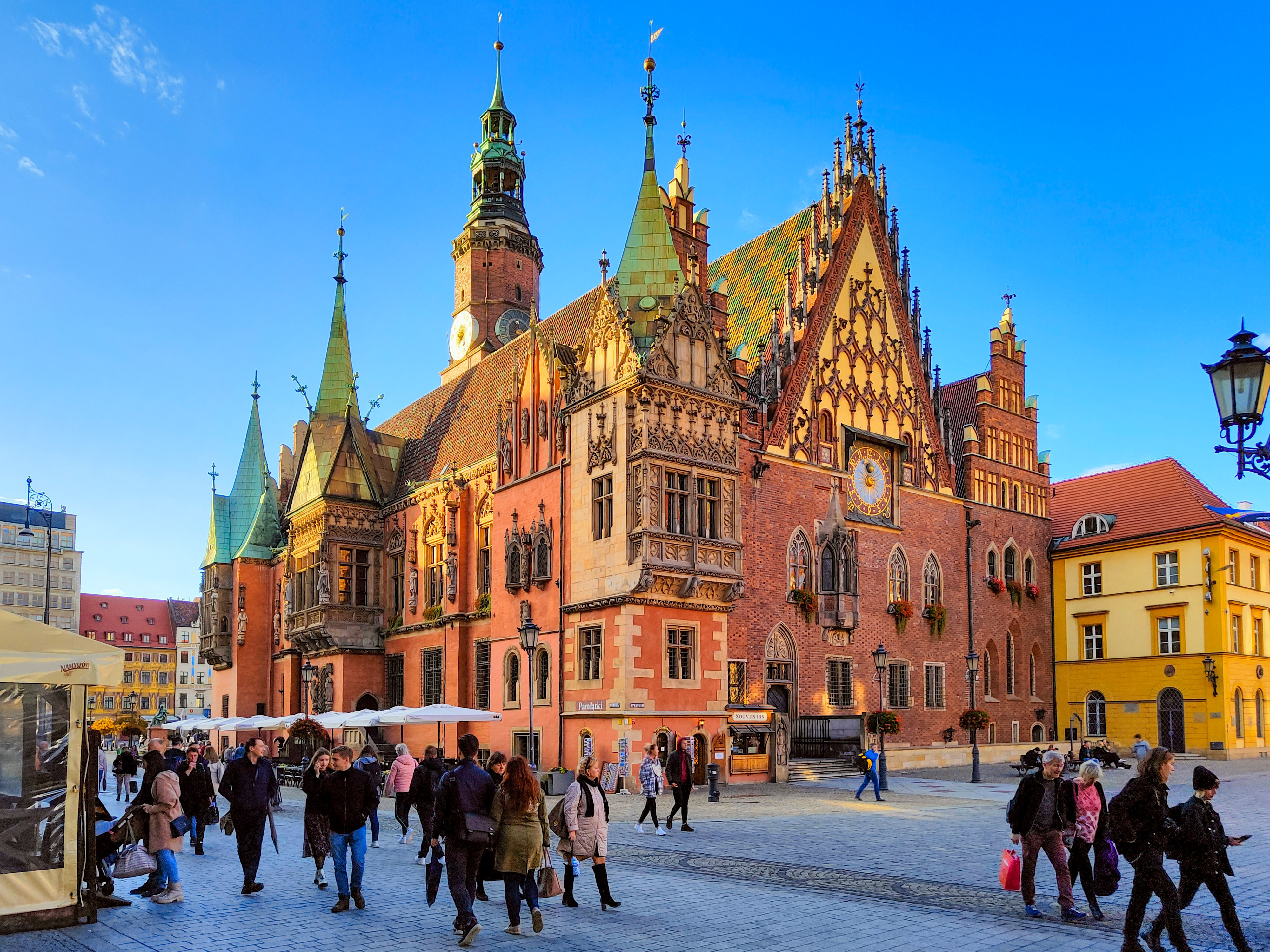
The Wrocław Town Hall is a historic building located in the center of the city's Market Square. Construction began in the late 13th century and continued over several hundred years, resulting in a complex structure that blends Gothic and Renaissance architectural styles. It served as the seat of the city council and the center of civic administration for centuries.
The building is renowned for its highly ornate eastern facade, which features intricate stone carvings, and its astronomical clock, installed in the 16th century. Today, the Town Hall houses the Museum of Bourgeois Art and serves as a primary landmark representing the historical wealth and autonomy of the city during the Middle Ages.
Key Facts
- Materials
- Brick, Sandstone
- Civilization
- Polish/Silesian
- Accessibility
- Ground floor accessible, upper levels limited
- Date(s)
- 1299 - 1504
- Condition
- Well-preserved, houses a museum
- Original Function
- Administrative seat and city council hall
- Key Figures
- Hans Berthold, Paul Preuss
Initial Construction
13th centuryThe original structure was a single-story building erected around 1299. It served as the primary administrative hub for the growing merchant city.
Gothic Expansion
14th - 15th centuryThe building underwent significant expansion, adding the two-story structure and the iconic tower. The ornate eastern facade, a masterpiece of Gothic stone carving, was completed during this period.
Renaissance Additions
16th centuryDuring the Renaissance, the building received further decorative updates, including the installation of the astronomical clock and interior modifications to reflect the changing tastes of the era.
Modern Era and Restoration
20th century - presentThe building survived World War II with relatively minor damage compared to the surrounding city. Extensive restoration efforts in the late 20th century preserved its historical integrity, and it now functions as a museum.
Cultural Significance
The Town Hall stands as a symbol of Wrocław's historical independence and its status as a major center of trade and culture in Central Europe. It reflects the influence of the Hanseatic League and the architectural evolution of the Silesian region over five centuries.
Interpretive Notes
Scholarly debates and areas of uncertainty
There is ongoing academic discussion regarding the exact sequence of the building's expansion phases, as the structure was modified incrementally over 200 years, making the original 13th-century footprint difficult to isolate from later Gothic additions.
Visiting Information
Entry Rules
Open Tuesday to Sunday. Tickets are required for museum entry. Visitors must follow standard museum conduct rules.
Best Times to Visit
Morning hours are best to avoid crowds in the Market Square. The exterior is particularly notable during the golden hour for photography.
Photography
Personal photography is permitted. Flash and tripods are prohibited inside the museum galleries.
Preservation Notes
The building is a protected historical monument. Visitors are requested to refrain from touching the stone carvings on the exterior facade.
Nearby POIs
9 shownSources & Further Reading
- [1]Wrocław Town Hall: A History of the City's Heart — Marek Burak. Wrocław University Press (2010)
- [2]Gothic Architecture in Silesia — Anna Kowalska. Polish Academy of Sciences (2015)
Key Facts
- Materials
- Brick, Sandstone
- Civilization
- Polish/Silesian
- Accessibility
- Ground floor accessible, upper levels limited
- Date(s)
- 1299 - 1504
- Condition
- Well-preserved, houses a museum
- Original Function
- Administrative seat and city council hall
- Key Figures
- Hans Berthold, Paul Preuss