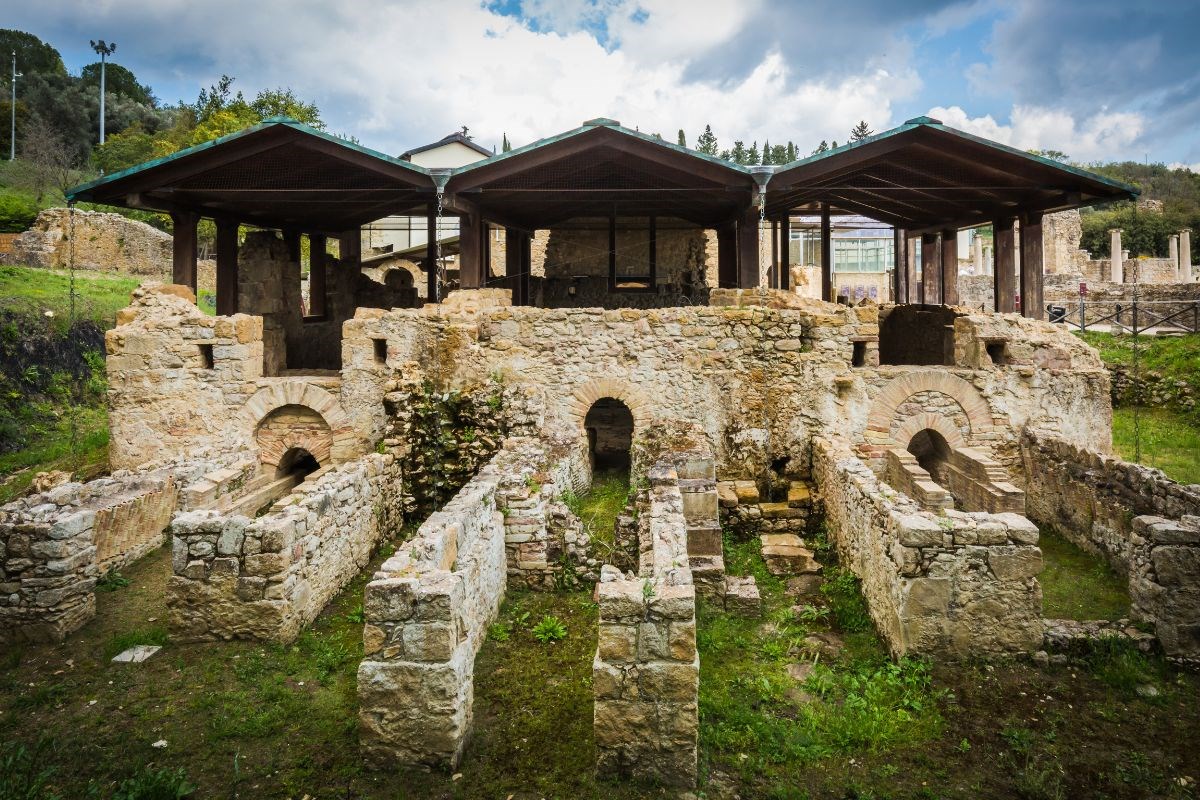
The Villa Romana del Casale is a large and elaborate Roman villa located near Piazza Armerina, Sicily. Constructed in the early 4th century CE, it is renowned for housing the most extensive and best-preserved collection of Roman mosaics in the world. The villa served as the center of a vast agricultural estate and is believed to have been the residence of a member of the Roman senatorial aristocracy or even a member of the imperial family.
The site is organized into four distinct sections: the monumental entrance, the private apartments, the central peristyle, and the great triclinium. The mosaics, which cover nearly 3,500 square meters, depict a wide range of themes including mythological scenes, hunting expeditions, and daily life, providing unparalleled insight into the artistic and social culture of the late Roman Empire.
Key Facts
- Materials
- Stone, Brick, Mortar, Tesserae (glass and stone)
- Civilization
- Roman
- Accessibility
- Partially accessible; some areas feature ramps and boardwalks
- Date(s)
- Early 4th century CE
- Condition
- Well-preserved, protected by modern roofing structures
- Original Function
- Residential villa and agricultural estate center
- Key Figures
- Maximian
Construction and Peak
4th century CEThe villa was built on the site of an older rural estate. Its construction is attributed to the Roman elite, with some scholars suggesting it was the retirement residence of the co-emperor Maximian.
Abandonment and Burial
12th century CEThe villa remained in use through the Byzantine and Arab periods but was eventually abandoned following a landslide that buried the structure in mud, which paradoxically preserved the mosaics for centuries.
Rediscovery and Excavation
19th-20th centuryWhile the site was known locally, systematic archaeological excavations were not conducted until the 1920s and 1950s, revealing the full extent of the complex and its intricate floor decorations.
Cultural Significance
The Villa Romana del Casale is a primary source for understanding the lifestyle of the Roman elite in the late imperial period. Its mosaics are considered a masterpiece of Roman art, documenting not only the aesthetic preferences of the time but also the trade networks and exotic animals imported from Africa for the Roman games.
Today, the site is a cornerstone of Sicilian cultural heritage and a major destination for the study of Roman domestic architecture and decorative arts. It serves as a vital link in the history of Mediterranean cultural exchange.
Interpretive Notes
Scholarly debates and areas of uncertainty
The identity of the villa's owner remains a subject of intense academic debate. While the scale and luxury suggest an imperial owner like Maximian, other theories propose a high-ranking official or a wealthy local landowner. Additionally, the exact function of the 'Great Hunt' mosaic is debated, with some interpreting it as a display of imperial power and others as a record of actual trade in wild animals.
Visiting Information
Entry Rules
Open daily. Tickets can be purchased at the entrance or online. Modest dress is recommended. Visitors must follow marked paths to protect the mosaic surfaces.
Best Times to Visit
Spring and autumn offer the most comfortable temperatures for exploring the outdoor sections of the site. Early morning visits are recommended to avoid peak tourist crowds.
Photography
Personal photography is permitted without flash or tripods. Professional photography requires prior authorization from the regional cultural authorities.
Preservation Notes
The site is protected by a modern canopy system. Visitors must remain on the elevated walkways at all times to prevent damage to the mosaics. Touching the mosaics is strictly prohibited.
Nearby POIs
0 shownNo nearby POIs listed yet.
Sources & Further Reading
- [1]The Roman Villa of Casale at Piazza Armerina — Patrizio Pensabene. L'Erma di Bretschneider (2005)
- [2]Villa Romana del Casale: The Mosaics — R.J.A. Wilson. HMSO (1983)
Key Facts
- Materials
- Stone, Brick, Mortar, Tesserae (glass and stone)
- Civilization
- Roman
- Accessibility
- Partially accessible; some areas feature ramps and boardwalks
- Date(s)
- Early 4th century CE
- Condition
- Well-preserved, protected by modern roofing structures
- Original Function
- Residential villa and agricultural estate center
- Key Figures
- Maximian
Nearby POIs
0 shownNo nearby POIs listed yet.