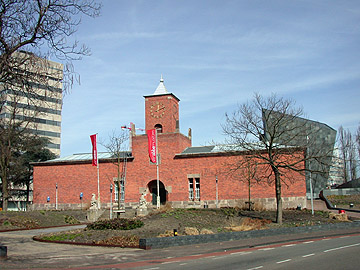
The Van Abbemuseum is a prominent museum for modern and contemporary art located in Eindhoven, Netherlands. Founded in 1936 by Henri van Abbe, the institution is renowned for its extensive collection of international art, including one of the world's most significant holdings of works by the Russian avant-garde artist El Lissitzky.
The museum complex is defined by a dialogue between its original 1936 brick building, designed by architect Alexander Kropholler, and a striking 2003 expansion by Abel Cahen. This architectural juxtaposition reflects the museum's commitment to examining the societal role of art, often prioritizing experimental curation and inclusive accessibility practices over traditional display methods.
Key Facts
- Materials
- Brick, Glass, Steel
- Civilization
- Dutch
- Accessibility
- Fully wheelchair accessible with specialized sensory-friendly programming
- Date(s)
- 1936 (original), 2003 (expansion)
- Condition
- Active
- Original Function
- Art Museum
- Key Figures
- Henri van Abbe, Alexander Kropholler, Abel Cahen, El Lissitzky
Founding and Early Years
1936The museum was established by Henri van Abbe, a local cigar manufacturer and art collector, who donated his collection and the funds for the building to the city of Eindhoven. The original structure was designed by Alexander Kropholler in a traditionalist brick style.
Post-War Expansion
1950s-1990sFollowing the Second World War, the museum shifted its focus toward international modernism. It gained global recognition for its acquisitions of works by Picasso, Chagall, and particularly the comprehensive collection of El Lissitzky's work.
Architectural Transformation
2003To accommodate a growing collection and modern curatorial needs, a major expansion designed by Abel Cahen was opened. The new wing introduced a contemporary aesthetic that contrasts with the original 1936 building, creating a unique architectural campus.
Contemporary Mission
21st CenturyIn recent years, the museum has become a leader in inclusive museum practices, focusing on accessibility for visitors with disabilities and exploring the political and social dimensions of contemporary art through its 'Museum of the Future' initiatives.
Cultural Significance
The Van Abbemuseum serves as a critical cultural hub in the Netherlands, known for its progressive approach to the role of museums in society. It is recognized for challenging the traditional 'white cube' gallery model, instead fostering dialogue around social justice, inclusivity, and the democratization of art.
Its collection of Russian avant-garde art provides a vital historical link to early 20th-century radicalism, which the museum continues to connect to contemporary political discourse. The institution is widely regarded as a pioneer in developing accessibility standards for blind and visually impaired visitors.
Interpretive Notes
Scholarly debates and areas of uncertainty
There is ongoing academic discussion regarding the museum's 'de-colonial' curatorial approach. Some critics argue that the focus on social activism and accessibility sometimes overshadows the traditional aesthetic appreciation of the art objects themselves, while proponents view this shift as a necessary evolution for 21st-century institutions.
Visiting Information
Entry Rules
Open Tuesday through Sunday. Tickets can be purchased online or at the desk. The museum is closed on Mondays. Visitors are encouraged to check the website for specific exhibition-related guidelines.
Best Times to Visit
Weekday mornings are generally quieter. The museum is a popular destination for school groups, so visiting outside of peak educational hours can provide a more contemplative experience.
Photography
Personal photography is permitted for non-commercial use without flash or tripods. Specific temporary exhibitions may have restricted photography policies.
Preservation Notes
Maintain a respectful distance from artworks. Large bags and backpacks must be stored in the provided lockers. Do not touch the art unless explicitly indicated for interactive exhibits.
Nearby POIs
1 shownSources & Further Reading
- [1]
- [2]Museums and the Future of Accessibility — Annemarie de Wildt. Journal of Museum Studies (2019)
Key Facts
- Materials
- Brick, Glass, Steel
- Civilization
- Dutch
- Accessibility
- Fully wheelchair accessible with specialized sensory-friendly programming
- Date(s)
- 1936 (original), 2003 (expansion)
- Condition
- Active
- Original Function
- Art Museum
- Key Figures
- Henri van Abbe, Alexander Kropholler, Abel Cahen, El Lissitzky