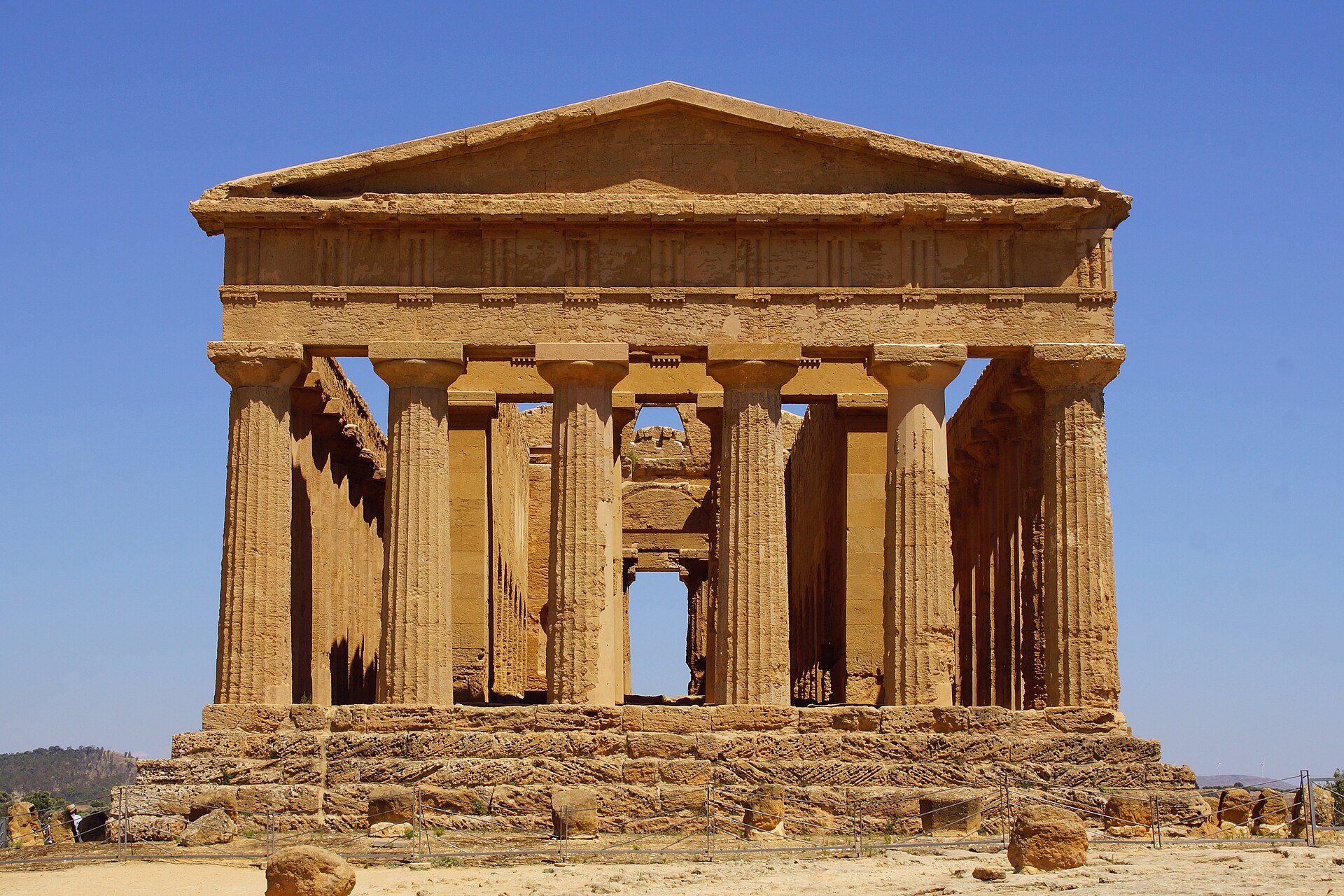
The Valley of the Temples (Valle dei Templi) is an archaeological site in Agrigento, Sicily, representing one of the most significant examples of ancient Greek art and architecture. The site comprises the remains of seven monumental Doric-style temples, constructed between the 6th and 5th centuries BCE on a ridge overlooking the Mediterranean Sea. It served as the sacred heart of the ancient city of Akragas, a powerful polis of Magna Graecia.
Despite centuries of seismic activity and human intervention, several structures, most notably the Temple of Concordia, remain remarkably well-preserved. The site provides critical insight into urban planning, religious practice, and the socio-political influence of Greek colonies in the Western Mediterranean during the Classical period.
Key Facts
- Materials
- Calcarenite (local sandstone), Stucco, Marble
- Civilization
- Ancient Greek (Magna Graecia)
- Accessibility
- Partially accessible; some paths are uneven and steep
- Date(s)
- 580 BCE - 406 BCE
- Condition
- Archaeological park with partially restored structures
- Original Function
- Religious sanctuary and civic center
- Key Figures
- Theron of Akragas, Empedocles
Foundation of Akragas
580 BCEThe city of Akragas was founded by Greek colonists from Gela and Rhodes. The ridge was selected for its defensive advantages and proximity to the sea, quickly becoming a prosperous trade hub.
The Golden Age
5th Century BCEUnder the tyranny of Theron and the subsequent democratic period, the city reached its peak. The majority of the monumental temples were commissioned during this era, reflecting the city's immense wealth and cultural ambition.
Carthaginian Destruction
406 BCEThe city was besieged and sacked by Carthaginian forces. Many of the temples were damaged or left unfinished, marking the end of the city's period of unbridled expansion.
Roman and Byzantine Transition
210 BCE - 6th Century CEFollowing the Roman conquest, the city was renamed Agrigentum. The Temple of Concordia was notably converted into a Christian basilica in the 6th century, which contributed to its survival.
Modern Preservation
19th Century - PresentThe site became a focal point for European travelers and archaeologists. It was designated a UNESCO World Heritage site in 1997, and ongoing conservation efforts focus on structural stabilization and landscape management.
Cultural Significance
The Valley of the Temples is a cornerstone of Sicilian cultural identity and a testament to the historical integration of Greek culture into the Mediterranean landscape. It serves as a primary site for understanding the architectural evolution of the Doric order outside of the Greek mainland.
Beyond its archaeological value, the site is a symbol of the historical continuity of Sicily, bridging the gap between ancient Hellenic influence and the island's subsequent Roman, Byzantine, and medieval layers.
Interpretive Notes
Scholarly debates and areas of uncertainty
The identification of the temples remains a subject of debate. While traditional names like the 'Temple of Juno' or 'Temple of Concordia' are widely used, they are largely based on Renaissance-era attributions rather than definitive epigraphic evidence. Scholars continue to analyze the original dedications of these structures.
Visiting Information
Entry Rules
Open daily. Tickets can be purchased online or at the entrance. The site is divided into two main zones (Eastern and Western). Modest dress is recommended, though not strictly enforced as it is an archaeological park rather than an active place of worship.
Best Times to Visit
Early morning or late afternoon to avoid the intense Sicilian sun and peak tour bus crowds. Spring and autumn offer the most temperate weather for walking the extensive site.
Photography
Personal photography is permitted. Professional or commercial photography, including the use of tripods and drones, requires prior authorization from the park administration.
Preservation Notes
Visitors must remain on designated paths to protect the fragile archaeological strata. Climbing on temple ruins is strictly prohibited. The site is exposed with little shade; visitors are advised to carry water and sun protection.
Nearby POIs
0 shownNo nearby POIs listed yet.
Sources & Further Reading
- [1]The Valley of the Temples: A Guide to the Archaeological Park — Giuseppe Castellana. Edizioni di Passaggio (2015)View
- [2]Magna Graecia: The Archaeology of Greek Colonies in Italy — T.J. Dunbabin. Oxford University Press (1948)
Key Facts
- Materials
- Calcarenite (local sandstone), Stucco, Marble
- Civilization
- Ancient Greek (Magna Graecia)
- Accessibility
- Partially accessible; some paths are uneven and steep
- Date(s)
- 580 BCE - 406 BCE
- Condition
- Archaeological park with partially restored structures
- Original Function
- Religious sanctuary and civic center
- Key Figures
- Theron of Akragas, Empedocles
Nearby POIs
0 shownNo nearby POIs listed yet.