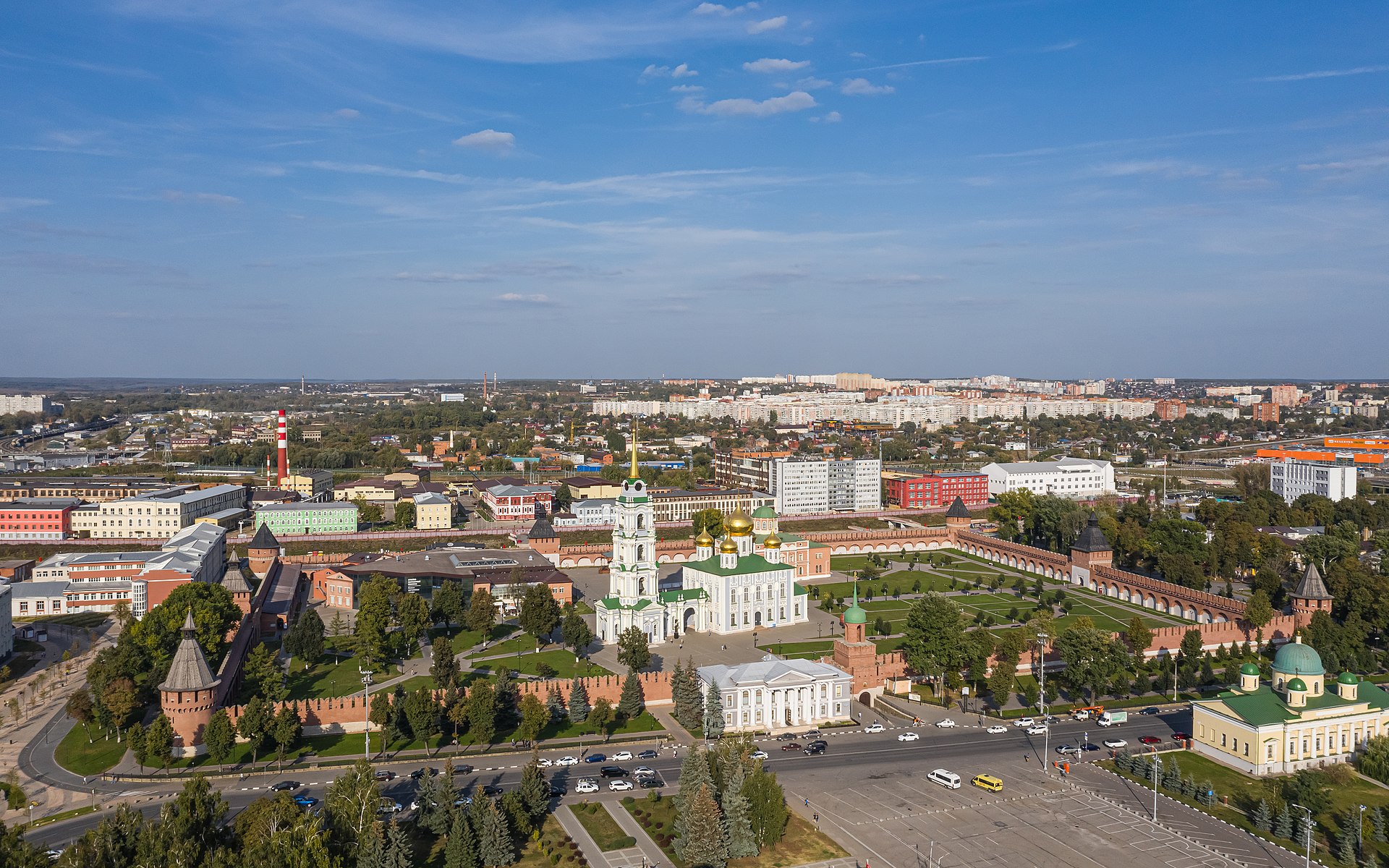
The Tula Kremlin is a 16th-century fortress located in the city of Tula, Russia. Commissioned by Grand Prince Vasily III, it was constructed between 1507 and 1520 as a critical defensive outpost along the southern frontier of the Grand Duchy of Moscow, specifically designed to protect the region from Crimean Tatar raids.
The complex is characterized by its red-brick walls and nine towers, which enclose a space containing two historic cathedrals and various administrative buildings. Unlike many other Russian fortresses of the era, the Tula Kremlin was built on low-lying ground near the Upa River, utilizing a sophisticated system of moats and water management to enhance its defensive capabilities.
Key Facts
- Materials
- Red brick, White limestone
- Civilization
- Grand Duchy of Moscow
- Accessibility
- Ground level accessible, some interior museum areas have stairs
- Date(s)
- 1507-1520
- Condition
- Restored and active cultural complex
- Original Function
- Military fortress
- Key Figures
- Vasily III, Ivan the Terrible
Foundation and Strategic Purpose
1507-1520The fortress was established as part of the 'Great Abatis Line,' a series of fortifications intended to secure the southern borders of the Muscovite state. Its construction marked a transition from wooden fortifications to more durable stone and brick structures.
Military Significance
16th-17th centuryThe Kremlin played a vital role in repelling numerous incursions by the Crimean Khanate. Its strategic location allowed it to serve as a staging ground for Russian military campaigns and a refuge for the local population during sieges.
Religious and Civic Development
18th-19th centuryAs the military frontier moved southward, the fortress lost its primary defensive utility. The interior space was developed with the construction of the Assumption Cathedral and the Epiphany Cathedral, transforming the site into a religious and administrative center for the city.
Modern Restoration
20th century - presentFollowing decades of neglect during the Soviet era, the Kremlin underwent extensive restoration work in the 21st century. Today, it functions as a museum complex and a central public space for Tula, hosting exhibitions and cultural events.
Cultural Significance
The Tula Kremlin serves as a symbol of Russian statehood and the historical struggle to secure the southern borders. It represents the architectural evolution of Russian military engineering, blending Italian-influenced brickwork techniques with traditional Russian fortress design.
Locally, the site is the heart of Tula's cultural life. It houses the Tula State Museum of Weapons and serves as a focal point for city celebrations, maintaining a strong connection between the modern urban population and the city's medieval origins.
Interpretive Notes
Scholarly debates and areas of uncertainty
There is ongoing academic discussion regarding the extent of Italian influence in the design of the towers and walls. While the architectural style clearly reflects the work of foreign masters employed by the Muscovite court, the degree to which local builders adapted these designs to the specific marshy terrain of the Upa River remains a subject of study.
Visiting Information
Entry Rules
The Kremlin grounds are open to the public daily. Entry to the complex is free, though individual museums and cathedrals within the walls require separate tickets. Visitors are expected to respect the religious nature of the active cathedrals.
Best Times to Visit
Late spring and early autumn offer the most comfortable weather for walking the perimeter walls. Summer weekends are popular for local cultural events.
Photography
Personal photography is permitted throughout the grounds. Professional or commercial photography may require prior authorization from the museum administration.
Preservation Notes
Visitors are requested to stay on designated paths and refrain from climbing on the historic brick walls. Restoration work is ongoing in various sections of the complex.
Nearby POIs
0 shownNo nearby POIs listed yet.
Sources & Further Reading
- [1]The Architecture of the Russian Kremlin — William Craft Brumfield. Cambridge University Press (2013)View
- [2]Tula Kremlin: History and Architecture — A. V. Shekov. Tula State University Press (2015)
Key Facts
- Materials
- Red brick, White limestone
- Civilization
- Grand Duchy of Moscow
- Accessibility
- Ground level accessible, some interior museum areas have stairs
- Date(s)
- 1507-1520
- Condition
- Restored and active cultural complex
- Original Function
- Military fortress
- Key Figures
- Vasily III, Ivan the Terrible
Nearby POIs
0 shownNo nearby POIs listed yet.