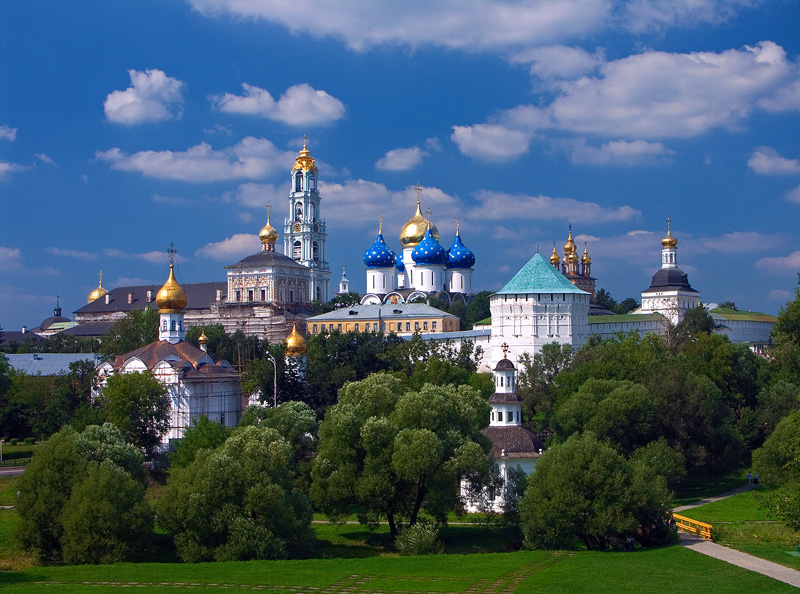
Trinity Lavra of St. Sergius
The Trinity Lavra of St. Sergius is the most important Russian monastery and the spiritual center of the Russian Orthodox Church. Located in the town of Sergiev Posad, the monastery was founded in 1337 by St. Sergius of Radonezh, one of the most venerated saints of the Russian Orthodox Church. It serves as an active monastic community and a significant site of pilgrimage, housing the relics of its founder within the Trinity Cathedral.
The architectural ensemble is a prime example of Russian Orthodox ecclesiastical design, featuring a collection of cathedrals, churches, and defensive fortifications that evolved over several centuries. The site played a pivotal role in Russian history, acting as a fortress during the Time of Troubles and a center for cultural and religious development throughout the Muscovite and Imperial periods.
Key Facts
- Materials
- White stone, Brick, Gold leaf, Limestone
- Civilization
- Russian
- Accessibility
- Accessible; some areas restricted to clergy and monastics
- Date(s)
- 1337 - 19th century
- Condition
- Active monastery and UNESCO World Heritage site
- Original Function
- Monastery and spiritual center
- Key Figures
- St. Sergius of Radonezh, Andrei Rublev, Boris Godunov
Foundation and Early Growth
14th centuryThe monastery was established by Sergius of Radonezh in the wilderness of Radonezh. It quickly grew from a small wooden church into a major spiritual center, attracting monks and pilgrims from across the Russian lands.
Architectural Flourishing
15th-16th centuryThe stone Trinity Cathedral was constructed in 1422 to house the relics of St. Sergius. During this period, the monastery became a center for icon painting, with masters like Andrei Rublev contributing to its interior decoration.
Fortification and Siege
17th centuryThe monastery's defensive walls were tested during the Time of Troubles, when the Lavra withstood a sixteen-month siege by Polish-Lithuanian forces, cementing its status as a symbol of national and religious resilience.
Imperial Patronage and Modern Era
18th century - presentThe Lavra received significant support from the Tsars, including Peter the Great. Following the Soviet period, during which it was closed and repurposed, the monastery was returned to the Church in 1946 and remains a functioning religious institution.
Cultural Significance
The Trinity Lavra is considered the 'Vatican' of the Russian Orthodox Church. It represents the intersection of Russian national identity, spiritual devotion, and architectural heritage. The site is central to the history of Russian icon painting and liturgical music, and it continues to serve as a primary destination for pilgrims seeking the intercession of St. Sergius.
Interpretive Notes
Scholarly debates and areas of uncertainty
Debates exist regarding the extent of the monastery's political influence during the consolidation of the Muscovite state and the degree to which its architectural style was influenced by Italian architects versus indigenous Russian traditions.
Visiting Information
Entry Rules
Open daily. Entry is free, but visitors are expected to dress modestly (shoulders and knees covered; women should wear headscarves). Photography is prohibited inside the cathedrals.
Best Times to Visit
Early morning or late afternoon to avoid large tour groups. Major feast days, particularly the feast of St. Sergius (July 18 and October 8), draw significant crowds.
Photography
Photography is permitted on the grounds but strictly forbidden inside all churches and cathedrals.
Preservation Notes
The site is a protected UNESCO World Heritage property. Visitors must remain on marked paths and refrain from touching icons or frescoes.
Nearby POIs
0 shownNo nearby POIs listed yet.
Sources & Further Reading
- [1]The Trinity-St. Sergius Lavra: A History — David Goldfrank. Russian History Journal (1998)
- [2]Russian Monasteries and the Church — John Meyendorff. St. Vladimir's Seminary Press (1989)
Key Facts
- Materials
- White stone, Brick, Gold leaf, Limestone
- Civilization
- Russian
- Accessibility
- Accessible; some areas restricted to clergy and monastics
- Date(s)
- 1337 - 19th century
- Condition
- Active monastery and UNESCO World Heritage site
- Original Function
- Monastery and spiritual center
- Key Figures
- St. Sergius of Radonezh, Andrei Rublev, Boris Godunov
Nearby POIs
0 shownNo nearby POIs listed yet.