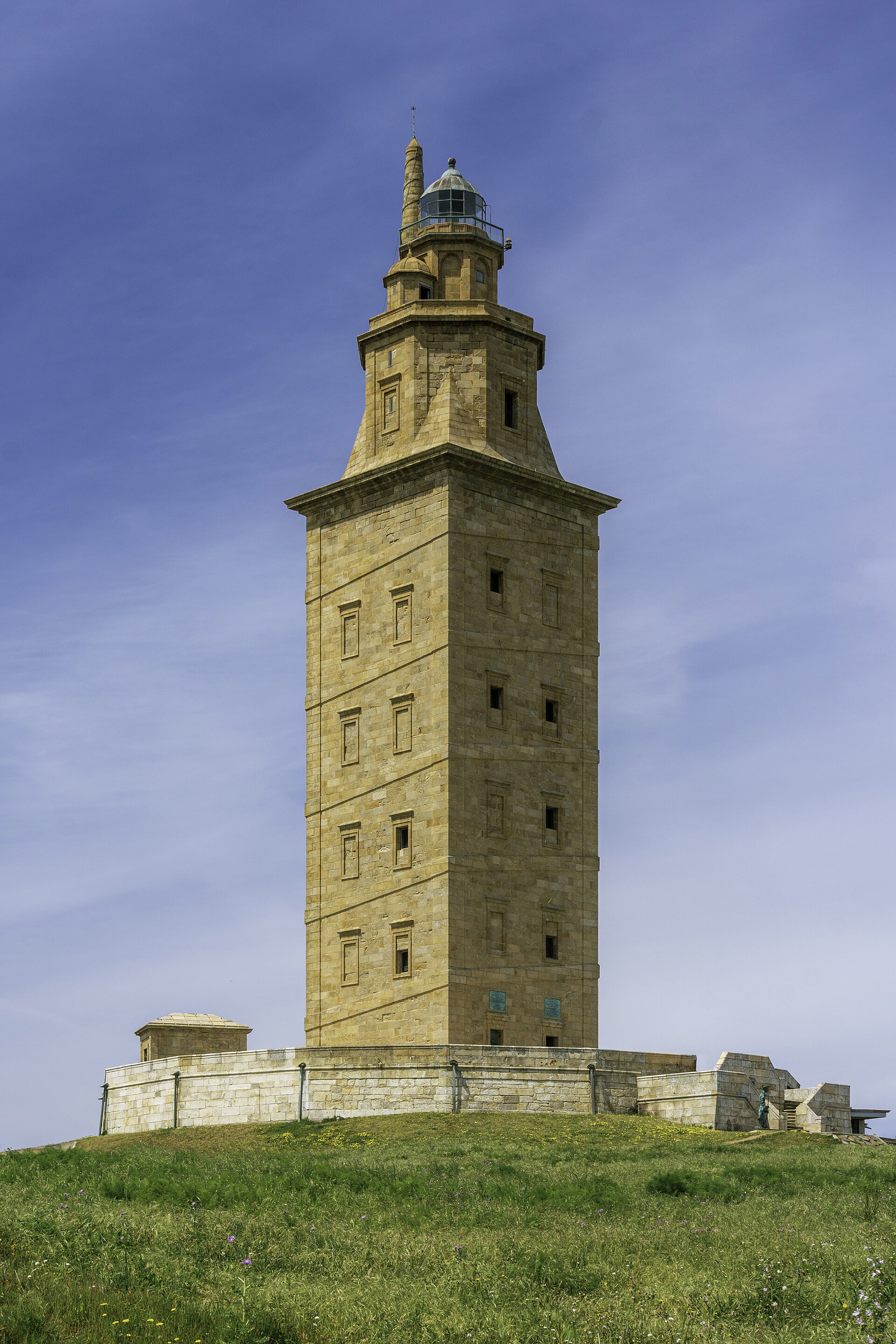
The Tower of Hercules is an ancient Roman lighthouse located on a peninsula about 2.4 kilometers from the center of A Coruña, Galicia, Spain. Standing approximately 55 meters tall, it is the oldest Roman lighthouse in existence that is still in use today. The structure overlooks the North Atlantic coast and has served as a vital navigational aid for maritime traffic since the late 1st century CE.
The current appearance of the tower is the result of a major neoclassical restoration completed in 1791 by architect Eustaquio Giannini. This renovation encased the original Roman core within a new exterior shell, preserving the ancient masonry while updating the structure to meet modern maritime requirements. The site was designated a UNESCO World Heritage Site in 2009 due to its exceptional testimony to the architectural and maritime history of the Roman Empire.
Key Facts
- Materials
- Granite, Stone masonry
- Civilization
- Roman
- Accessibility
- Accessible via stairs; limited mobility access to upper levels
- Date(s)
- Late 1st century CE
- Condition
- Active, fully restored
- Original Function
- Lighthouse and navigational beacon
- Key Figures
- Gaius Sevius Lupus, Eustaquio Giannini
Roman Origins
1st century CEThe tower was constructed during the reign of Emperor Trajan. An inscription at the base identifies the architect as Gaius Sevius Lupus from Aeminium (modern-day Coimbra, Portugal), who dedicated the structure to Mars.
Medieval Decline
Middle AgesFollowing the fall of the Roman Empire, the tower lost its primary function as a lighthouse and was repurposed as a fortress. It fell into disrepair during the medieval period as maritime trade routes shifted.
Neoclassical Restoration
1791Under the direction of the Consulado de Galicia, architect Eustaquio Giannini undertook a comprehensive restoration. He reinforced the Roman core with a new stone facade and added a modern lantern, ensuring the tower's longevity.
Modern Recognition
20th-21st centuryThe site was recognized as a National Monument of Spain in 1931. In 2009, it was inscribed on the UNESCO World Heritage list, highlighting its unique status as the only Roman lighthouse to maintain its original function.
Cultural Significance
The Tower of Hercules is a powerful symbol of Galicia's maritime heritage and its deep connection to the Atlantic. It represents the continuity of Roman engineering and the enduring importance of maritime safety in European history.
Locally, the tower is linked to various mythological legends, including the myth of Hercules, from whom the tower derives its name. It remains a central landmark for the city of A Coruña and a focal point for regional cultural identity.
Interpretive Notes
Scholarly debates and areas of uncertainty
There is ongoing academic discussion regarding the original height and the specific lighting mechanism used during the Roman period. While the base remains well-documented, the exact configuration of the upper levels prior to the 18th-century restoration remains a subject of archaeological speculation.
Visiting Information
Entry Rules
Open daily. Tickets are required for entry to the interior and the climb to the top. Visitors should check the official website for seasonal hours and potential closures due to weather conditions.
Best Times to Visit
Late spring and early autumn offer the best weather for visiting the surrounding park. Sunset provides excellent views of the Atlantic coastline.
Photography
Personal photography is permitted throughout the site. Commercial photography requires prior authorization from the municipal authorities.
Preservation Notes
The site is protected under strict heritage laws. Visitors are requested to stay on designated paths within the surrounding sculpture park and refrain from touching the original Roman masonry exposed in the interior.
Nearby POIs
0 shownNo nearby POIs listed yet.
Sources & Further Reading
- [1]
- [2]The Roman Lighthouse of A Coruña — José M. Bello Diéguez. Archaeological Journal of Galicia (2010)
Key Facts
- Materials
- Granite, Stone masonry
- Civilization
- Roman
- Accessibility
- Accessible via stairs; limited mobility access to upper levels
- Date(s)
- Late 1st century CE
- Condition
- Active, fully restored
- Original Function
- Lighthouse and navigational beacon
- Key Figures
- Gaius Sevius Lupus, Eustaquio Giannini
Nearby POIs
0 shownNo nearby POIs listed yet.