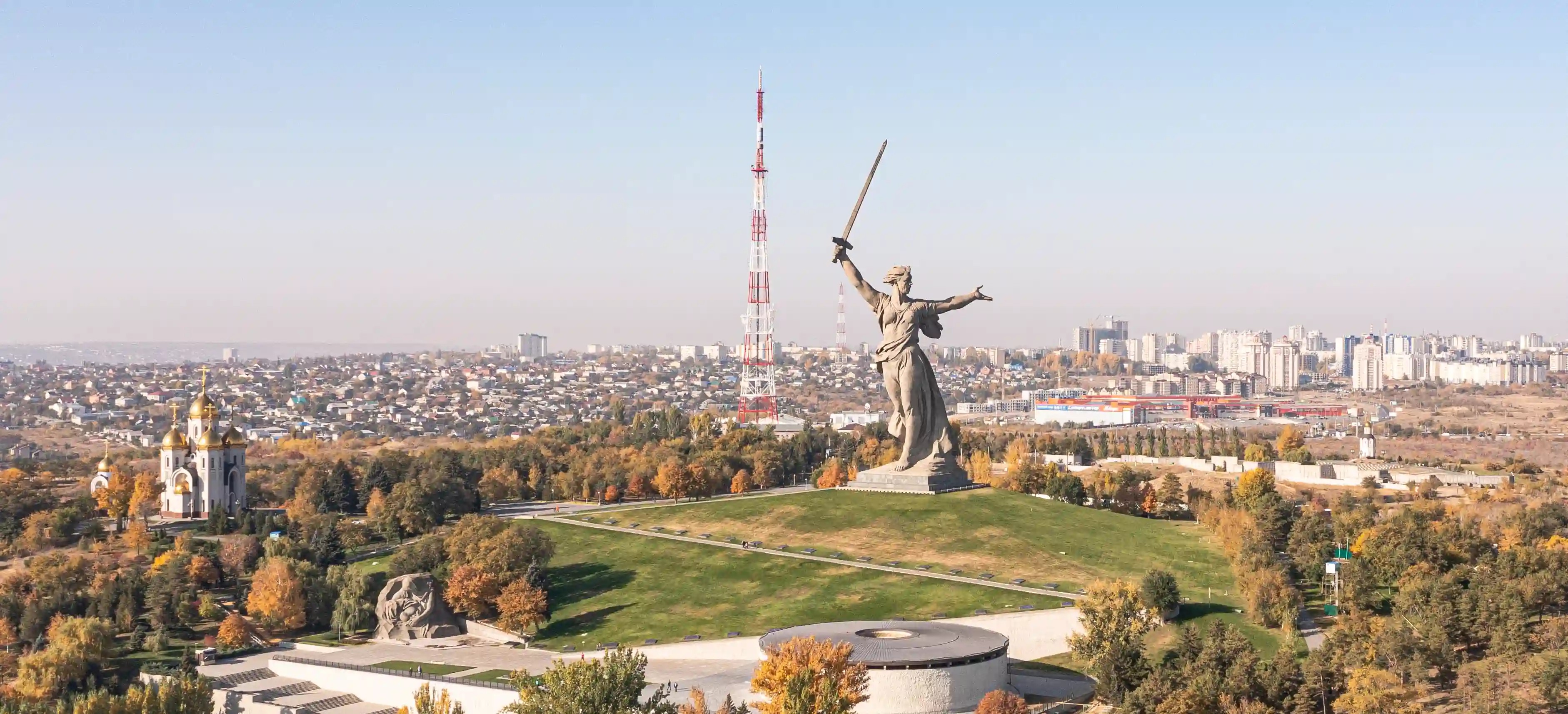
The Motherland Calls is a monumental statue located on Mamayev Kurgan in Volgograd, Russia, commemorating the Battle of Stalingrad. Designed by sculptor Yevgeny Vuchetich and structural engineer Nikolai Nikitin, it was dedicated in 1967 as the centerpiece of a vast memorial complex honoring the Soviet victory in one of the deadliest battles of World War II.
The statue depicts a woman stepping forward with a raised sword, calling upon her countrymen to resist the enemy. Standing 85 meters tall from the tip of the sword to the top of the plinth, it was the tallest statue in the world upon its completion and remains the tallest in Europe. The structure is an engineering feat of prestressed concrete and wire ropes, designed to withstand the harsh winds of the Volga region.
Key Facts
- Materials
- Prestressed concrete, Steel cables
- Civilization
- Soviet Union
- Accessibility
- Accessible via a long staircase; limited mobility access to the base
- Date(s)
- 1959-1967
- Condition
- Well-maintained, active memorial site
- Original Function
- War memorial
- Key Figures
- Yevgeny Vuchetich, Nikolai Nikitin, Vasily Chuikov
Conception and Design
1959Following a national competition, the Soviet government commissioned the memorial complex to honor the defenders of Stalingrad. Yevgeny Vuchetich was selected as the lead sculptor, aiming to create a dynamic figure that embodied the spirit of the Soviet resistance.
Construction Challenges
1959-1967The construction required innovative engineering to ensure the stability of the massive, forward-leaning figure. Nikolai Nikitin utilized a system of prestressed concrete and steel cables to support the weight, a technique he later applied to the Ostankino Tower.
Inauguration
1967The monument was officially unveiled on October 15, 1967. It became the focal point of the Mamayev Kurgan memorial complex, which includes a Hall of Military Glory and the graves of thousands of soldiers, including the tomb of Marshal Vasily Chuikov.
Modern Restoration
2010-2020Over decades, the statue suffered from structural stress due to wind and groundwater. Extensive restoration projects were conducted, including the replacement of internal steel cables and the cleaning of the concrete surface to preserve the monument for future generations.
Cultural Significance
The Motherland Calls serves as the primary symbol of the Soviet victory in the Great Patriotic War. It represents the immense sacrifice of the city of Stalingrad and the resilience of the Soviet people. The statue is deeply embedded in Russian national identity, serving as a site for annual commemorations and military parades.
Beyond its political role, the statue is a landmark of Socialist Realist art. Its dramatic pose and scale continue to influence public monumental art across the former Soviet states, symbolizing the transition from the trauma of war to the permanence of historical memory.
Interpretive Notes
Scholarly debates and areas of uncertainty
Debates often center on the technical challenges of preserving the prestressed concrete, which has shown signs of degradation due to the statue's unique structural design. Additionally, art historians discuss the statue's place within the broader context of 20th-century monumentalism, comparing its aesthetic impact to other global icons of the era.
Visiting Information
Entry Rules
The memorial complex is open to the public daily. Entry to the grounds is free. Visitors are expected to maintain a respectful demeanor as the site serves as a war cemetery.
Best Times to Visit
Early morning or late afternoon to avoid the intense summer heat on the exposed hill. May 9th (Victory Day) is the most significant date for visiting, though it is extremely crowded.
Photography
Personal photography is permitted throughout the memorial complex. Commercial filming requires prior authorization from the museum administration.
Preservation Notes
The monument is a protected cultural heritage site. Visitors must remain on designated paths and are prohibited from climbing on the memorial structures.
Nearby POIs
1 shownSources & Further Reading
- [1]The Motherland Calls: Monumentalism and Memory — S. A. Ivanov. Russian Academy of Arts Press (2015)
- [2]Engineering the Soviet Monument — Nikolai Nikitin. Soviet Architecture Review (1968)
Key Facts
- Materials
- Prestressed concrete, Steel cables
- Civilization
- Soviet Union
- Accessibility
- Accessible via a long staircase; limited mobility access to the base
- Date(s)
- 1959-1967
- Condition
- Well-maintained, active memorial site
- Original Function
- War memorial
- Key Figures
- Yevgeny Vuchetich, Nikolai Nikitin, Vasily Chuikov