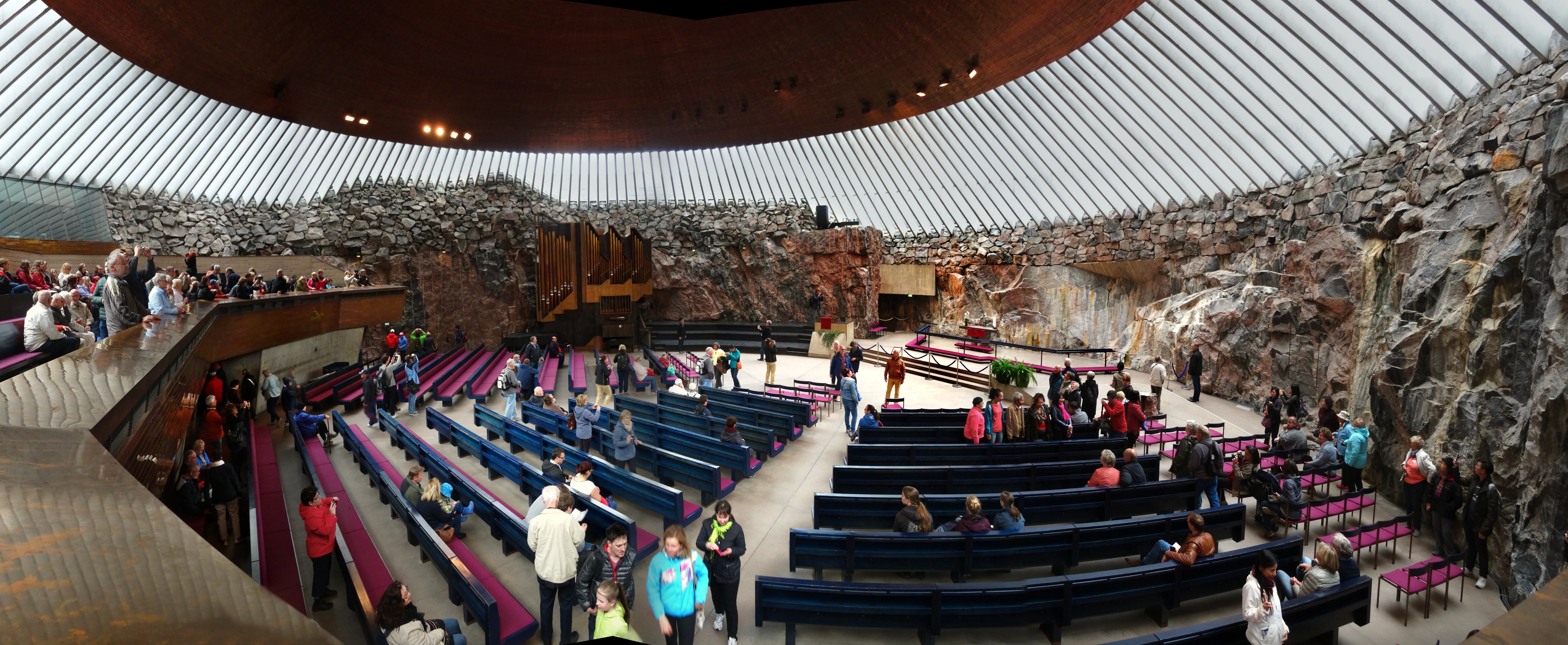
Temppeliaukio Church, also known as the Rock Church, is a Lutheran place of worship located in the Töölö neighborhood of Helsinki. Designed by architects Tuomo and Timo Suomalainen, the structure was completed in 1969 and is excavated directly into a natural granite outcrop. The interior walls consist of exposed, rugged rock, while the ceiling is lined with copper wire and supported by 180 radial concrete beams.
Natural light enters the space through a continuous skylight that encircles the dome, illuminating the rough stone surfaces and creating a unique atmosphere. Due to the acoustic properties of the unhewn rock walls, the church is frequently utilized as a concert venue, serving as one of Helsinki's most significant architectural landmarks.
Key Facts
- Materials
- Granite, Copper, Concrete, Glass
- Civilization
- Finnish
- Accessibility
- Wheelchair accessible via ramp
- Date(s)
- 1968-1969
- Condition
- Active church and concert venue
- Original Function
- Church
- Key Figures
- Tuomo Suomalainen, Timo Suomalainen
Design Competition
1961An architectural competition for the site was held in 1961. The winning entry by brothers Tuomo and Timo Suomalainen proposed a radical design that utilized the natural topography of the rock formation rather than leveling it.
Construction
1968-1969Construction began in early 1968 after a period of delay. The project required the excavation of approximately 9,000 cubic meters of rock. The interior was finished with a copper-lined dome and a skylight, maintaining the raw aesthetic of the excavated space.
Inauguration and Legacy
1969-PresentThe church was consecrated in September 1969. It has since become a major tourist destination and a celebrated example of 20th-century Finnish architecture, noted for its integration of natural geological features into modern design.
Cultural Significance
Temppeliaukio Church represents a pinnacle of Finnish modernism, reflecting a deep cultural respect for the natural landscape. It serves as a symbol of Helsinki's architectural innovation, blending sacred space with geological heritage. The church is a central element of the city's identity, attracting visitors globally for both its religious services and its world-class acoustics.
Interpretive Notes
Scholarly debates and areas of uncertainty
There is occasional academic discussion regarding the classification of the church within the broader context of Brutalism versus Organic Modernism. While the use of raw, exposed materials aligns with Brutalist tendencies, the integration with the natural site is often cited as a hallmark of Organic architecture.
Visiting Information
Entry Rules
Open to the public daily. Entry is ticketed for tourists. The church remains an active place of worship; visitors are requested to maintain silence and respect ongoing religious services or concerts.
Best Times to Visit
Early morning or late afternoon to experience the changing light through the skylight. Weekdays are generally less crowded than weekends.
Photography
Personal photography is permitted. Tripods and professional equipment require prior authorization from the parish office.
Preservation Notes
The rock walls are natural and fragile; visitors are asked not to touch or climb on the exposed granite. The copper ceiling and skylight undergo regular maintenance to preserve the acoustic integrity of the space.
Nearby POIs
11 shown- Suomen Kansallismuseo0.3 km
- National Museum of Finland0.3 km
- Helsinki Art Museum0.5 km
- Museum of Contemporary Art Kiasma0.7 km
- Kamppi Chapel0.7 km
- Ateneum Art Museum1.1 km
- Sibelius Monument1.2 km
- Helsinki Cathedral1.5 km
- Bank of Finland Museum1.6 km
- Architecture & Design Museum1.6 km
- Presidential Palace1.8 km
Sources & Further Reading
- [1]The Rock Church: Temppeliaukio — Timo Suomalainen. Helsinki Parish Union (1995)
- [2]Finnish Architecture: 1960s to Present — Malcolm Quantrill. Praeger (1998)
Key Facts
- Materials
- Granite, Copper, Concrete, Glass
- Civilization
- Finnish
- Accessibility
- Wheelchair accessible via ramp
- Date(s)
- 1968-1969
- Condition
- Active church and concert venue
- Original Function
- Church
- Key Figures
- Tuomo Suomalainen, Timo Suomalainen
Nearby POIs
11 shown- Suomen Kansallismuseo0.3 km
- National Museum of Finland0.3 km
- Helsinki Art Museum0.5 km
- Museum of Contemporary Art Kiasma0.7 km
- Kamppi Chapel0.7 km
- Ateneum Art Museum1.1 km
- Sibelius Monument1.2 km
- Helsinki Cathedral1.5 km
- Bank of Finland Museum1.6 km
- Architecture & Design Museum1.6 km
- Presidential Palace1.8 km