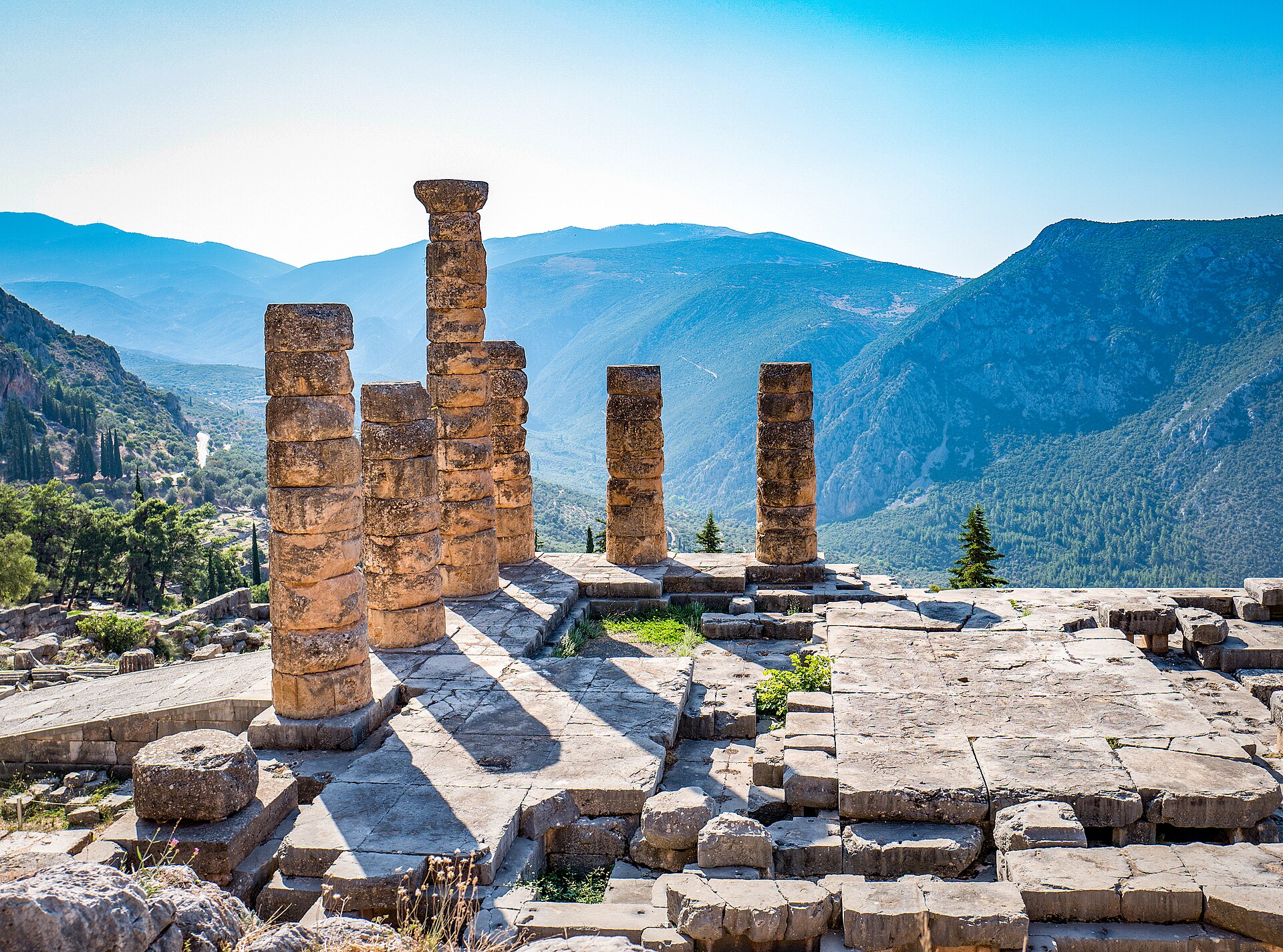
The Temple of Apollo at Delphi served as the most significant religious sanctuary in the ancient Greek world, housing the Oracle of Delphi. It was the site where the Pythia, the high priestess, delivered prophecies that influenced major political decisions, military campaigns, and the founding of colonies across the Mediterranean.
The current ruins represent the fourth iteration of the temple, constructed in the 4th century BCE following the destruction of its predecessor by earthquake and fire. Built in the Doric order, the structure was designed to house the sacred omphalos, or 'navel of the world,' and functioned as the spiritual epicenter of the Delphic amphictyony.
Key Facts
- Materials
- Limestone, Pentelic marble
- Civilization
- Ancient Greek
- Accessibility
- Steep, uneven terrain; partially accessible via paved paths
- Date(s)
- 330 BCE
- Condition
- Ruined; foundation and several columns remain
- Original Function
- Religious sanctuary and oracular site
- Key Figures
- Pythia, Apollo, Spintharus, Xenodorus, Agathon
Early Foundations
8th-6th century BCEThe earliest temples were constructed of wood and later stone. The first stone temple, known as the Alcmaeonid temple, was built in the 6th century BCE but was destroyed by fire in 548 BCE.
The Classical Reconstruction
4th century BCEFollowing the destruction of the Archaic temple, the current structure was commissioned. Architects Spintharus, Xenodorus, and Agathon designed the temple, which was completed around 330 BCE.
Roman Influence and Decline
1st century BCE - 4th century CEThe temple remained active through the Roman period, though it suffered from looting and political instability. It was eventually closed by Emperor Theodosius I in 391 CE as part of the suppression of pagan cults.
Cultural Significance
The Temple of Apollo was central to the Greek identity, acting as a neutral ground where city-states sought divine guidance. Its influence extended beyond religion into diplomacy, as the Oracle's pronouncements were often treated as binding political advice.
Today, the site is a symbol of the intellectual and spiritual heritage of Classical Greece. It remains a primary destination for archaeological study and a focal point for understanding the intersection of ancient politics and religious practice.
Interpretive Notes
Scholarly debates and areas of uncertainty
The nature of the 'Delphic vapors' that supposedly induced the Pythia's trances remains a subject of debate. While some geological studies suggest the presence of ethylene gas rising from a fault line, other scholars argue that the evidence is inconclusive and that the trance may have been purely ritualistic or psychological.
Visiting Information
Entry Rules
Open daily. Tickets are required for entry to the archaeological site and the adjacent museum. Visitors are advised to wear comfortable walking shoes due to the steep incline of the sanctuary.
Best Times to Visit
Early morning or late afternoon to avoid the intense sun and large tour groups. Spring and autumn offer the most temperate weather for exploring the hillside.
Photography
Personal photography is permitted. Tripods and commercial filming require prior authorization from the Hellenic Ministry of Culture.
Preservation Notes
The site is fragile; visitors must remain on designated paths. Do not climb on or touch the ancient masonry. Restoration efforts are ongoing to stabilize the remaining columns.
Nearby POIs
0 shownNo nearby POIs listed yet.
Sources & Further Reading
- [1]Delphi: A History of the Center of the Ancient World — Michael Scott. Princeton University Press (2014)
- [2]The Delphic Oracle: Its Responses and Operations — Joseph Fontenrose. University of California Press (1978)
Key Facts
- Materials
- Limestone, Pentelic marble
- Civilization
- Ancient Greek
- Accessibility
- Steep, uneven terrain; partially accessible via paved paths
- Date(s)
- 330 BCE
- Condition
- Ruined; foundation and several columns remain
- Original Function
- Religious sanctuary and oracular site
- Key Figures
- Pythia, Apollo, Spintharus, Xenodorus, Agathon
Nearby POIs
0 shownNo nearby POIs listed yet.