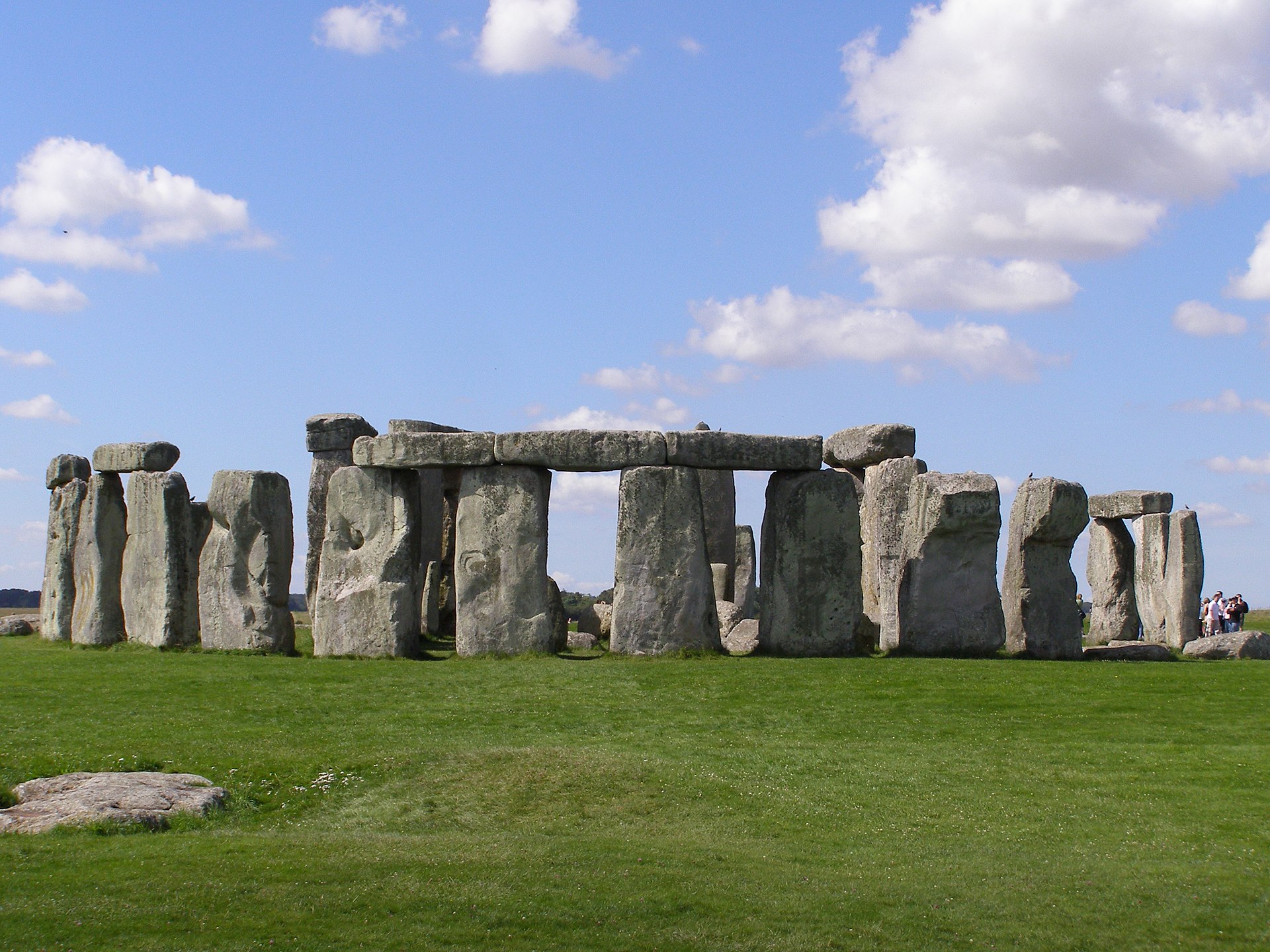
Stonehenge is a prehistoric megalithic monument located on Salisbury Plain in Wiltshire, England. Constructed in multiple phases between approximately 3000 BCE and 1600 BCE, it consists of concentric arrangements of earthworks, standing stones, and lintelled trilithons. The monument forms part of a broader ritual landscape that includes burial mounds, processional avenues, and associated settlements such as Durrington Walls. Its scale, astronomical alignments, and engineering techniques position it as one of the most intensively studied prehistoric sites in Europe.
Key Facts
- Materials
- Sarsen sandstone, Bluestone (dolerite, rhyolite, tuff)
- Dimensions
- Outer sarsen circle approximately 33m in diameter; tallest stones approximately 7m high
- Civilization
- Neolithic and Bronze Age communities of Britain
- Date(s)
- c. 3000-1600 BCE
- Condition
- Standing stone monument within protected archaeological landscape
- Original Function
- Ceremonial and funerary complex
Initial Earthwork Enclosure
c. 3000 BCEThe earliest phase consisted of a circular earth bank and ditch enclosure with entrances aligned roughly northeast-southwest. Aubrey Holes—circular pits within the enclosure—likely held timber posts or stones and were later used for cremation burials.
Bluestone Phase
c. 2600 BCESmaller bluestones, transported from the Preseli Hills in present-day Wales, were erected at the site. Their movement over distances exceeding 200 kilometers represents a significant logistical undertaking in prehistoric Britain.
Sarsen Monument Construction
c. 2500 BCELarge sarsen stones sourced from the Marlborough Downs were arranged into a circular outer ring and a central horseshoe of trilithons. Mortise-and-tenon and tongue-and-groove joints were used to secure lintels, demonstrating advanced stoneworking techniques.
Later Reconfiguration and Bronze Age Use
c. 2200-1600 BCEThe monument underwent rearrangements of bluestones and continued to function within a wider funerary landscape marked by barrow cemeteries. Use appears to have diminished by the mid-2nd millennium BCE.
Antiquarian Study and Modern Archaeology
17th century - presentEarly antiquarians proposed interpretations ranging from Druidic temple to Roman construction. Systematic archaeological investigation in the 20th and 21st centuries clarified its Neolithic origins and its relationship to surrounding monuments within the Stonehenge World Heritage landscape.
Cultural Significance
Stonehenge forms part of a ceremonial landscape reflecting social organization, ritual practice, and long-distance exchange networks in prehistoric Britain. The transport of bluestones from Wales suggests coordinated labor and interregional connections. In later cultural memory, the monument became associated with Celtic Druids, national heritage narratives, and modern ritual gatherings. Today it serves as a focal point for discussions of prehistoric astronomy, monumentality, and conservation management.
Interpretive Notes
Scholarly debates and areas of uncertainty
The precise function of Stonehenge remains debated. While astronomical alignments with the solstices are widely recognized, scholars disagree on whether the monument functioned primarily as a calendrical device, funerary complex, healing center, or elite ceremonial gathering place. Debate also continues regarding the method of bluestone transport, with hypotheses ranging from human overland hauling to partial glacial movement during earlier geological periods.
Visiting Information
Entry Rules
Paid admission required for access to the stone circle perimeter path. Advance booking recommended. Special access visits allow entry inside the stone circle outside normal hours. Managed by English Heritage.
Best Times to Visit
Morning entry slots reduce visitor density. Summer solstice attracts significant attendance with managed access protocols. Weather conditions on Salisbury Plain can be variable throughout the year.
Photography
Personal photography permitted. Drones prohibited without prior authorization. Commercial filming requires permit approval.
Preservation Notes
Do not cross barriers or touch the stones during standard visiting hours. The surrounding landscape includes protected archaeological features; remain on designated paths.
Nearby POIs
0 shownNo nearby POIs listed yet.
Sources & Further Reading
- [1]Stonehenge: A New History of the World's Greatest Stone Circle — Mike Parker Pearson. Simon & Schuster (2012)
- [2]Stonehenge Complete — Christopher Chippindale. Thames & Hudson (2004)
- [3]Stonehenge and the Neolithic World — Mike Parker Pearson (ed.). British Museum Press (2013)
Key Facts
- Materials
- Sarsen sandstone, Bluestone (dolerite, rhyolite, tuff)
- Dimensions
- Outer sarsen circle approximately 33m in diameter; tallest stones approximately 7m high
- Civilization
- Neolithic and Bronze Age communities of Britain
- Date(s)
- c. 3000-1600 BCE
- Condition
- Standing stone monument within protected archaeological landscape
- Original Function
- Ceremonial and funerary complex
Nearby POIs
0 shownNo nearby POIs listed yet.