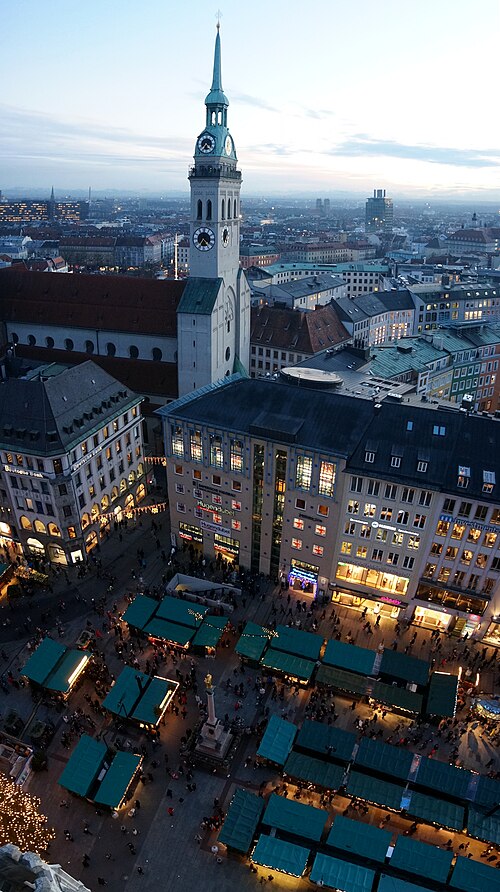
St. Peter's Church, known locally as 'Alter Peter', is the oldest parish church in Munich, with its origins dating back to the 12th century. The current structure represents a complex architectural evolution, having been rebuilt following a major fire in the 14th century and subsequently remodeled in the Baroque and Rococo styles during the 18th century.
The interior is noted for its elaborate high altar, designed by Erasmus Grasser, and the ornate ceiling frescoes by Johann Baptist Zimmermann. The church is perhaps most famous for housing the gilded, jewel-encrusted skeleton of Saint Munditia, a Roman martyr whose remains were brought to the church in 1677.
Key Facts
- Materials
- Brick, Stucco, Marble, Gold leaf
- Civilization
- Bavarian
- Accessibility
- Ground floor accessible; tower climb via stairs only
- Date(s)
- 1180 CE (original), 1368 CE (Gothic rebuild)
- Condition
- Active religious site and tourist landmark
- Original Function
- Parish church
- Key Figures
- Erasmus Grasser, Johann Baptist Zimmermann, Saint Munditia
Foundations
12th CenturyThe site was originally occupied by a small church built by monks on the Petersbergl hill, predating the official founding of Munich in 1158. It served as the primary religious center for the early settlement.
Gothic Reconstruction
14th CenturyFollowing a devastating fire in 1327, the church was reconstructed in the Gothic style. The new building was consecrated in 1368, establishing the core structural footprint that remains today.
Baroque Transformation
17th-18th CenturyDuring the Baroque period, the interior was extensively renovated. The iconic tower was topped with a new lantern dome after being damaged by lightning, and the interior was decorated with the opulent Rococo frescoes that define its current appearance.
Modern Era
20th Century - PresentThe church suffered significant damage during World War II air raids. Post-war restoration efforts focused on preserving the surviving historical fabric and carefully reconstructing the damaged interior elements.
Cultural Significance
St. Peter's Church serves as a primary symbol of Munich's historical identity, often referred to as the 'heart' of the city. Its tower, known as 'Alter Peter', provides a panoramic view of the city center and is a central reference point for local geography and tourism.
The presence of Saint Munditia’s remains highlights the historical Bavarian tradition of venerating catacomb saints, which remains a point of fascination for visitors and a unique element of the church's devotional history.
Interpretive Notes
Scholarly debates and areas of uncertainty
There is ongoing academic discussion regarding the extent of the original 12th-century foundations and how much of the pre-fire Gothic structure was incorporated into the 14th-century rebuild. Additionally, the conservation of the jewel-encrusted relics is a subject of debate between those favoring strict preservation and those advocating for continued display as part of the church's living heritage.
Visiting Information
Entry Rules
Open daily. Entry to the church is free. A small fee is required to climb the tower. Visitors are requested to maintain silence and respect ongoing religious services.
Best Times to Visit
Early morning on weekdays to avoid large tourist groups. The tower is best visited on clear days for views reaching as far as the Alps.
Photography
Photography is permitted for personal use without flash. Tripods and professional equipment require prior authorization.
Preservation Notes
The church is a protected historical monument. Visitors must stay within designated areas and avoid touching the altars or historical artifacts.
Nearby POIs
11 shownSources & Further Reading
- [1]Munich: A History of the City — Richard Bauer. C.H. Beck (2008)
- [2]The Churches of Munich — Klaus Gallas. DuMont Buchverlag (1979)
Key Facts
- Materials
- Brick, Stucco, Marble, Gold leaf
- Civilization
- Bavarian
- Accessibility
- Ground floor accessible; tower climb via stairs only
- Date(s)
- 1180 CE (original), 1368 CE (Gothic rebuild)
- Condition
- Active religious site and tourist landmark
- Original Function
- Parish church
- Key Figures
- Erasmus Grasser, Johann Baptist Zimmermann, Saint Munditia