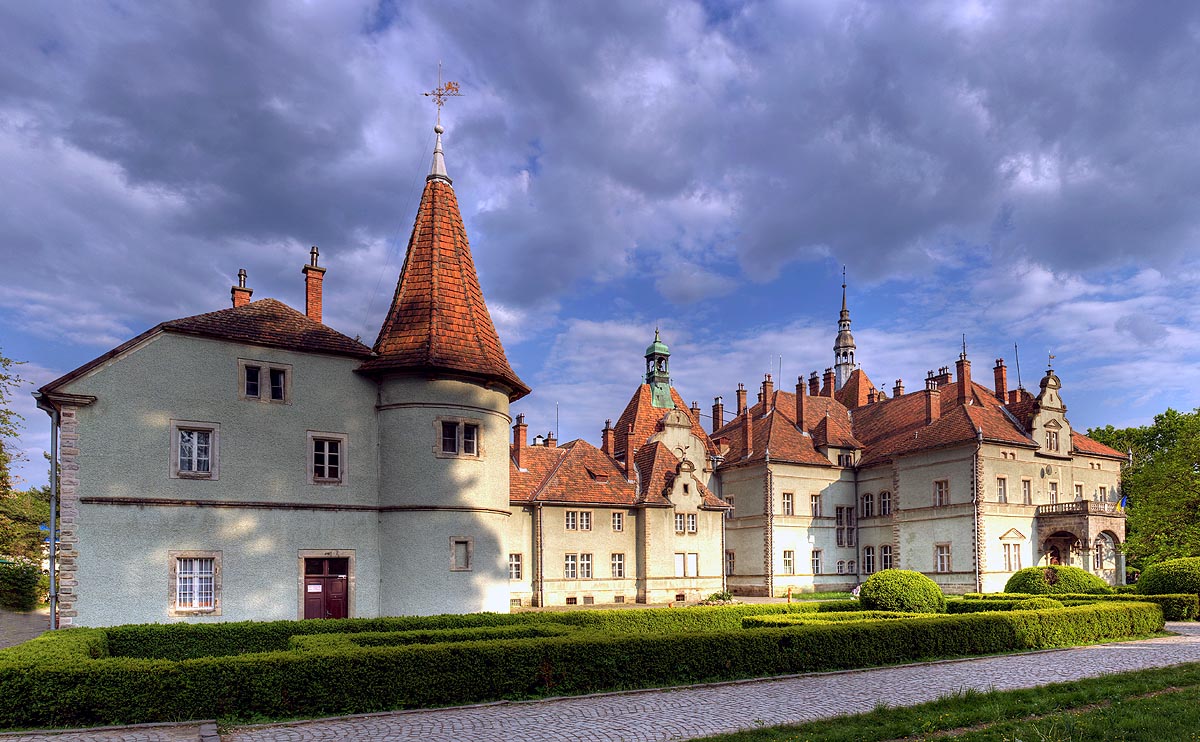
The Schenborn Palace, located in the village of Karpaty, Ukraine, was constructed between 1890 and 1895 as a hunting lodge and summer residence for the Austrian noble family of Schönborn-Buchheim. Designed by architect Zsigmond Gergely, the structure is a notable example of Romanticism, blending Neo-Renaissance and Neo-Gothic architectural elements. The palace is situated within a large English-style landscape park, which contains a variety of rare tree species and an artificial lake.
The building is famous for its astronomical symbolism, reflecting the calendar year in its architectural layout. It features 365 windows representing the days of the year, 52 rooms corresponding to the weeks, and 12 entrances representing the months. Following the Second World War, the palace was repurposed as a sanatorium, a function it continues to serve today, while remaining a significant cultural landmark in the Transcarpathian region.
Key Facts
- Materials
- Brick, Stone, Wood
- Civilization
- Austro-Hungarian
- Accessibility
- Grounds are accessible to visitors; interior access is limited
- Date(s)
- 1890-1895
- Condition
- Well-preserved, currently functioning as a health sanatorium
- Original Function
- Hunting lodge and summer residence
- Key Figures
- Erwin Friedrich Karl von Schönborn-Buchheim, Zsigmond Gergely
Construction and Design
1890-1895The palace was commissioned by Count Erwin Friedrich Karl von Schönborn-Buchheim. The architect Zsigmond Gergely designed the building to incorporate complex astronomical symbolism, integrating the calendar year into the structural count of windows, rooms, and entrances.
The Schönborn Era
1895-1944For several decades, the palace served as a prestigious hunting lodge for the Austro-Hungarian aristocracy. The surrounding park was meticulously landscaped with exotic flora, and the estate became a center for social gatherings and hunting expeditions.
Soviet Transformation
1945-1991Following the incorporation of Transcarpathia into the Ukrainian SSR, the palace was nationalized. In 1946, it was converted into the 'Karpaty' sanatorium, a specialized health resort for cardiovascular diseases, which necessitated interior modifications while preserving the exterior facade.
Modern Status
1991-PresentThe palace remains an active health facility under the management of the Ukrainian trade unions. It is recognized as a protected architectural monument of national importance, attracting tourists interested in its unique design and historical significance.
Cultural Significance
The Schenborn Palace is a primary example of the architectural legacy left by the Austro-Hungarian nobility in the Transcarpathian region. It serves as a symbol of the region's multicultural history and the transition from feudal aristocratic estates to public health institutions during the 20th century. The palace is deeply embedded in local folklore and regional tourism, frequently cited for its unique 'calendar' architecture.
Interpretive Notes
Scholarly debates and areas of uncertainty
There is minor scholarly discussion regarding the extent to which the 'calendar' design was a deliberate architectural program versus a retrospective interpretation applied to the building's layout in the mid-20th century. While the numbers align with the calendar, some architectural historians argue that such features were common in late 19th-century romantic architecture and may have been coincidental or exaggerated by later tourism narratives.
Visiting Information
Entry Rules
The palace grounds are open to the public for a small entrance fee. Access to the interior is restricted as it functions as an active sanatorium; visitors are generally limited to the exterior and the surrounding park.
Best Times to Visit
Spring and autumn are ideal for viewing the diverse botanical collection in the park. Weekdays are recommended to avoid weekend crowds from regional tour groups.
Photography
Exterior photography is permitted. Interior photography is generally prohibited due to the building's status as a private health facility.
Preservation Notes
The building is a protected monument. Visitors are requested to stay on designated paths within the park to protect the rare botanical species and to respect the privacy of the sanatorium patients.
Nearby POIs
2 shownSources & Further Reading
- [1]Architectural Heritage of Transcarpathia — Mikhail Fedaka. Uzhhorod Publishing (2002)
- [2]The Schönborn Estates in the 19th Century — Ivan Pop. Carpathian Historical Journal (2015)
Key Facts
- Materials
- Brick, Stone, Wood
- Civilization
- Austro-Hungarian
- Accessibility
- Grounds are accessible to visitors; interior access is limited
- Date(s)
- 1890-1895
- Condition
- Well-preserved, currently functioning as a health sanatorium
- Original Function
- Hunting lodge and summer residence
- Key Figures
- Erwin Friedrich Karl von Schönborn-Buchheim, Zsigmond Gergely