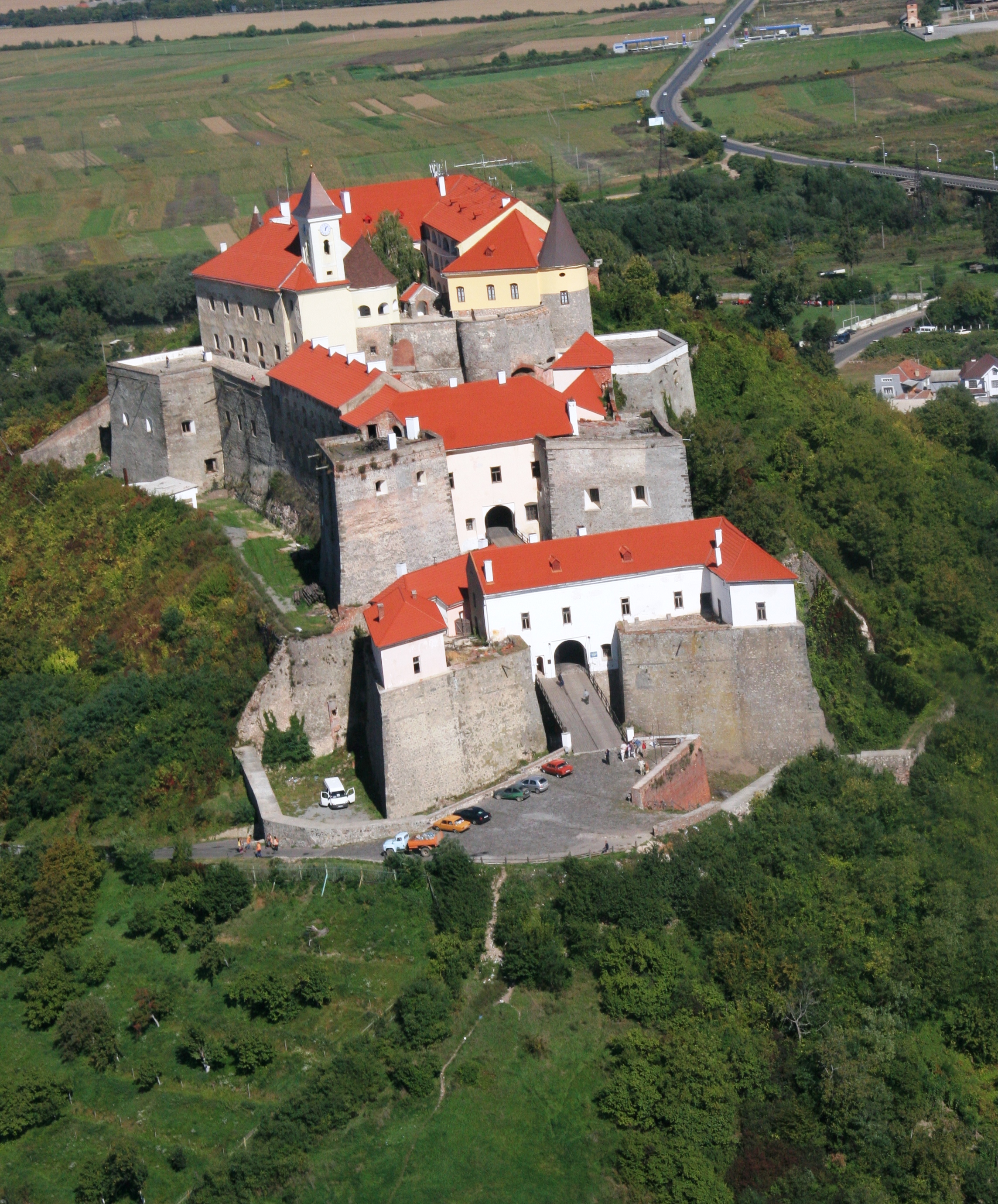
Palanok Castle is a historic fortification situated on a 68-meter-high volcanic hill in Mukachevo, Ukraine. The complex is divided into three distinct levels (the High, Middle, and Low castles), each representing different stages of construction and defensive evolution. Its strategic location overlooking the Latorica River valley made it a vital stronghold for various regional powers throughout the centuries.
The fortress features a complex system of bastions, moats, and thick stone walls designed to withstand prolonged sieges. While its origins are shrouded in legend, the castle gained significant prominence under the rule of the Podolye princes and later the Rákóczi family, serving as a center of political and military power in Transcarpathia.
Key Facts
- Materials
- Stone, Brick, Wood
- Civilization
- Hungarian / Transcarpathian
- Accessibility
- Accessible via paved path, steep incline to upper levels
- Date(s)
- 14th - 18th century
- Condition
- Well-preserved, functions as a historical museum
- Original Function
- Defensive fortress and administrative center
- Key Figures
- Sofia Báthory, Ilona Zrínyi, Ferenc Rákóczi II
Early Foundations
14th centuryThe earliest documented references to the castle date to the 14th century, when it served as a royal fortress for the Hungarian crown. It was significantly expanded by Prince Fedor Koriatovich, who received the castle as a gift and oversaw the construction of the deep well and initial defensive walls.
Strategic Expansion
16th - 17th centuryDuring the 17th century, the castle underwent major renovations under the Rákóczi family. The defensive capabilities were enhanced with the addition of modern bastions and artillery platforms, transforming it into one of the most formidable fortresses in the region.
Siege and Decline
1685-1688The castle is famously associated with the three-year siege led by Ilona Zrínyi against Austrian imperial forces. Following the eventual surrender and the subsequent suppression of the Rákóczi War of Independence, the castle lost its military significance and was converted into a prison.
Modern Era
20th century - presentAfter serving as a military barracks and a vocational school during the Soviet era, the site was designated as a historical monument. Extensive restoration work has been carried out to preserve the architecture, and it now houses the Mukachevo Historical Museum.
Cultural Significance
Palanok Castle is a symbol of Transcarpathian resilience and a focal point for regional identity. It represents the intersection of Hungarian, Ukrainian, and Austrian historical influences in the Carpathian Basin. The site is deeply embedded in local folklore, particularly regarding the heroism of Ilona Zrínyi, whose defense of the castle remains a celebrated narrative in local history.
Interpretive Notes
Scholarly debates and areas of uncertainty
The exact date of the castle's initial foundation remains a subject of archaeological investigation, as earlier wooden structures likely predated the stone fortifications. Additionally, the extent of the underground tunnel network connecting the castle to the town below is a topic of ongoing research and local speculation.
Visiting Information
Entry Rules
Open daily. Tickets are required for entry to the museum exhibitions. Visitors are advised to wear comfortable footwear due to the steep terrain and cobblestone paths.
Best Times to Visit
Late spring and early autumn offer the best weather for exploring the outdoor ramparts. Weekdays are recommended to avoid weekend crowds.
Photography
Personal photography is permitted throughout the grounds. Professional or commercial photography requires prior authorization from the museum administration.
Preservation Notes
Visitors are requested to remain on marked paths and refrain from climbing on the defensive walls or historical masonry. Restoration work is ongoing in certain sections of the complex.
Nearby POIs
2 shownSources & Further Reading
- [1]The History of Mukachevo and Palanok Castle — Ivan Pop. Uzhhorod University Press (2005)
- [2]Castles of Transcarpathia — Mykhailo Syrokhman. Karpaty Publishing (2010)
Key Facts
- Materials
- Stone, Brick, Wood
- Civilization
- Hungarian / Transcarpathian
- Accessibility
- Accessible via paved path, steep incline to upper levels
- Date(s)
- 14th - 18th century
- Condition
- Well-preserved, functions as a historical museum
- Original Function
- Defensive fortress and administrative center
- Key Figures
- Sofia Báthory, Ilona Zrínyi, Ferenc Rákóczi II