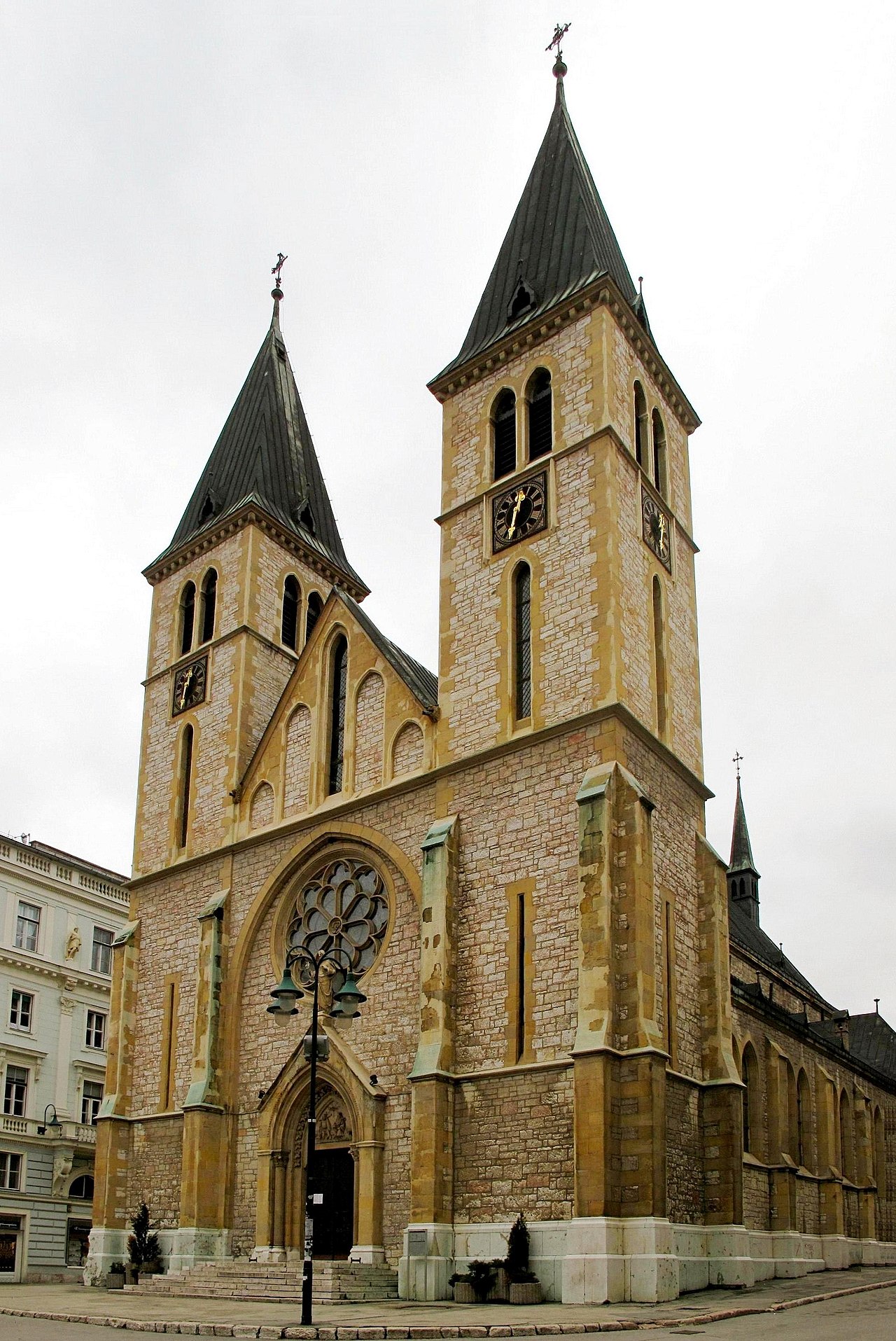
The Sacred Heart Cathedral in Sarajevo is the largest cathedral in Bosnia and Herzegovina and serves as the seat of the Archbishop of Vrhbosna. Designed by the architect Josip Vancaš, the structure was built between 1884 and 1889, reflecting the architectural influence of the Austro-Hungarian period in the city.
The cathedral is a prominent example of Neo-Gothic architecture, featuring two bell towers and a rose window above the main entrance. Its construction marked a significant moment in the religious and cultural landscape of Sarajevo, establishing a major center for the Catholic community within the city's diverse multi-confessional environment.
Key Facts
- Materials
- Stone, Brick, Stained glass
- Civilization
- Austro-Hungarian
- Accessibility
- Ground level access available
- Date(s)
- 1884-1889
- Condition
- Active religious site, well-preserved
- Original Function
- Cathedral
- Key Figures
- Josip Vancaš, Archbishop Josip Stadler
Planning and Construction
1884-1889Following the Austro-Hungarian occupation of Bosnia and Herzegovina, Archbishop Josip Stadler commissioned the construction of a new cathedral. Architect Josip Vancaš was selected to design the building, drawing inspiration from the Gothic style of Notre-Dame de Dijon.
Consecration and Early Years
1889-1914The cathedral was consecrated on September 14, 1889. It quickly became the spiritual center for the growing Catholic population in Sarajevo and a symbol of the city's integration into the broader European cultural sphere.
Conflict and Restoration
1992-1996During the Siege of Sarajevo, the cathedral sustained damage from shelling and mortar fire. Post-war restoration efforts were undertaken to repair the facade, roof, and interior, preserving the original Neo-Gothic features.
Cultural Significance
The cathedral stands as a symbol of the Catholic presence in Sarajevo and the city's historical role as a meeting point of Eastern and Western traditions. It is a landmark of the Austro-Hungarian architectural legacy that transformed the urban fabric of the city in the late 19th century.
Interpretive Notes
Scholarly debates and areas of uncertainty
Discussions among architectural historians often focus on the extent to which Vancaš's design successfully synthesized European Gothic revivalism with the specific climatic and urban constraints of Sarajevo.
Visiting Information
Entry Rules
Open daily for visitors and worshipers. Visitors are expected to maintain silence and dress modestly. Entry is free, though donations are welcomed.
Best Times to Visit
Morning hours are best for viewing the interior light through the stained glass. The surrounding square is often busy during local festivals.
Photography
Photography is permitted for personal use without flash. Professional photography requires prior permission from the parish office.
Preservation Notes
The structure is a protected national monument. Visitors should refrain from touching the interior artwork and remain within designated visitor areas.
Nearby POIs
11 shown- Gallery 11/07/95
- Siege of Sarajevo Museum0.1 km
- Museum of Crimes Against Humanity and Genocide0.1 km
- Orthodox Church of the Nativity of the Theotokos0.1 km
- Sarajevo 80s Museum0.2 km
- Olympic Museum Sarajevo0.2 km
- Sarajevo Clock Tower0.3 km
- Vječna vatra0.3 km
- Gazi Husrev-beg Mosque0.3 km
- War Childhood Museum0.4 km
- Emperor's Mosque0.4 km
Sources & Further Reading
- [1]Sarajevo: A Biography — Robert J. Donia. University of Michigan Press (2006)
- [2]The Architecture of Josip Vancaš in Sarajevo — Ibrahim Krzović. Sarajevo Publishing (2004)
Key Facts
- Materials
- Stone, Brick, Stained glass
- Civilization
- Austro-Hungarian
- Accessibility
- Ground level access available
- Date(s)
- 1884-1889
- Condition
- Active religious site, well-preserved
- Original Function
- Cathedral
- Key Figures
- Josip Vancaš, Archbishop Josip Stadler
Nearby POIs
11 shown- Gallery 11/07/95
- Siege of Sarajevo Museum0.1 km
- Museum of Crimes Against Humanity and Genocide0.1 km
- Orthodox Church of the Nativity of the Theotokos0.1 km
- Sarajevo 80s Museum0.2 km
- Olympic Museum Sarajevo0.2 km
- Sarajevo Clock Tower0.3 km
- Vječna vatra0.3 km
- Gazi Husrev-beg Mosque0.3 km
- War Childhood Museum0.4 km
- Emperor's Mosque0.4 km