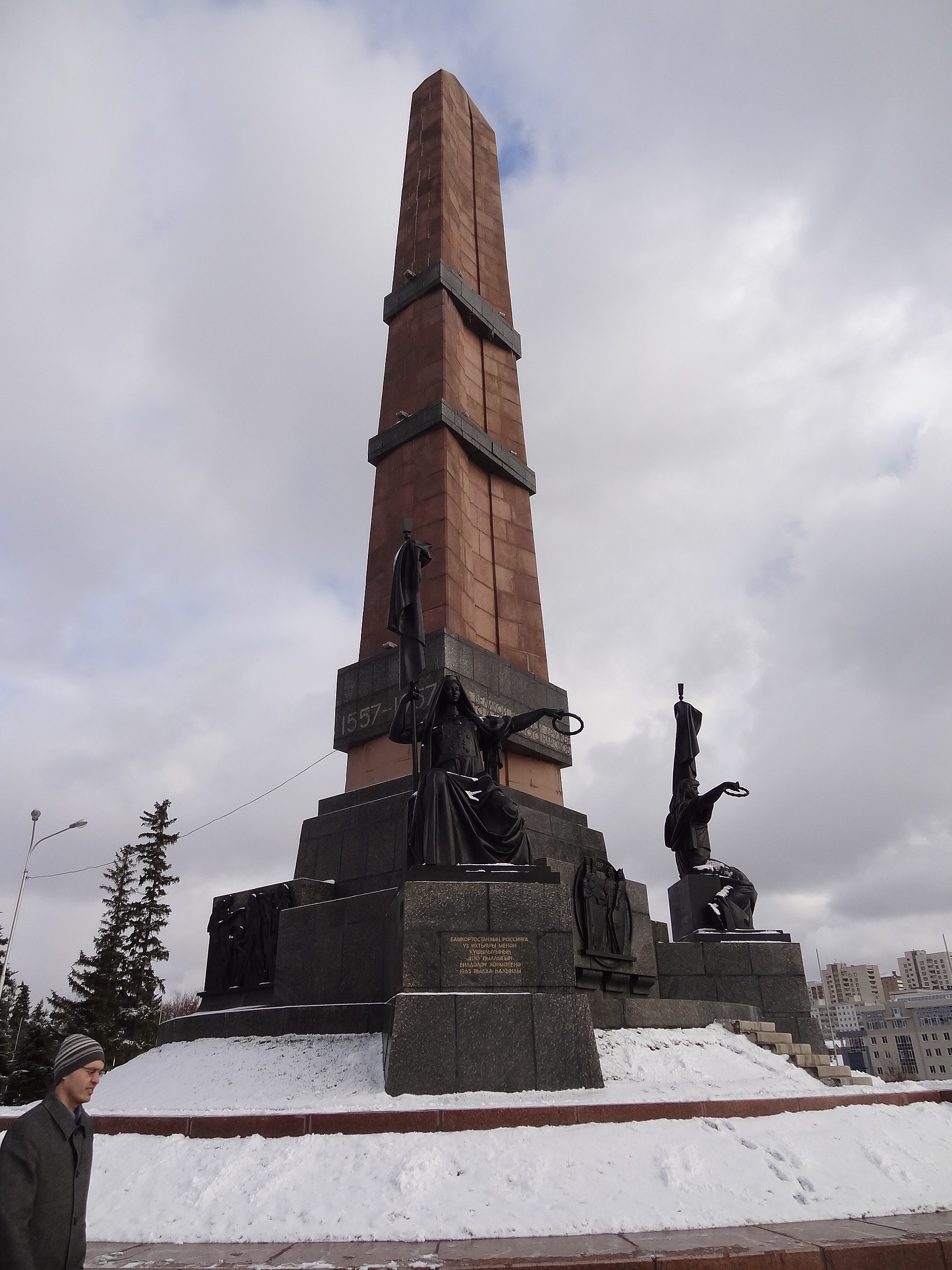
The Russian-Bashkir Friendship Monument is a prominent landmark located in Ufa, the capital of the Republic of Bashkortostan. It was erected to commemorate the 400th anniversary of the voluntary accession of Bashkortostan to the Russian state, an event historically dated to 1557. The monument serves as a symbol of historical unity and cooperation between the Russian and Bashkir peoples.
The structure features two tall, stylized stelae made of concrete and faced with white stone, representing the two nations. At the base, bronze sculptures depict two women holding laurel wreaths, symbolizing the friendship and shared history of the two cultures. The monument is situated on a high bank overlooking the Belaya River, providing a significant visual focal point for the city.
Key Facts
- Materials
- Concrete, White stone, Bronze
- Civilization
- Soviet
- Accessibility
- Accessible via public park pathways
- Date(s)
- 1957
- Condition
- Well-preserved, public landmark
- Original Function
- Commemorative monument
- Key Figures
- Mikhail Babushkin, Galina Levitskaya
Conception and Construction
1957The monument was commissioned to mark the 400th anniversary of the accession of Bashkortostan to Russia. It was designed by sculptors Mikhail Babushkin and Galina Levitskaya, with architects E.K. Kutirev and G.I. Gavrilov overseeing the structural design.
Symbolic Significance
20th CenturyThe design was intended to reflect the ideological framework of the Soviet era, emphasizing the 'friendship of peoples.' The two stelae were specifically engineered to represent the two distinct cultures merging into a single political and social entity.
Modern Status
21st CenturyToday, the monument remains a central site for civic ceremonies and public gatherings in Ufa. It has undergone periodic maintenance to preserve the bronze elements and the stone cladding of the stelae.
Cultural Significance
The monument is a cornerstone of Ufa's urban identity, representing the historical narrative of Bashkortostan's integration into the Russian state. It is frequently visited during national holidays and serves as a site for official commemorations regarding inter-ethnic relations within the Russian Federation.
Interpretive Notes
Scholarly debates and areas of uncertainty
The historical interpretation of the 'voluntary accession' of Bashkortostan remains a subject of academic discussion. While the monument reflects the official Soviet-era narrative of a peaceful and voluntary union, some modern historians argue that the process was more complex, involving varying degrees of local resistance and political negotiation.
Visiting Information
Entry Rules
The monument is located in a public park and is accessible 24 hours a day. No entry fees or specific dress codes apply.
Best Times to Visit
Daylight hours are recommended for viewing the architectural details and the surrounding river views. The site is particularly active during city-wide celebrations in the summer months.
Photography
None. Personal photography is permitted.
Preservation Notes
The site is maintained by the municipal authorities of Ufa. Visitors are requested to respect the surrounding park grounds and not to climb on the monument base.
Nearby POIs
1 shownSources & Further Reading
- [1]History of Bashkortostan: From the 16th Century to the Present — R.N. Suleymanov. Bashkir State University Press (2010)
- [2]Monuments of Ufa: Architectural Heritage — A.V. Petrov. Ufa Historical Society (2015)
Key Facts
- Materials
- Concrete, White stone, Bronze
- Civilization
- Soviet
- Accessibility
- Accessible via public park pathways
- Date(s)
- 1957
- Condition
- Well-preserved, public landmark
- Original Function
- Commemorative monument
- Key Figures
- Mikhail Babushkin, Galina Levitskaya